
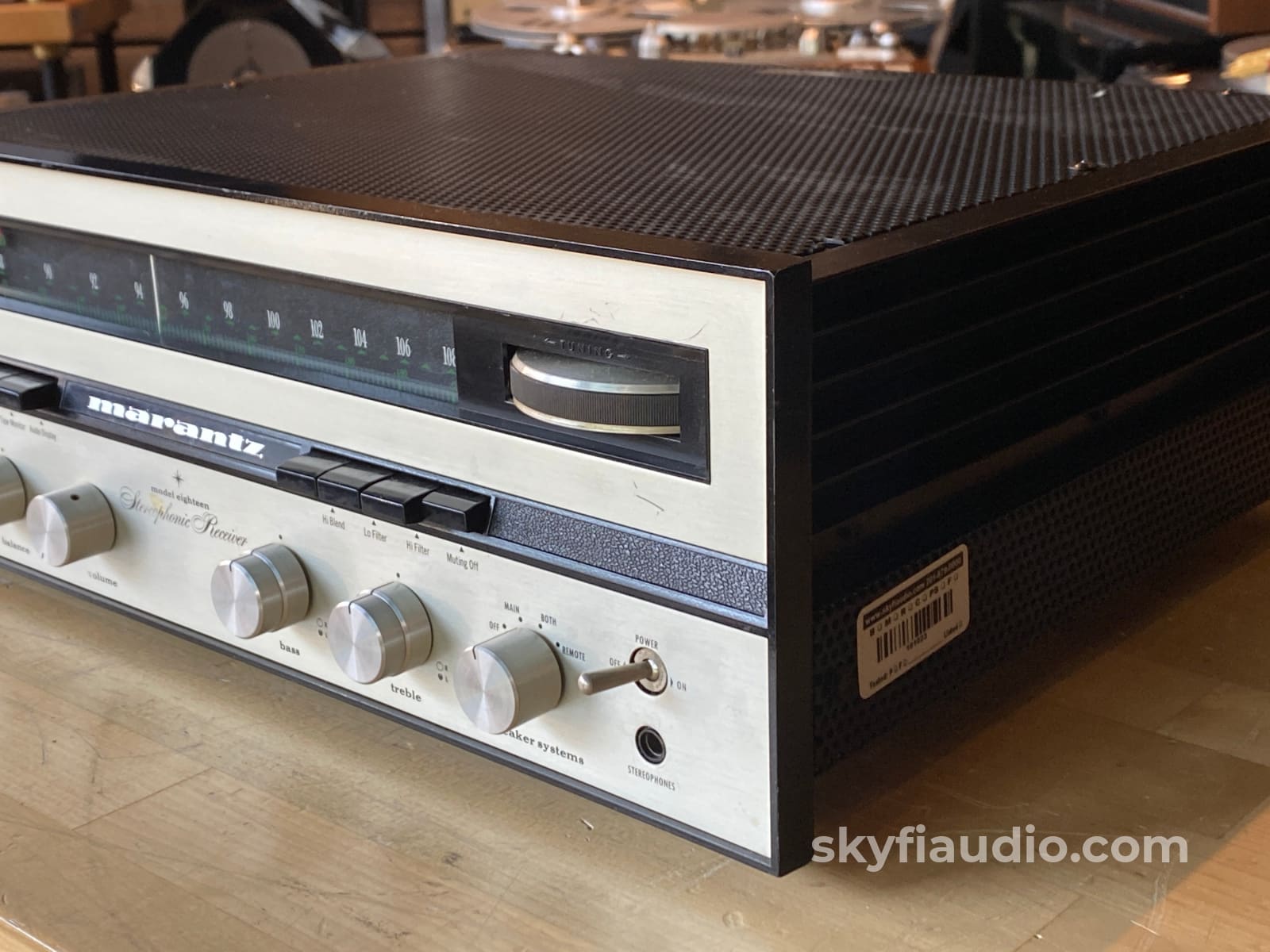
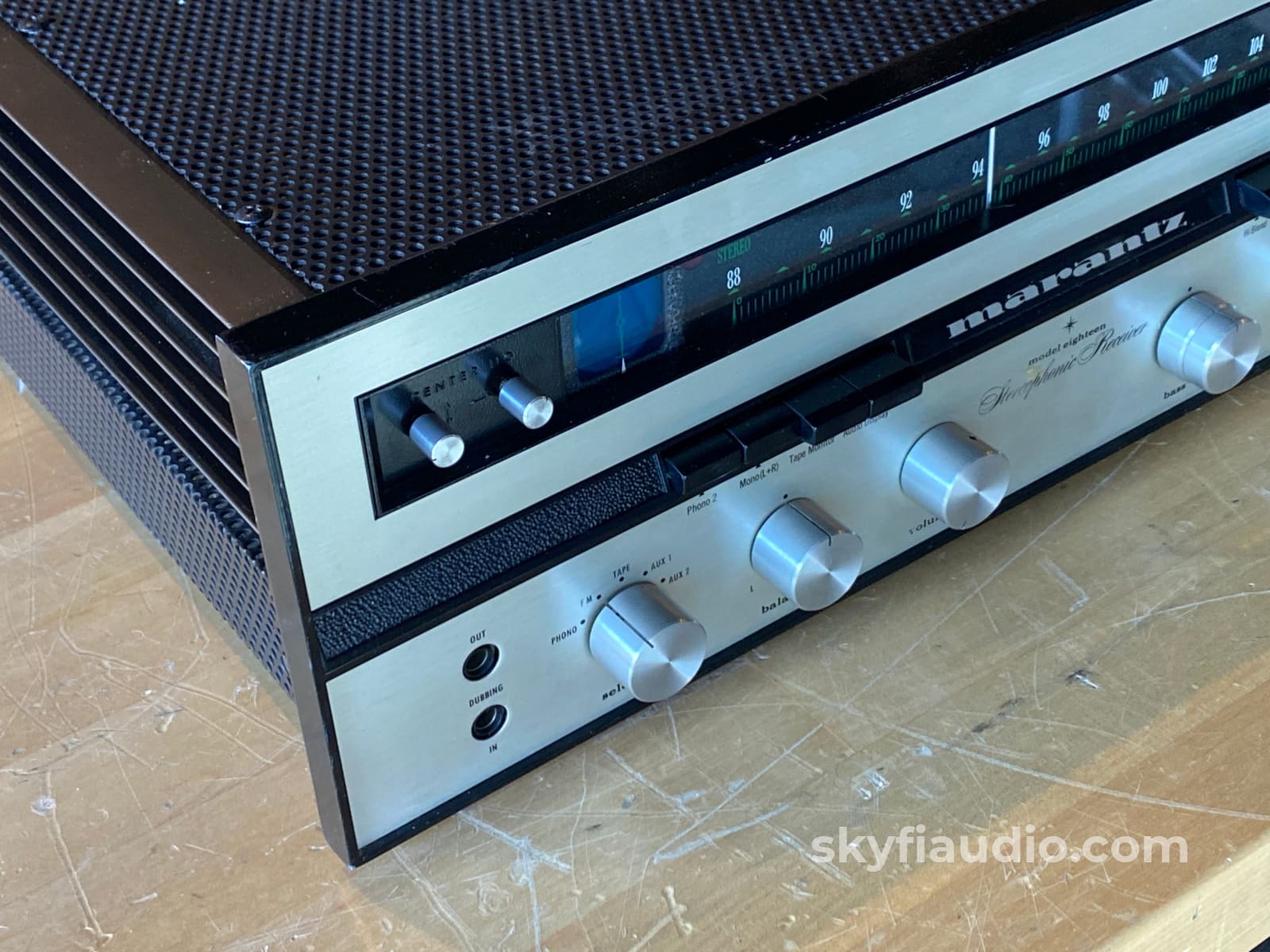
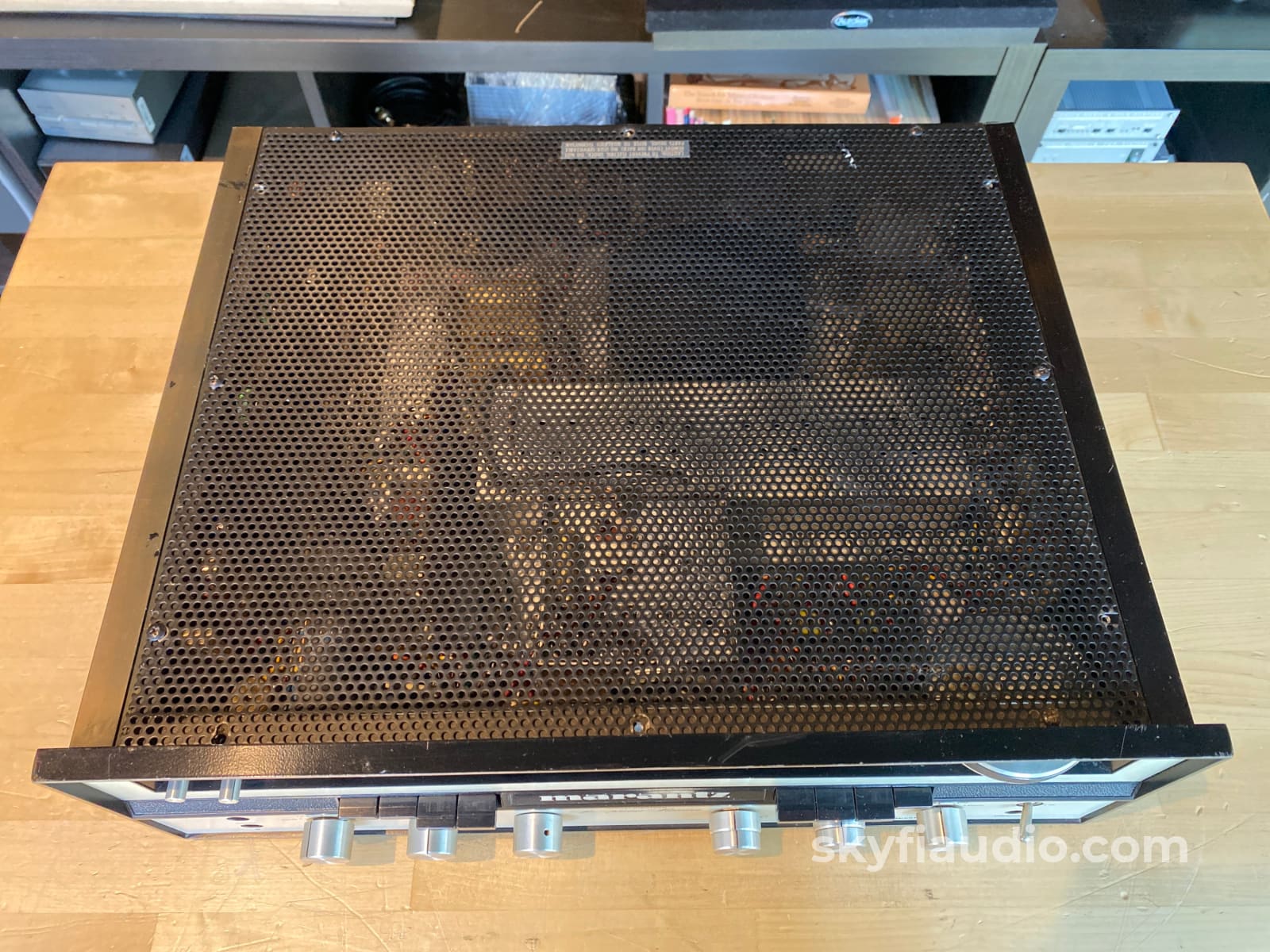
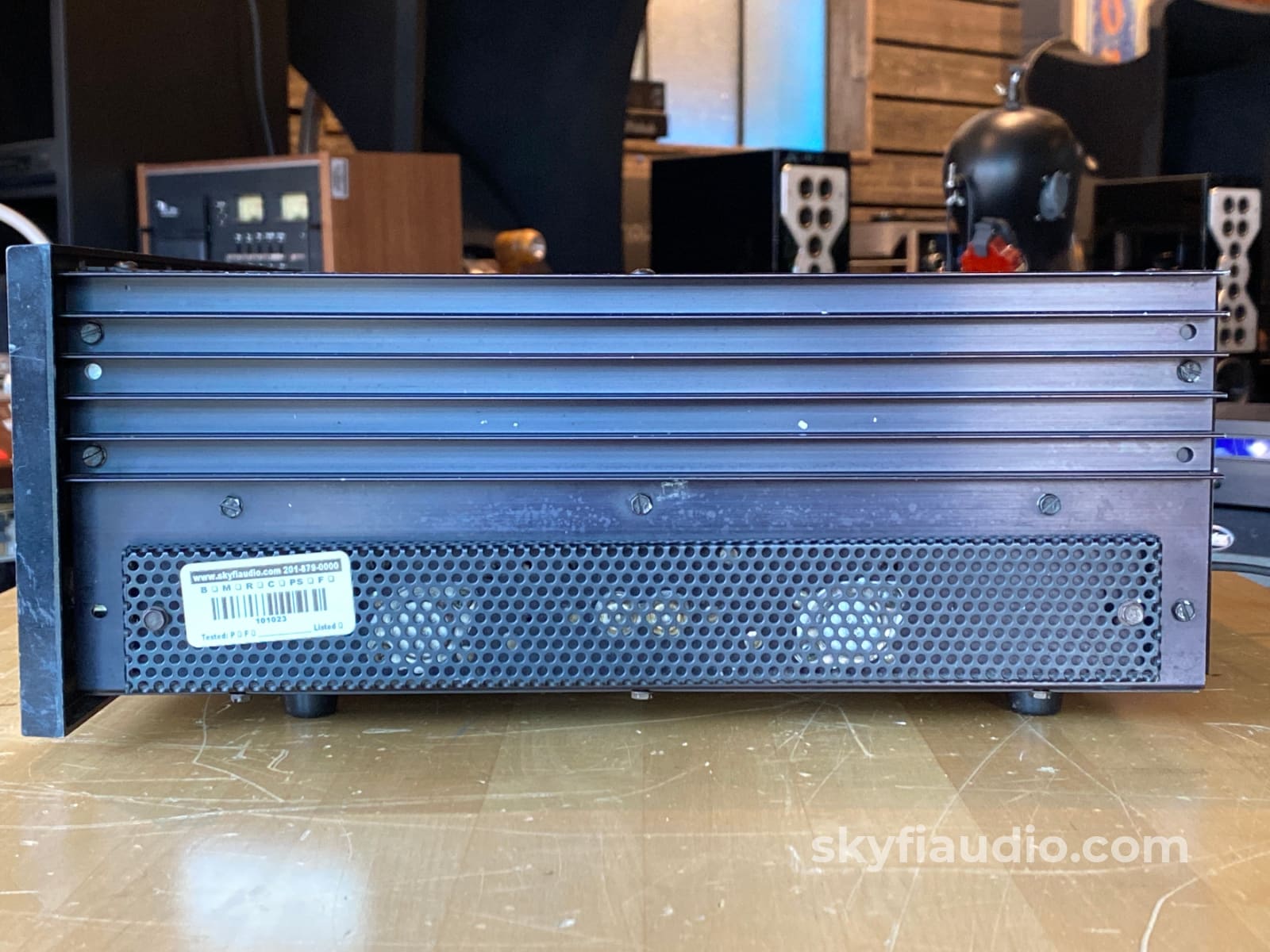
Marantz Model Eighteen - The First Marantz Receiver! 40WPC with Phono Input
Free Shipping (Contiguous U.S. Only)
Pickup available at SkyFi 479
Usually ready in 24 hours
Marantz Model Eighteen - The First Marantz Receiver! 40WPC with Phono Input
SkyFi 479
479 South Broad Street
Glen Rock NJ 07452
United States
General
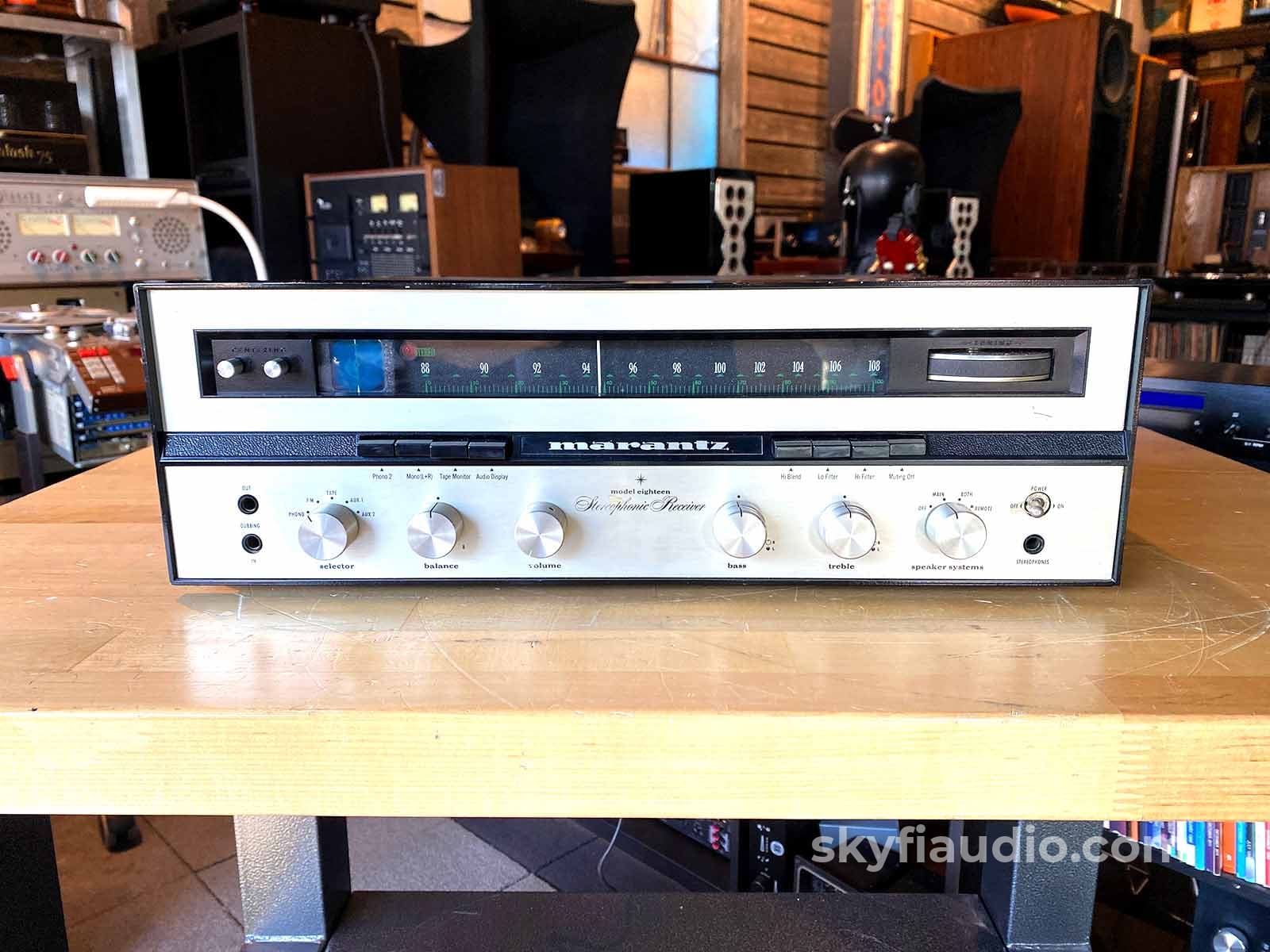
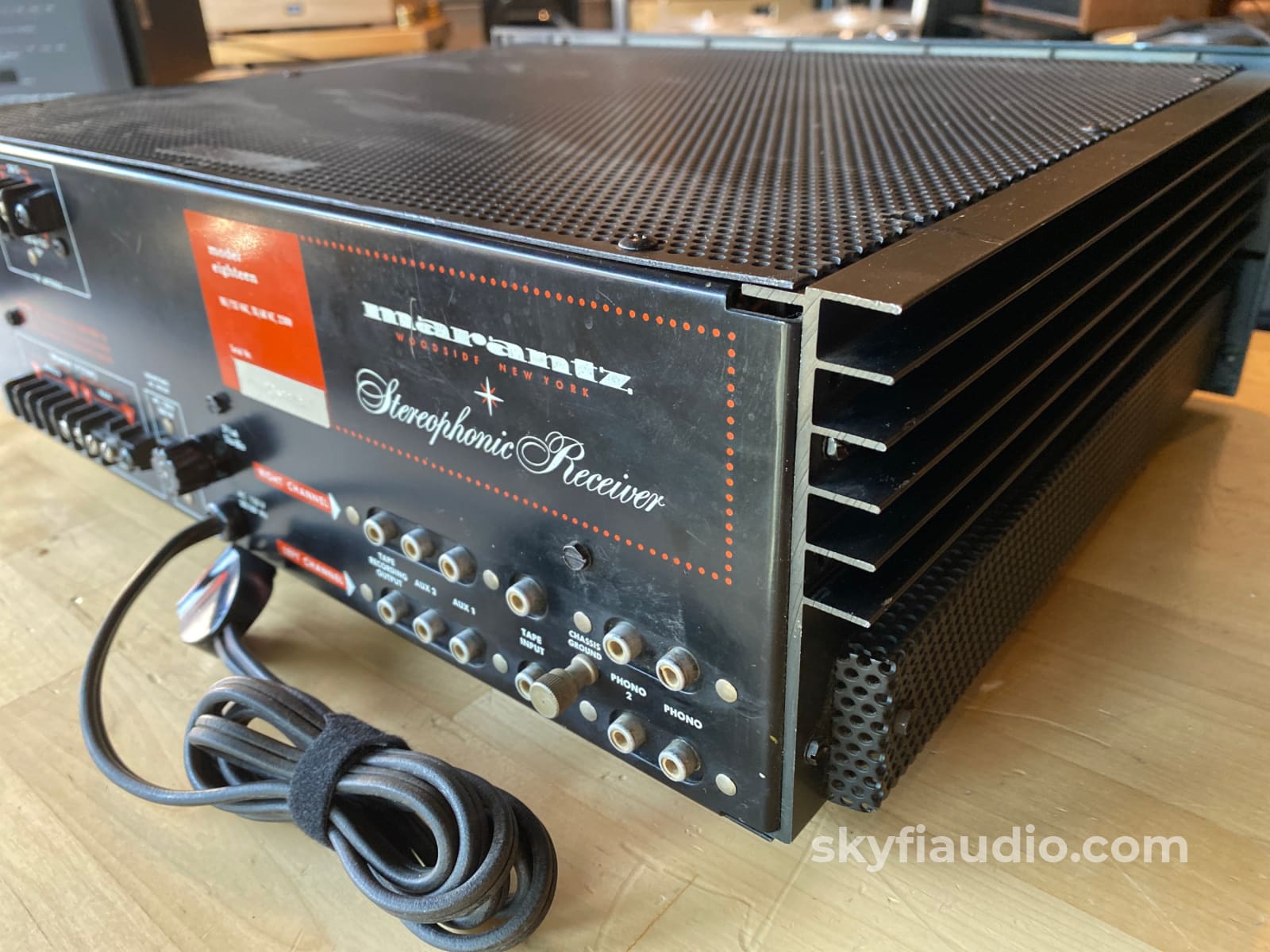
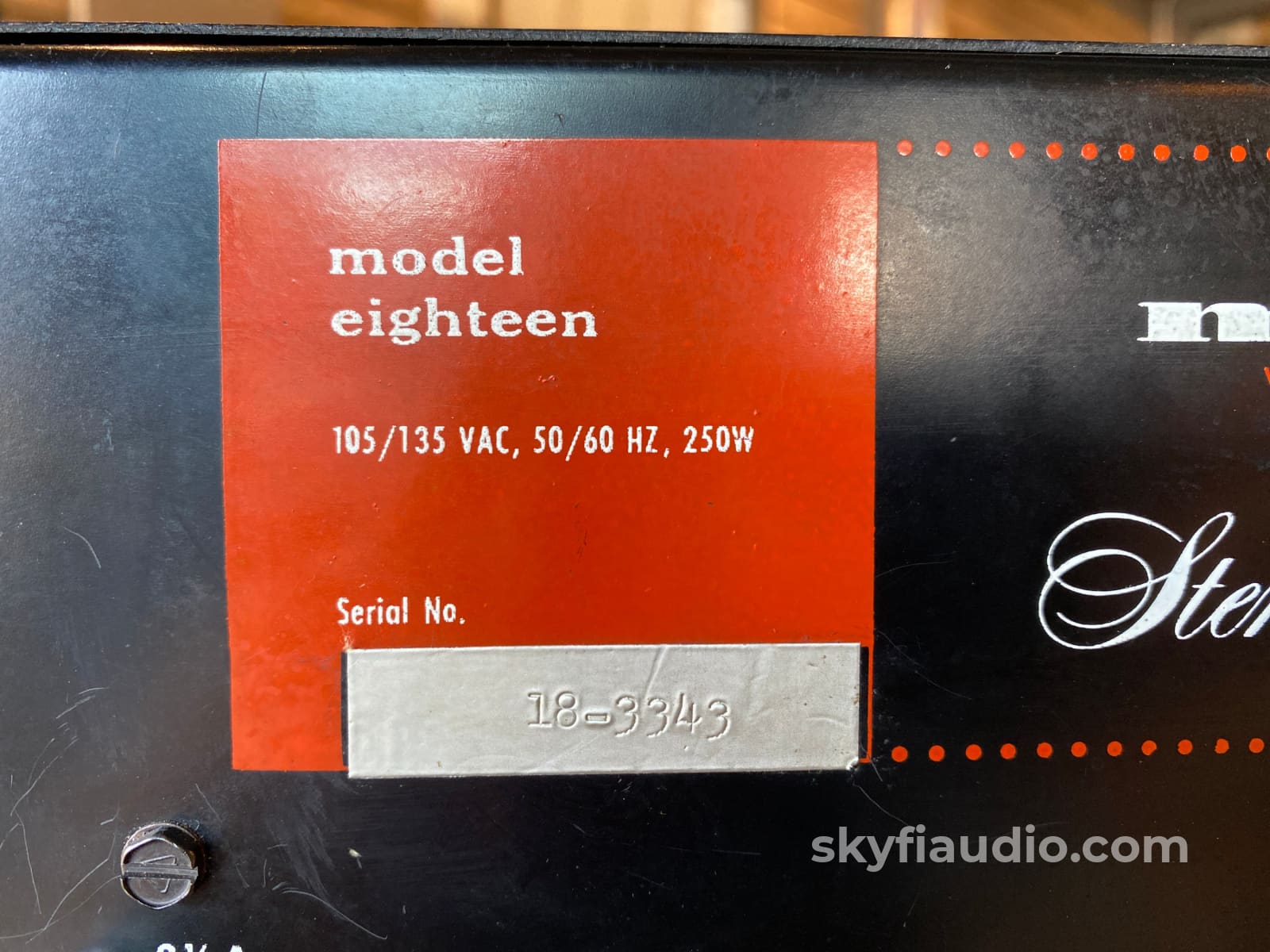
The very first Marantz receiver!
Sounds wonderful with both vintage and modern speakers.
While all audio functions fundamentally work with this vintage beauty, unfortunately the oscilloscope no longer functions.
We reviewed potential repair options during our troubleshooting, but the full replacement assembly required appears to be unobtainium today.
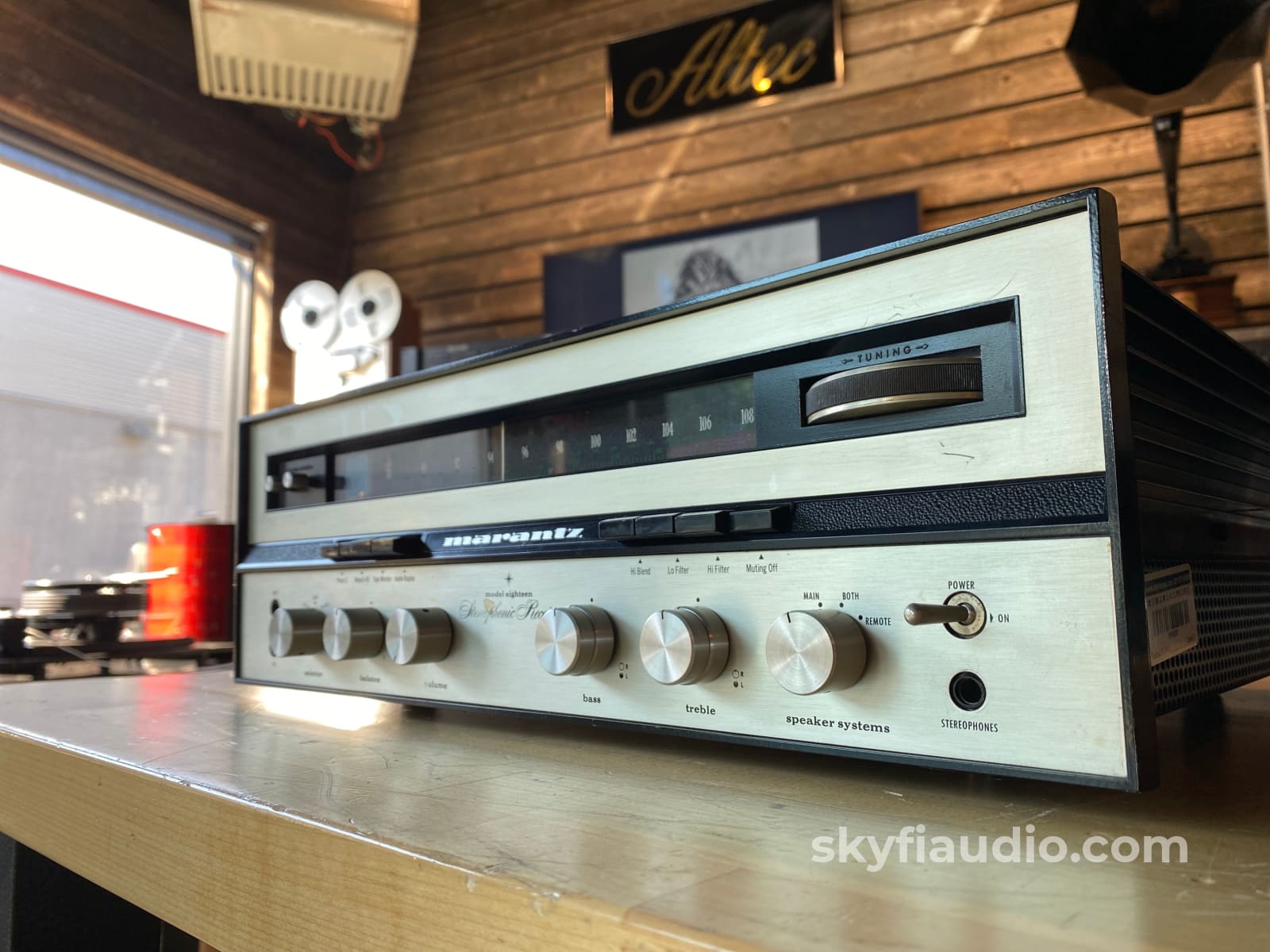
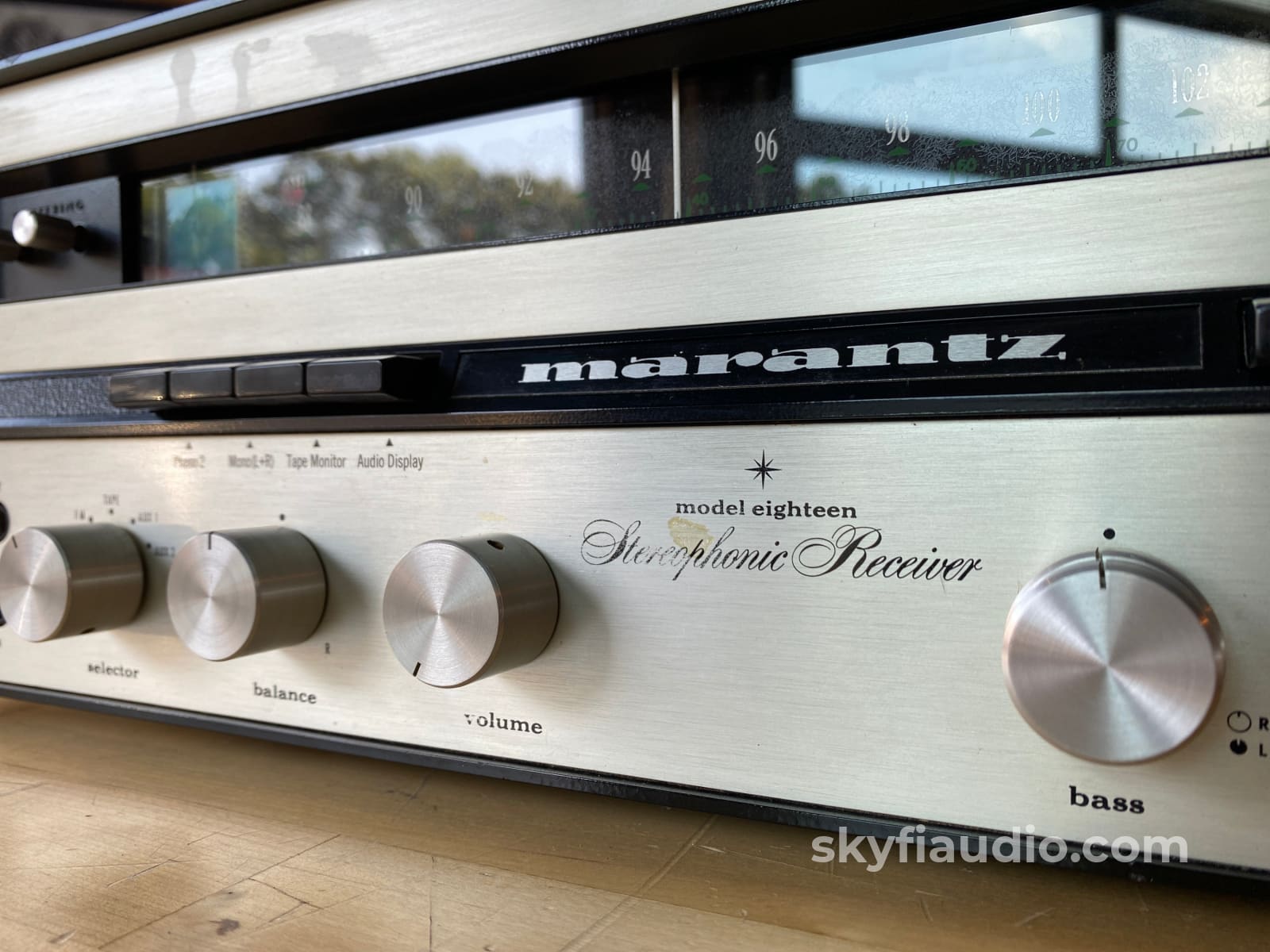
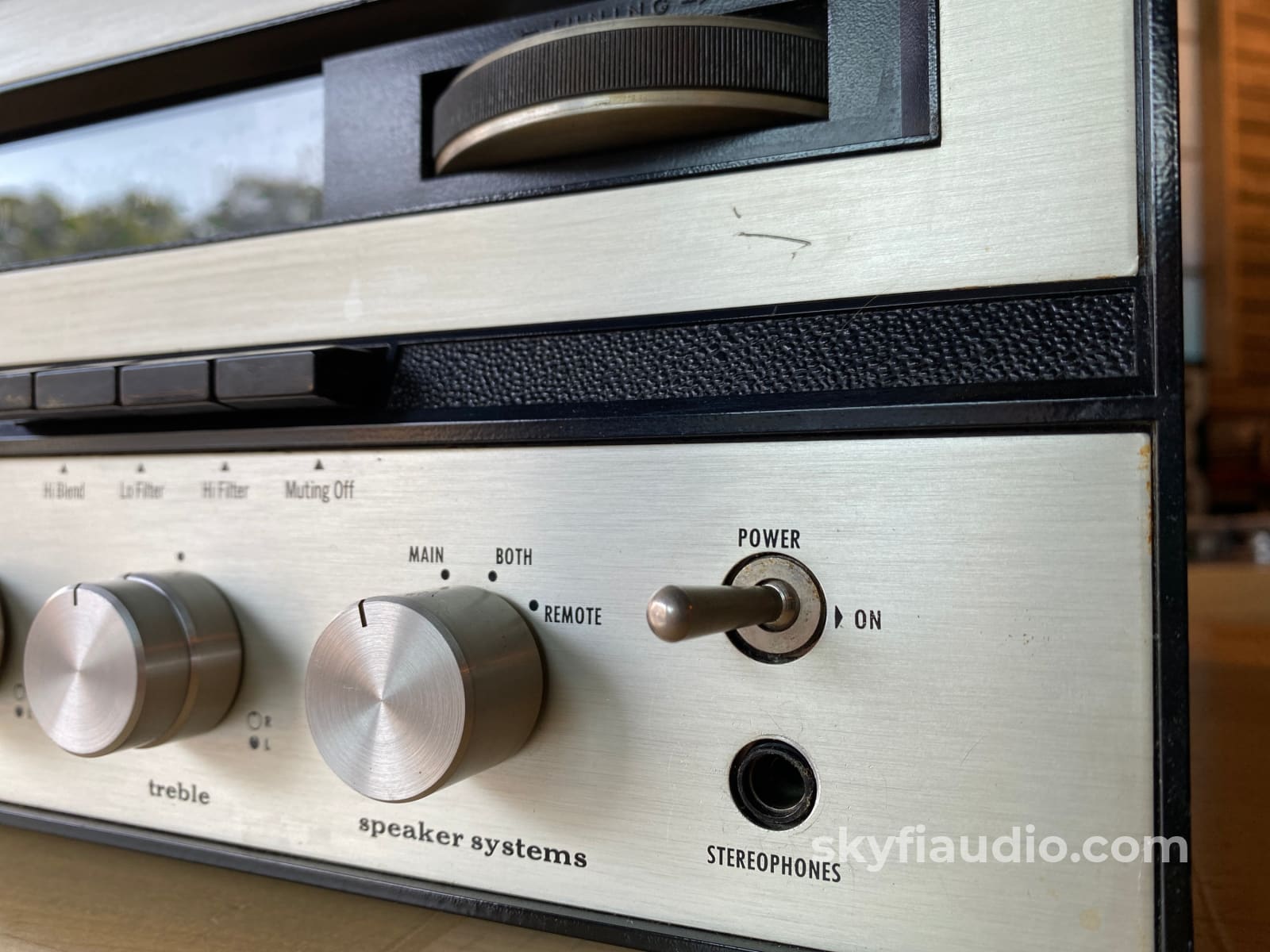
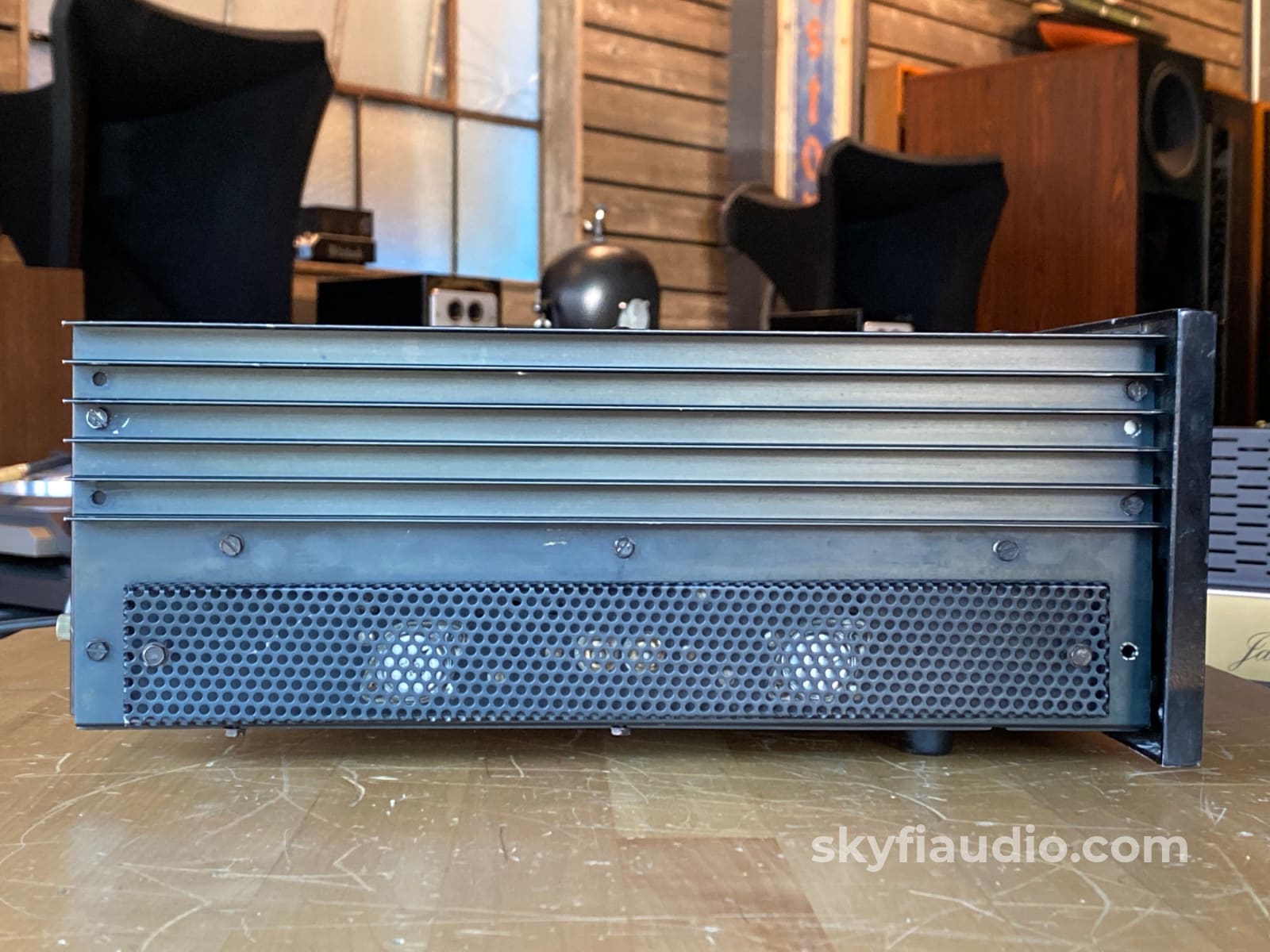
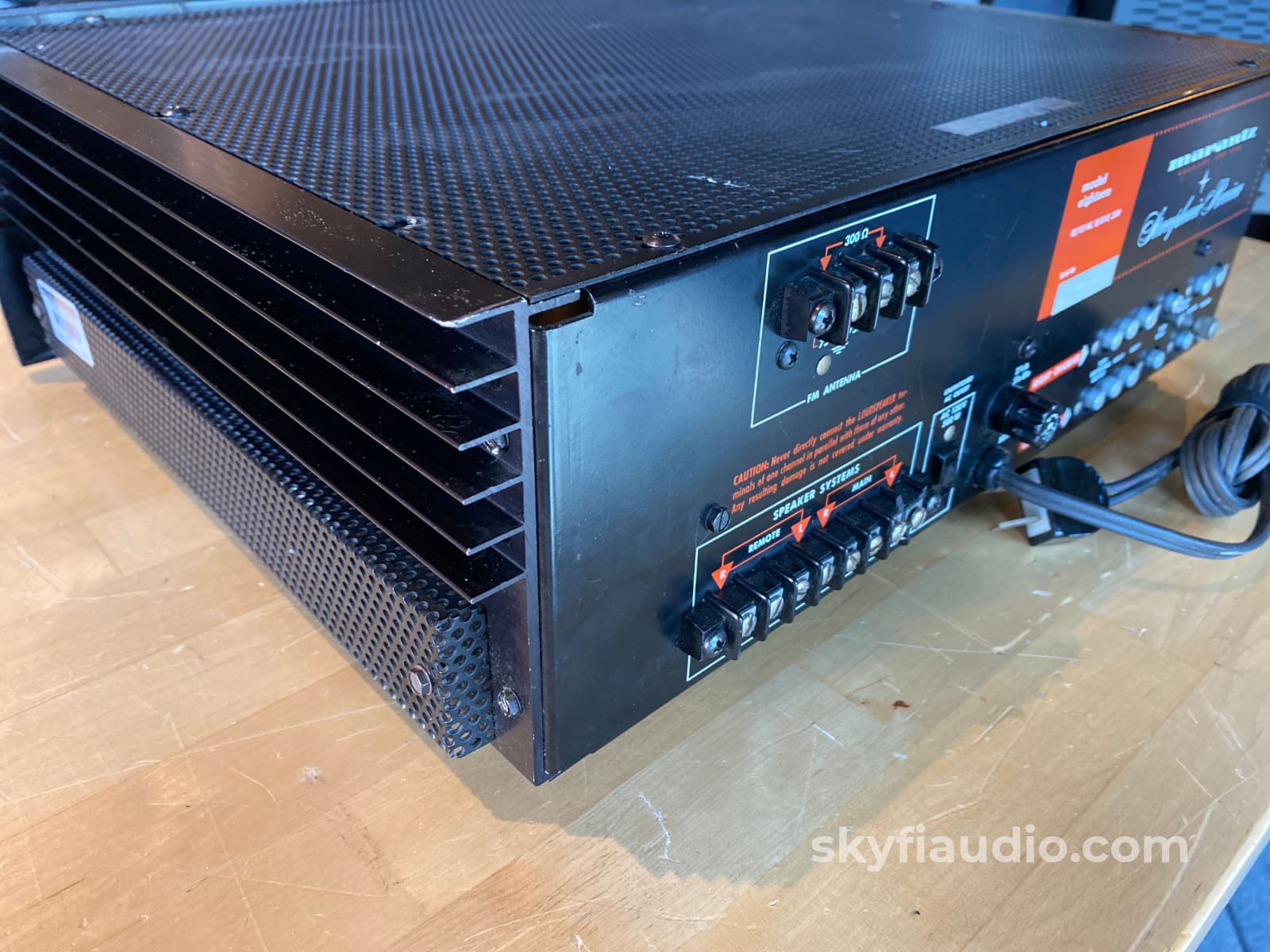
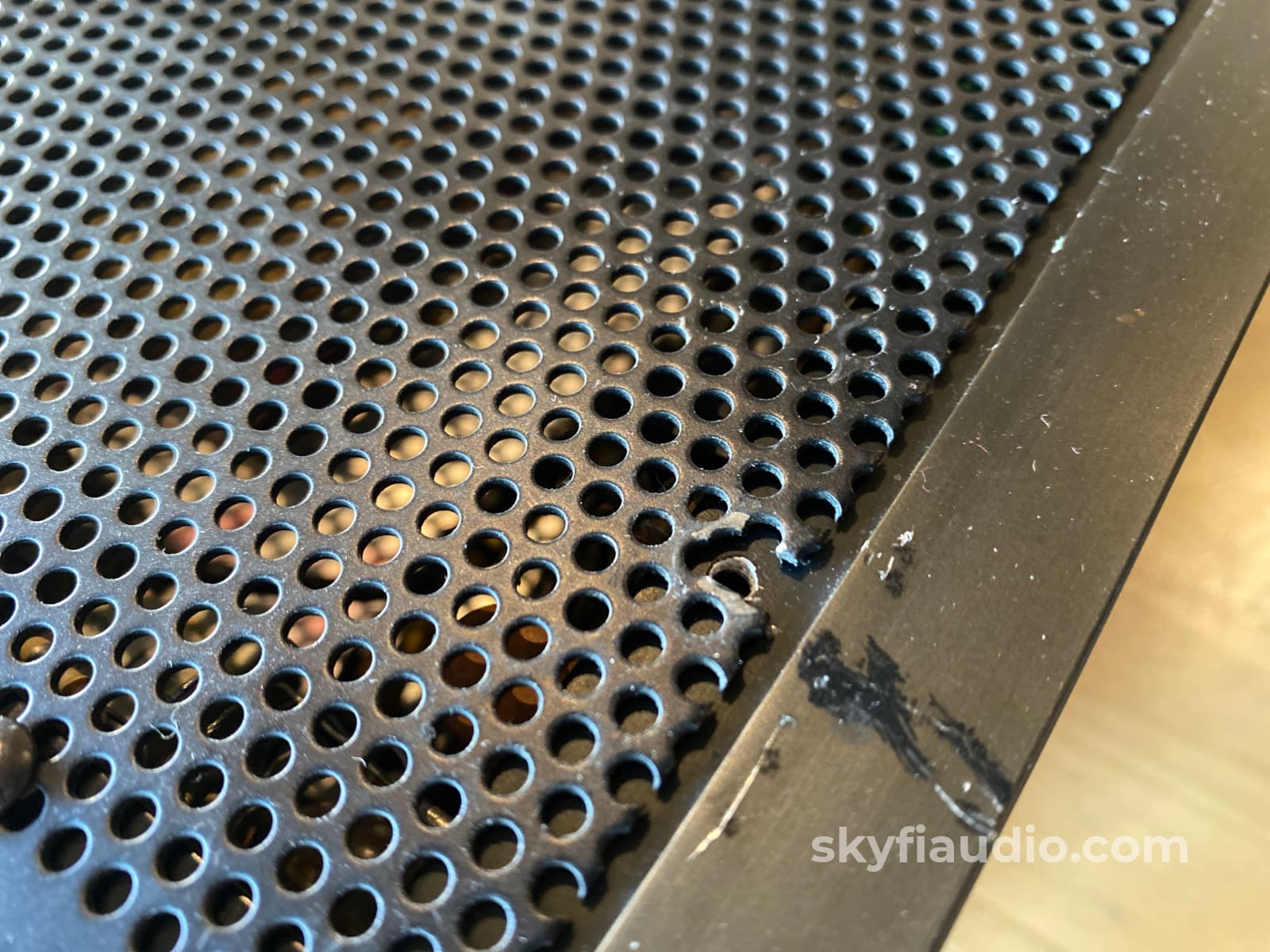
This receiver has minor cosmetic and electronic issues as noted below and would make a great restoration candidate or collector piece.
Important Notes:
• Oscilloscope non-functional.
• Aging carbon volume control causes slight volume discrepancy between channels depending on position of control.
• Faceplate has some faded lettering and some scratches and blemishes from age.
• Some original cover screws are missing.
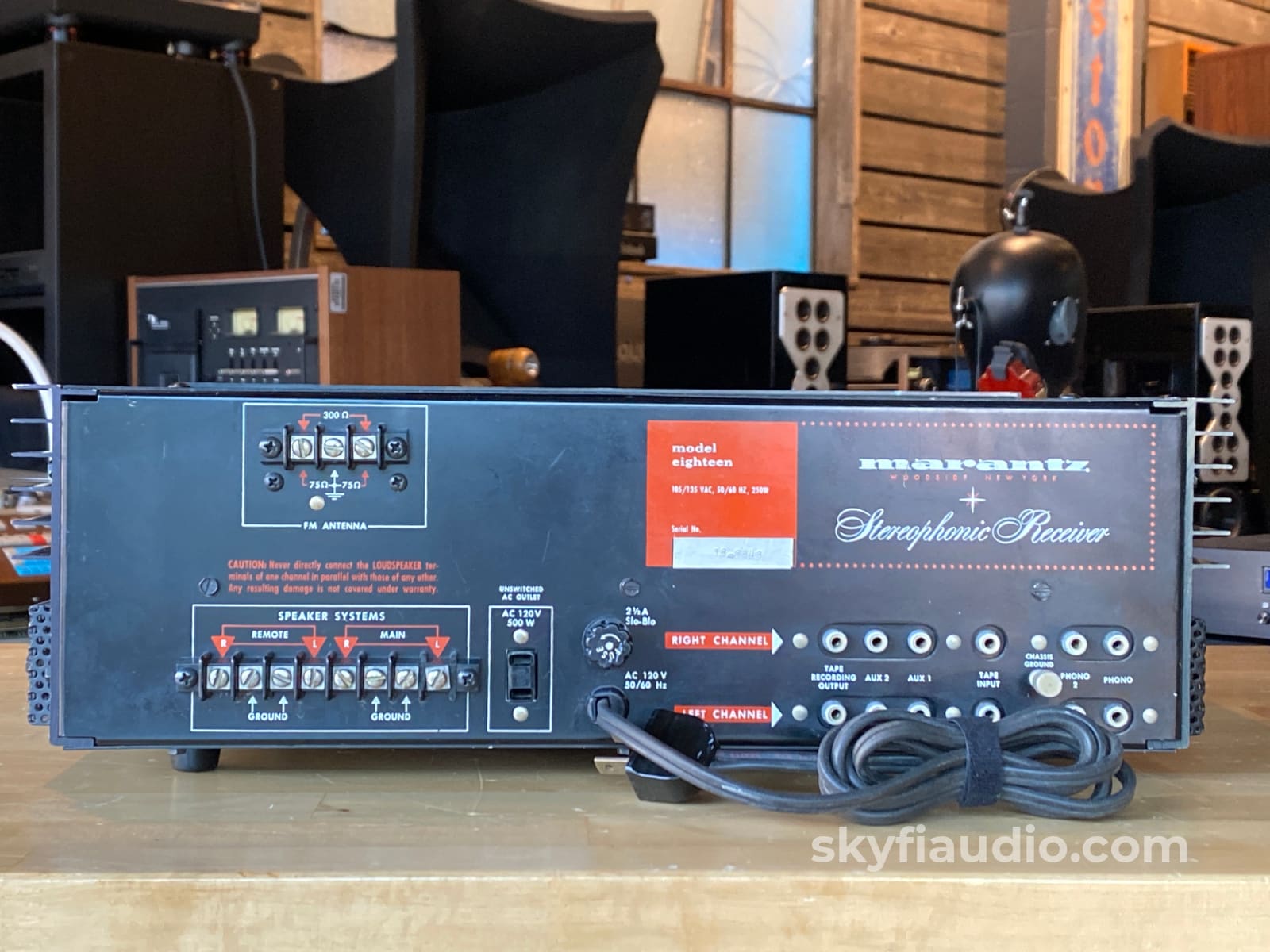
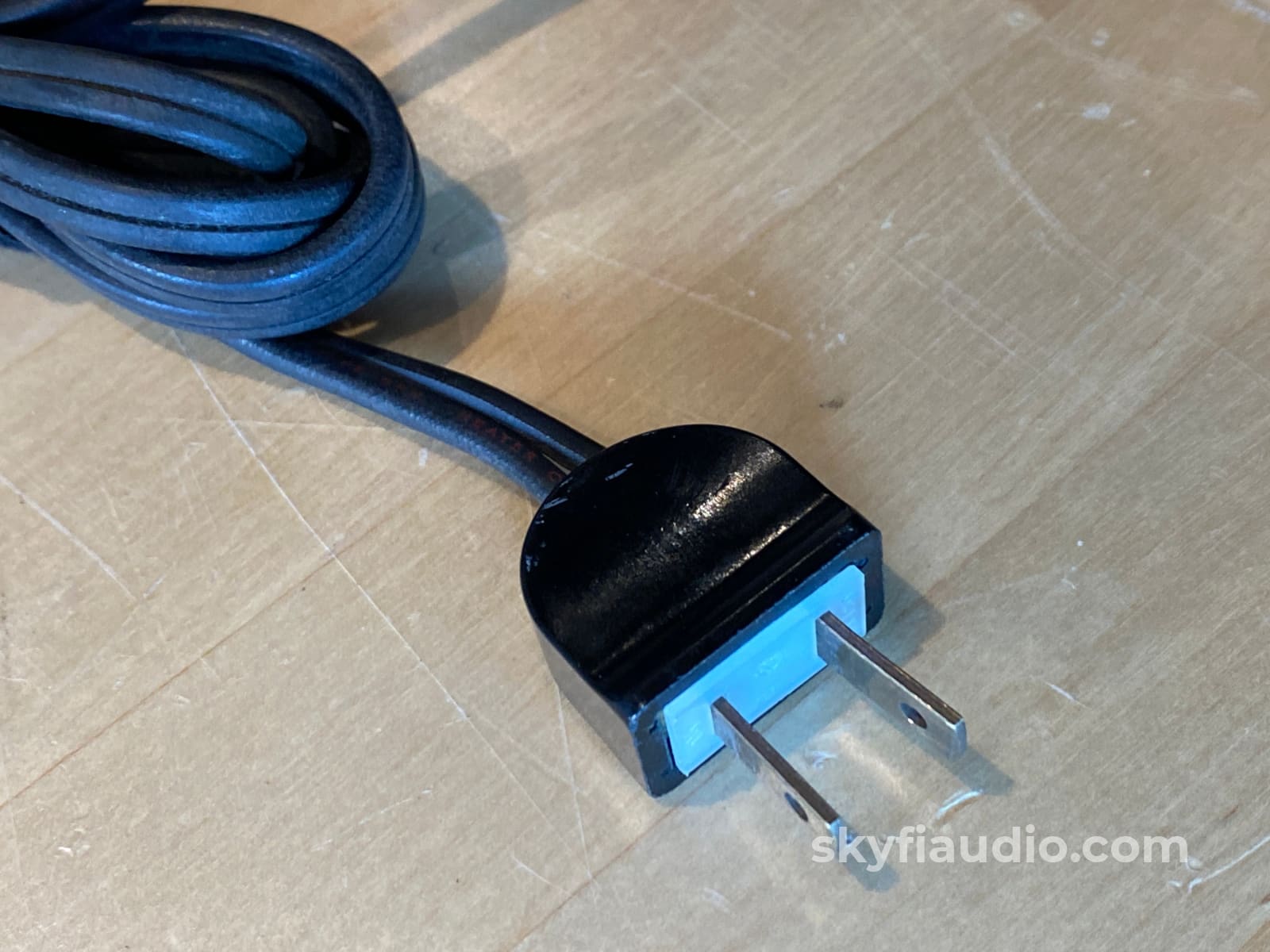
• AC power cord plug was replaced in the past.
Recommended Cables:
Ascent Series Hero Analog Interconnects (PAIR) - RCA Ultraplate or WBT Connectors
More from vintage Marantz documentation:
"With the exception of the cathode ray tube, the model eighteen is an all transistor receiver, based on the same advanced circuits used in the Marantz model 10B tuner, 7T solid state pre-amplifier and 15 solid state power amplifier.
It's circuitry includes 72 transistors and 76 diodes, a total of 149 solid state devices.
A tuner, pre-amplifier and power amplifier make up the three basic components mounted on a single chassis and sharing a common power supply.
Internal connections between these components have been designed to provide optimum performance from each component while retaining full flexibility.
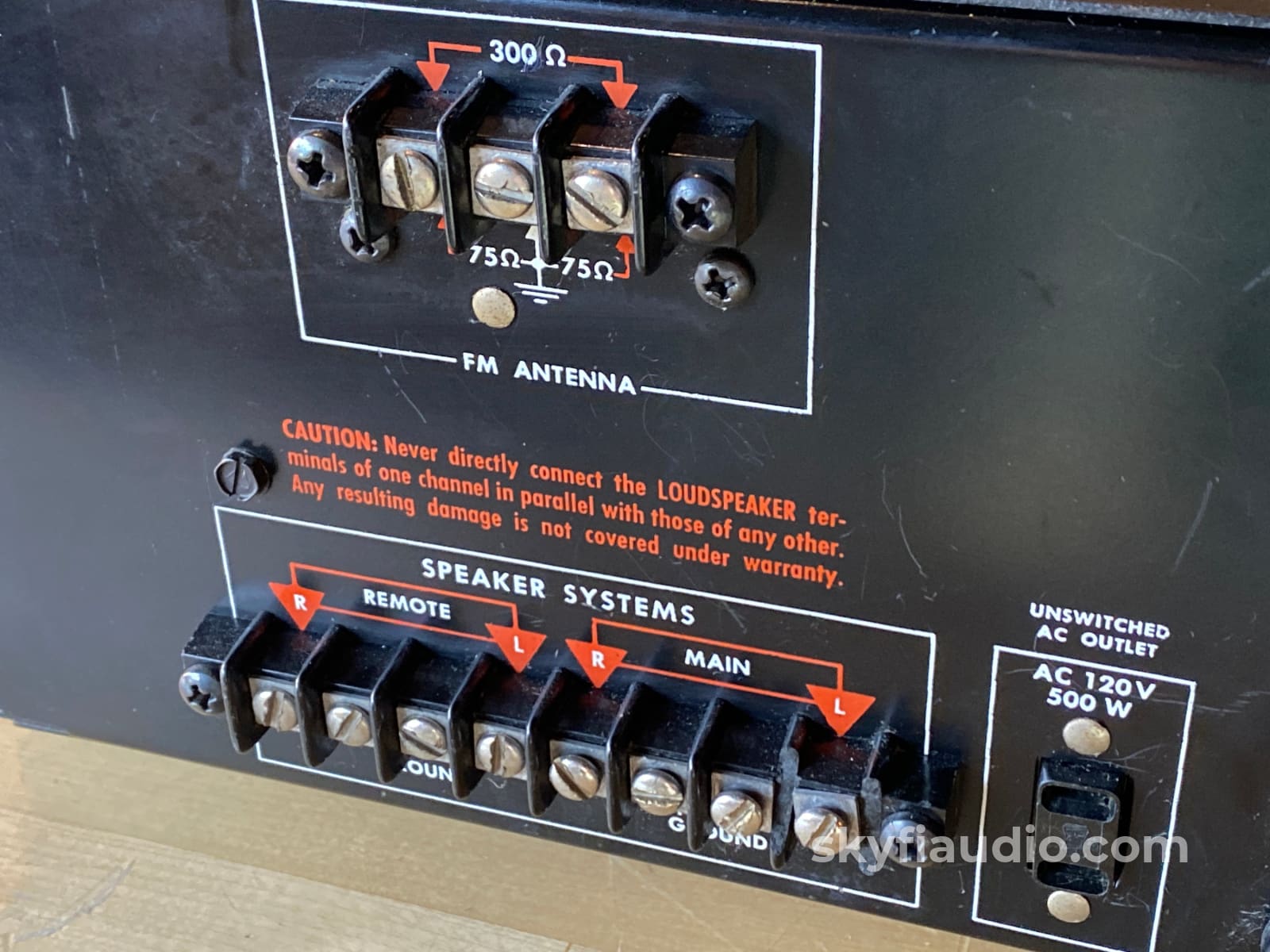
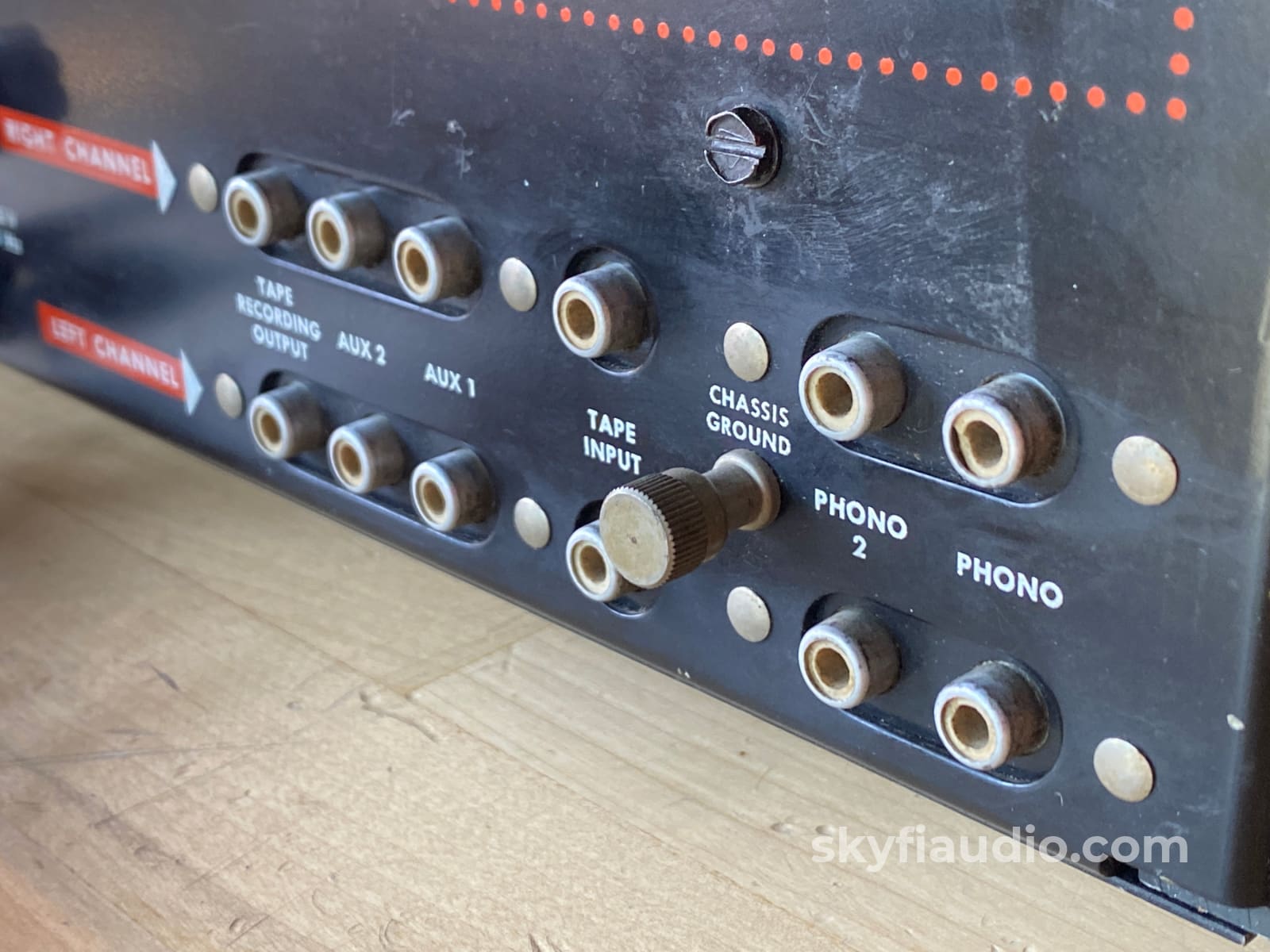
The model eighteen allows the connection of two pairs of loudspeakers, headphones, a turntable and record changer, an additional tuner, a TV sound source, and two tape recorders for record, playback and tape copying functions.
It's flexibility will allow other connections to be made for special applications and it's performance is the equal of the finest separate component system of comparable power."
Marantz Model Eighteen (18) Stereophonic Receiver - Owner's Manual
Marantz Model Eighteen (18) Stereophonic Receiver - Service Manual
Specifications
Tuning range:
FM, AM
Power Output:
40 watts per channel into 8Ω (stereo)
Frequency Response:
20 Hz to 20 kHz
Total Harmonic Distortion:
0.2%
Damping Factor:
30
Input Sensitivity:
1mV (MM), 100mV (line)
Signal to noise ratio:
80 dB (line)
Channel Separation:
35 dB (line)
Speaker Load Impedance:
4 Ω to 16 Ω
Dimensions:
18-1/4" x 6" x 16"
|
Item |
Included |
|
Original Box |
No - Not Included |
|
Manual |
No - Not Included |
|
Remote |
No - Not Applicable |
|
Cables |
Yes - Power Only |
|
Physical Condition |
6 / 10 |
|
Working Condition |
10 / 10 |
SkyFi Testing Process:
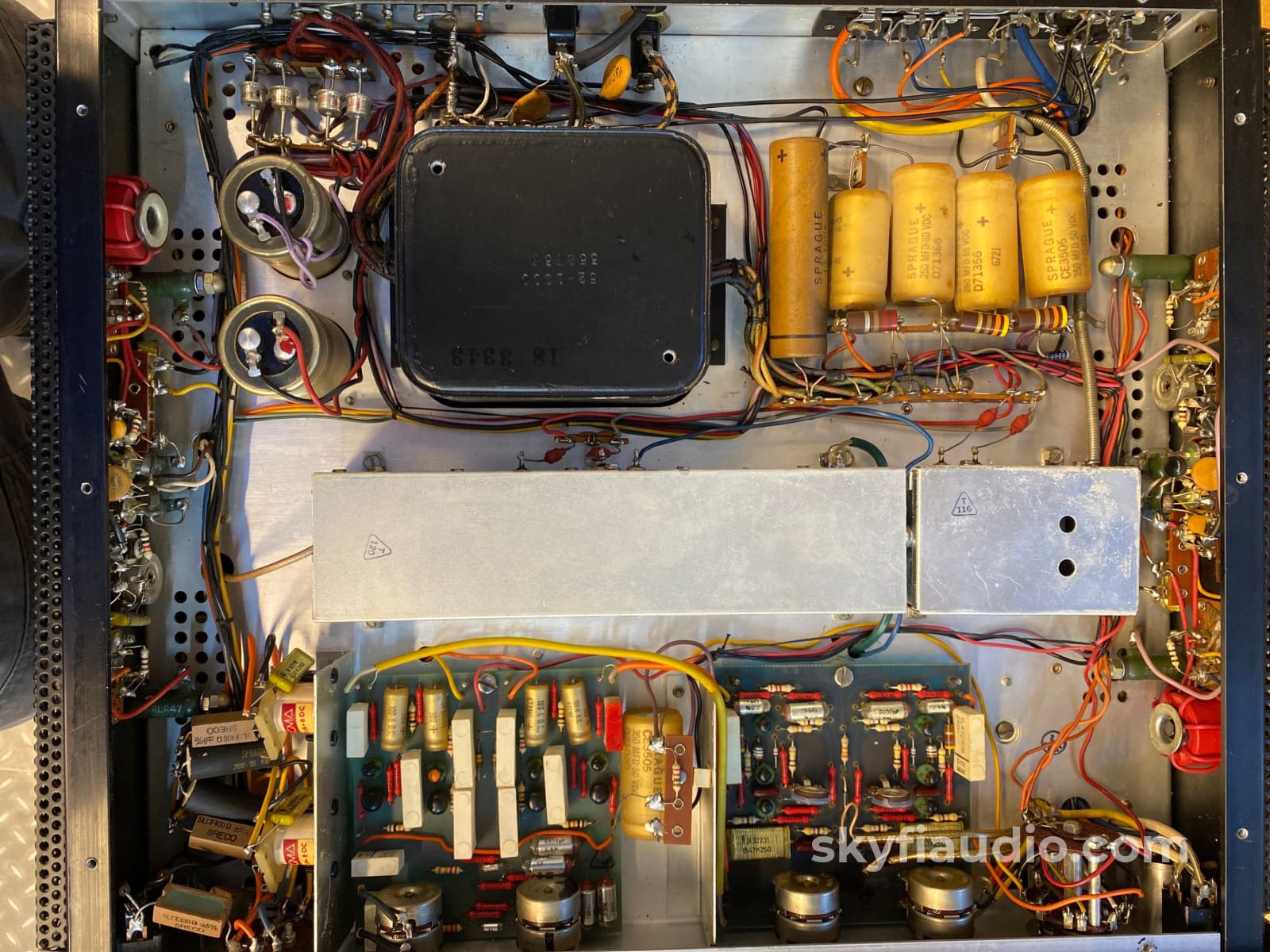
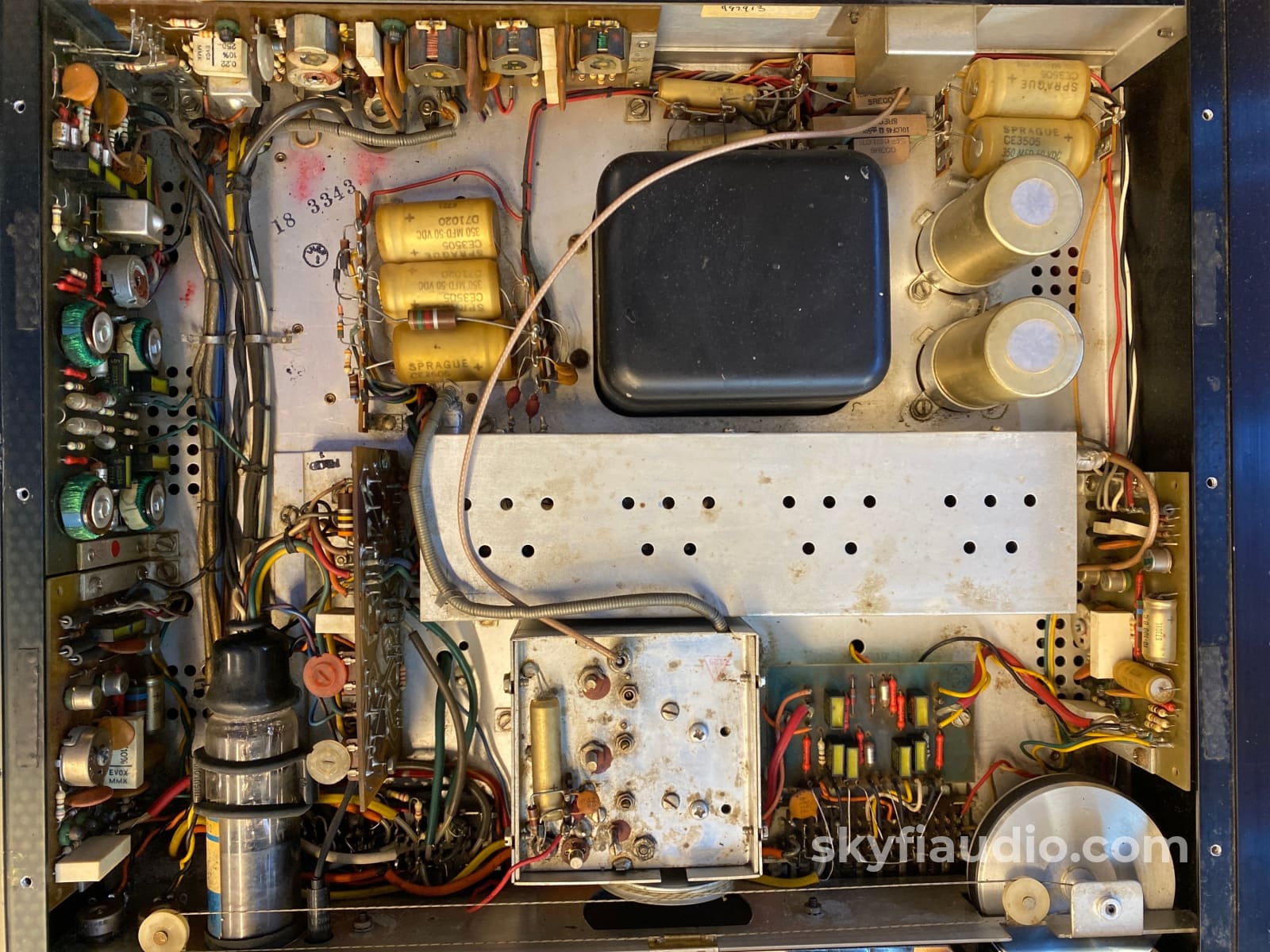
We start with a visual inspection of all internal components to make sure that there are no signs of heat stress or damage. Capacitors are checked for telltale signs of predictive failure including bulging, shrunken wrappers, or physical leakage. We also inspect the PCBs for discoloration from resistors or transistors that may have been running hot. On vintage units we often spot check select capacitors for value and ESR.
If the device has the ability to decouple the preamplifier from the power amplifier, we remove the jumpers and independently test each section. If the device cannot be decoupled, we assess the electronic condition of the piece by analyzing the speaker level output only.
We start by connecting the "Pre-Out" jacks of the receiver to a Sencore PA81 Power Analyzer which simulates real world loading conditions and gives us an oscilloscope interface. The first order of business is checking that the volume control works smoothly throughout its entire range with acceptable channel balance. This is accomplished by feeding a 1 KHz sine wave into one of the preamp’s line level inputs while monitoring the preamp’s output on an oscilloscope.
We then switch to a 1 KHz square wave to test the tone controls, loudness function, and filters where applicable. During this step we are watching for equal alteration of the test signal by both channels. This also helps us identify dirty controls that will need treatment.
Once the basic line stage functions are verified, we test each input individually. This is especially important for devices that use relays to select their sources.
If the preamp section is equipped with a phono stage we test that as well. We use an inverse RIAA filter which allows us to feed a reference test signal into the phono input with the proper RIAA equalization and level. A square wave or sine sweep is used to verify that the device’s phono stage is faithfully reproducing the RIAA curve.
To test the tuner, we connect one of the tape outputs to the Sencore PA81 and the antenna terminals to a Sencore SG80 which allows us to “simulate” an ideal radio station using precision test signals instead of music. This device, in conjunction with an oscilloscope allows us to properly evaluate the following parameters:
1) AM Reception (Where Applicable)
2) FM Mono Reception & Tuning Meter Function
3) FM MPX Reception (Stereo)
4) Dial Tracking: How accurately the tuner dial or display indicates the actual frequency of the broadcast being received.
5) Stereo Separation: A properly working stereo tuner will have minimal crosstalk between the left and right channel.
6) Sensitivity & Signal Strength Meter Function: By lowering the output of the SG80 we can simulate weak stations and determine how well the tuner will be able to pull in weak distant stations. This adjustment also helps us verify signal strength meter function.
If the tuner has acceptable performance related to the parameters above, we connect the unit for listening tests with a simple dipole antenna. We listen for audio reproduction quality of local stations and evaluate how many stations the tuner can receive while we sweep through the dial. We are looking to verify that the tuner can decode stereo on strong local broadcasts and pick up a wide variety of local stations at the bottom, middle, and top of the frequency band. At this point we also test convenience features such as muting, filters, built in oscilloscope function, etc.
Next we test the power amplifier section by connecting the receiver's speaker outputs to a Sencore PA81 Power Analyzer which acts as a dummy load, DC offset monitor, and oscilloscope interface. We start with a low level 1 KHz test signal at the Main In” jacks and slowly increase its amplitude while monitoring the output on an oscilloscope for signs of noise, clipping, distortion, or improper channel balance. We continue increasing the signal level until the amplifier reaches clipping.
At this point we take an output power measurement and compare it to the spec sheet of the amplifier to verify proper performance. We finish off the bench evaluation with a 1 KHz square wave check and a 20 Hz to 20 KHz sine sweep to assess the amplifier’s frequency response characteristics. This battery of tests will usually reveal if the amplifier has any issues that need further attention.
If the preamp and power amp both pass these tests, we reconnect the sections and verify that the preamp section can drive the power amp to rated power with a 1 KHz tone on one of the line level inputs.
Before the device leaves the bench, we perform a listening test with actual music using a variety of preferred test tracks. Our benches are outfitted with familiar monitor speakers which help us identify inconsistencies that will not always show up on our test gear. The main things that we are listening for are hum or noise with no signal present, proper center image, clicks, pops, or any other obvious undesirable audio characteristics.
If the unit passes all of these tests it is moved to our long term testing rig where we simulate real word operating conditions for 6-8 hours minimum. This allows us to monitor the unit for signs of thermal runaway or intermittent issues that only crop up when the unit has fully come up to temperature.

Choose options