




The Sequerra Model 1 FM Tuner - Serviced - Rare
Free Shipping (Contiguous U.S. Only)
Pickup available at SkyFi 479
Usually ready in 24 hours
The Sequerra Model 1 FM Tuner - Serviced - Rare
SkyFi 479
479 South Broad Street
Glen Rock NJ 07452
United States
General:
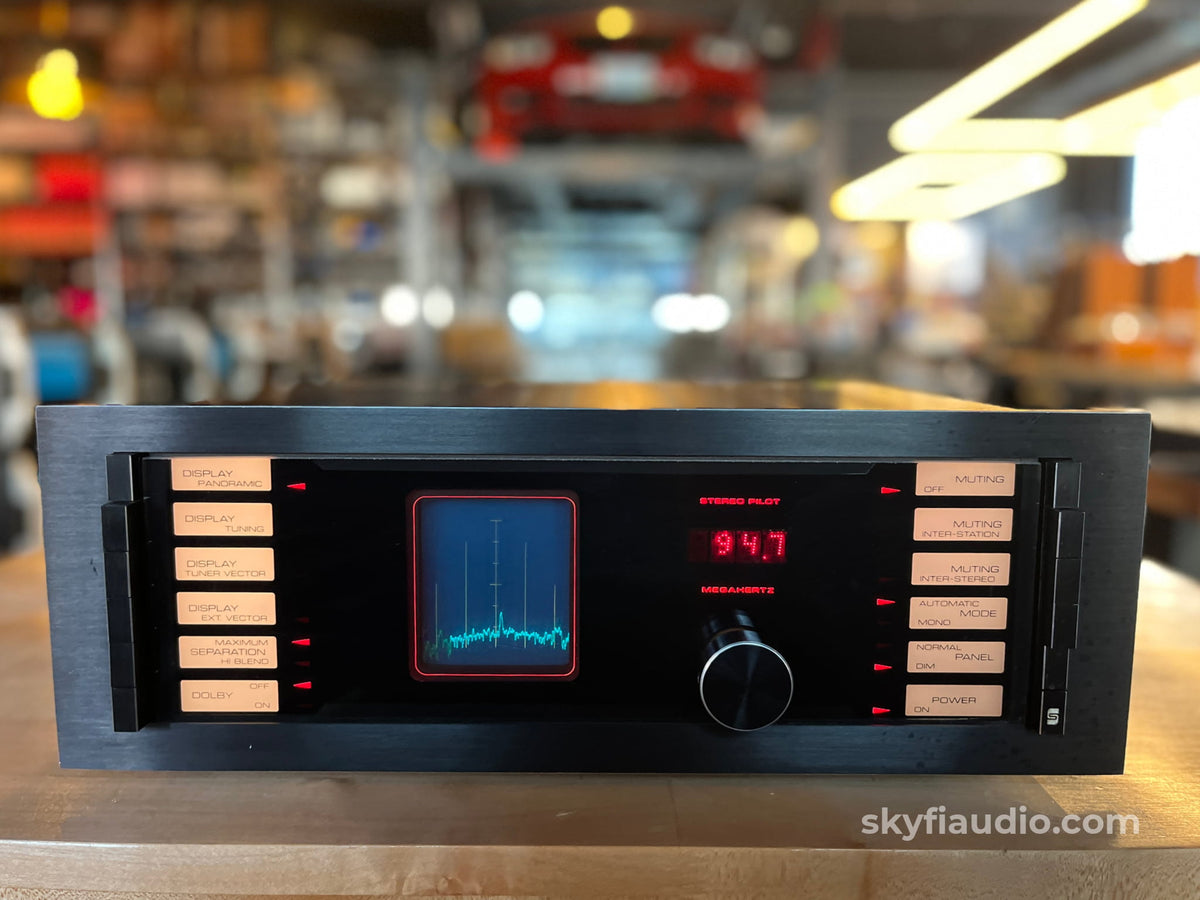
The Sequerra Model 1 is possibly the best FM tuner ever made! Only about 1400 were ever produced.
This particular tuner series came out in 1974 at a time where there was some pretty fierce competition. The Marantz Model 10B had been around for a little bit, and the McIntosh MR78 had just come out a year before, so there were three all-American made tuners that are now considered the best tuners ever made. Much better than their British counterparts.
A lot had to do with the fact that in the US designers had the additional challenge of designing tuners to work over significant distances to reach stations - unlike the UK which is a more compact area. These 3 tuners were the absolute best of the best, and this Sequerra was the most sophisticated and most expensive by a large margin.
When this tuner came out in 1974 it was almost $2000, which is almost the price of a car in today's money! During its run which ended in the late 90's, it went all the way up to $4,000 in this variation. There were other variations like the reference models that easily exceeded $10,000, but this was considered reasonable/within reason, as this is more of an actual lab instrument than a piece of home audio equipment. And you can tell by its construction, design, parts quality, and presentation. It was really designed for radio stations to analyze their signals and understand their performance limitations, and was quickly adopted by home owners that wanted the absolute best of the best.
Check out our Youtube Video on the Sequerra Model 1 for more:
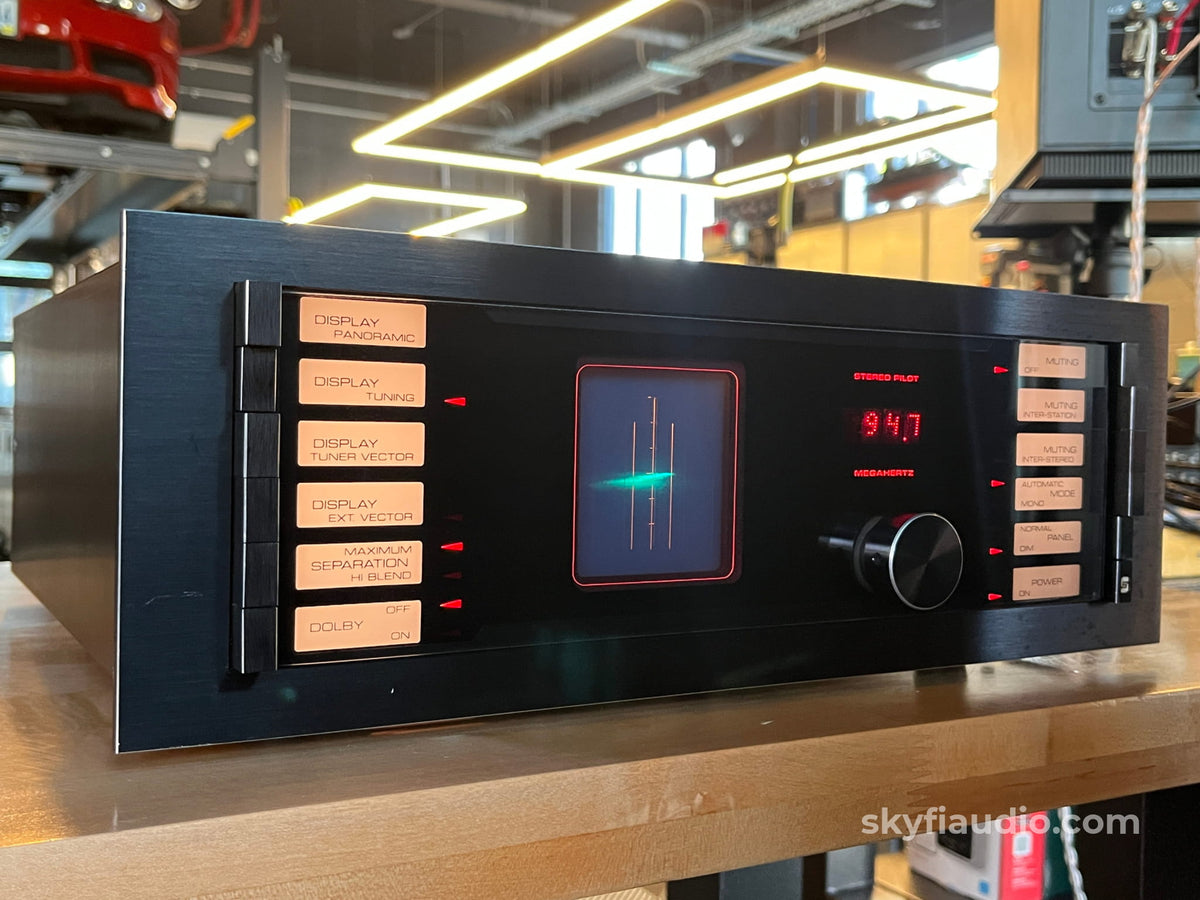
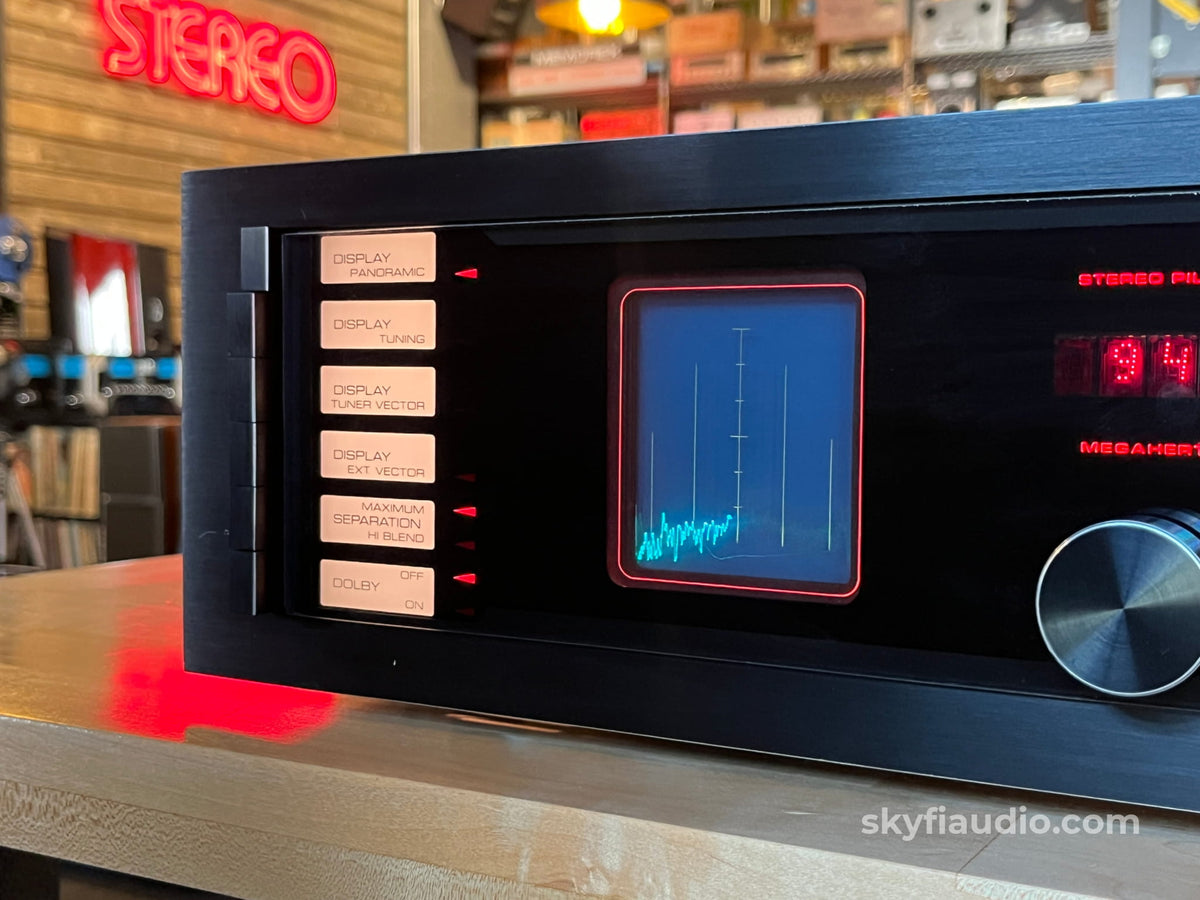
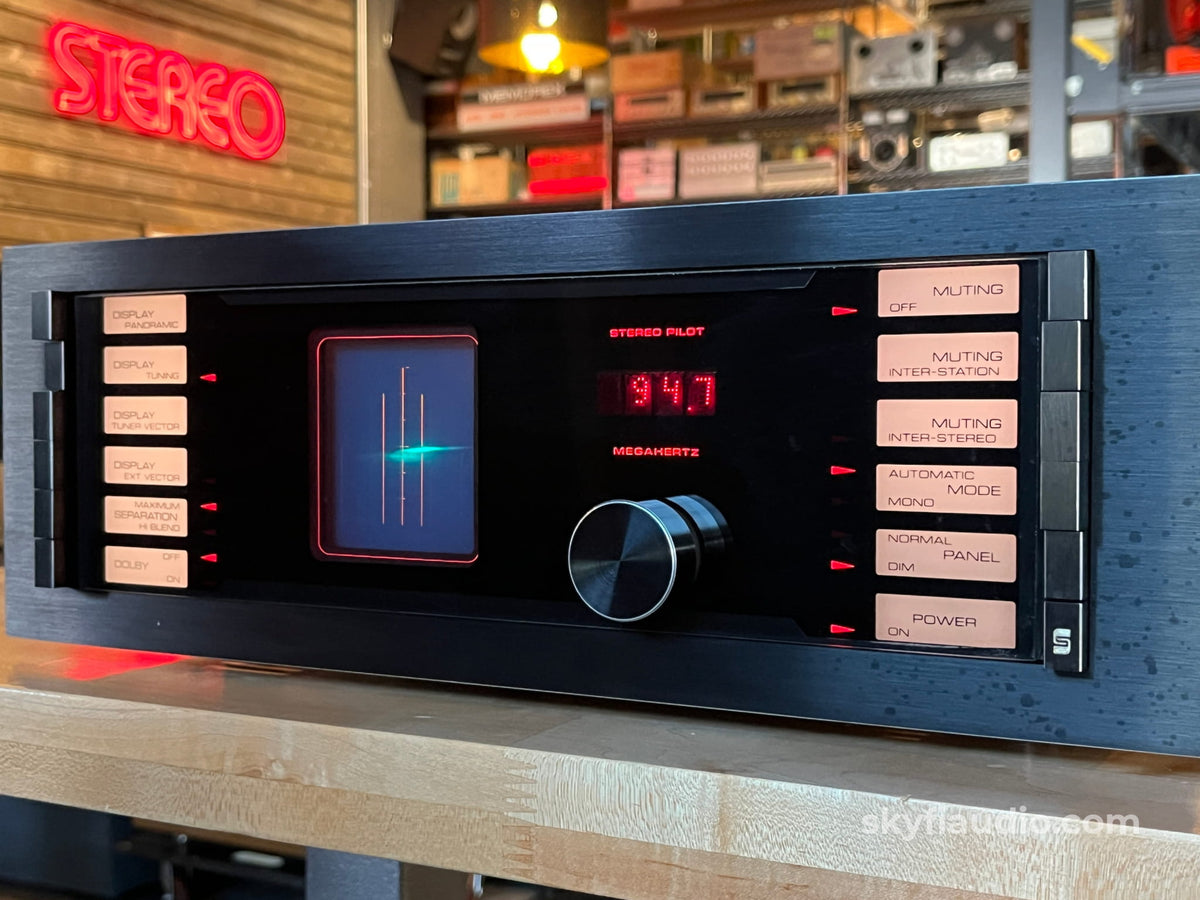
Probably the neatest feature is the built in oscilloscope that is hard to miss. It has several different modes - Panoramic, Display Tuning, and Tuner Vector. And there's also a 4th mode titled External Vector which allows you to input external signal.
The CRT Scope is super bright and very responsive. All controls work as they should. It is able to reproduce a strong stable signal as you would expect and is sounding fabulous. Any imperfection you see in the display are cause by the refresh rate of the camera, not visible in real life.
This particular Sequerra Model 1 has been serviced and aligned in house so you can be sure you are going to get maximum performance and long term reliability. This is absolutely essential if you want performance as close to new as possible.
Internally it's quickly obvious that this is more of a lab piece of equipment than a home component.
It will be packed with attention and care so it arrives safely at its new home.
SkyFi Cosmetic Notes:
Very light cosmetic blemishes are present throughout. Light spots on the faceplate. The barrier strip for the antenna connections on the rear panel has two broken barriers. We will supply a 300 ohm to Coaxial 75ohm antenna adapter.
SkyFi Technical Notes:
This tuner was serviced in house here at SkyFi. It arrived with some out of spec power supply voltages and a nonfunctional MPX section. We replaced select out of spec components in both circuits, aligned the MPX, discriminator, and scope, cleaned the controls, and replaced a few burnt out lamps. After service, this FM1 was one the most sensitive tuners that we have ever tested here at the shop.
Ownership:
Second Owner
Connections:
RCA, Antenna Connections, Detector output
General Sound:
Smooth, uncolored, undistorted natural and clean
Cosmetic Condition:
7/10 = Good. One or two minor scratches. Well Maintained. See our detailed rating description here.
Working Condition:
Working perfectly and tested in our lab.
Included:
Unit, power cord and FM 300Ohm adapter.
Packing:
Will be packed using our highly developed in-house process and custom packing materials.Original MSRP:
$2,500.00
Specs:
- Wave Bands: FM Broadcast Band only
- Intermediate Frequency (IF): 10,700 kHz
- Tuned Circuits: 24 FM circuits
- Tube / Valve Complement: 1 CRT / display tube (D10-160GH)
- Semiconductors: 84 transistors, 58 ICs
- Power Requirements: AC 120 / 240 Volts
Dimensions:
16 x 5.75 x 12.75 inch / 406 x 146 x 324 mm
Weight:
50 lbs.
Approximate Age:
1974
Link to Manual:
Click Here
Recommended Cables:
Kimber Kable - RCA Interconnects - Better
Kimber Kable - RCA Interconnects - Best
Testing Process:
We start with a visual inspection of all internal components to make sure that there are no signs of heat stress or damage. Capacitors are checked for telltale signs of predictive failure including bulging, shrunken wrappers, or physical leakage. We also inspect the PCBs for discoloration from resistors or transistors that may have been running hot.
On vintage units we often spot check select capacitors for value and ESR. Vintage analog tuners also have moving parts related to the tuning gang and dial string. These parts are inspected for smooth operation.
If the unit passes visual inspection it is bench tested for a handful of key performance parameters using a Sencore SG80 AM/FM Stereo Analyzer. The SG80 allows us to “simulate” an ideal radio station using precision test signals instead of music. This device in conjunction with an oscilloscope allows us to properly evaluate the following parameters:
1) AM Reception (Where Applicable)
2) FM Mono Reception & Tuning Meter Function
3) FM MPX Reception (Stereo)
4) Dial Tracking: How accurately the tuner dial or display indicates the actual frequency of the broadcast being received.
5) Stereo Separation: A properly working stereo tuner will have minimal crosstalk between the left and right channel.
6) Sensitivity & Signal Strength Meter Function: By lowering the output of the SG80 we can simulate weak stations and determine how well the tuner will be able to pull in weak distant stations. This adjustment also helps us verify signal strength meter function.
If the tuner has acceptable performance related to the parameters above we connect the unit for listening tests with a simple dipole antenna. We listen for audio reproduction quality of local stations and evaluate how many stations the tuner can receive while we sweep through the dial.
We are looking to verify that the tuner can decode stereo on strong local broadcasts and pick up a wide variety of local stations at the bottom, middle, and top of the frequency band. At this point we also test convenience features such as muting, filters, built in oscilloscope function, etc.
We finish up with an extended listening test on our long term test rig. We tune in to a strong local station and monitor for drift over a minimum period of 2-3 hours.

Choose options