
McIntosh MA8950 Solid State Integrated Amplifier - Pre-Loved
Price listed is MSRP. Please call to order and discuss pricing.
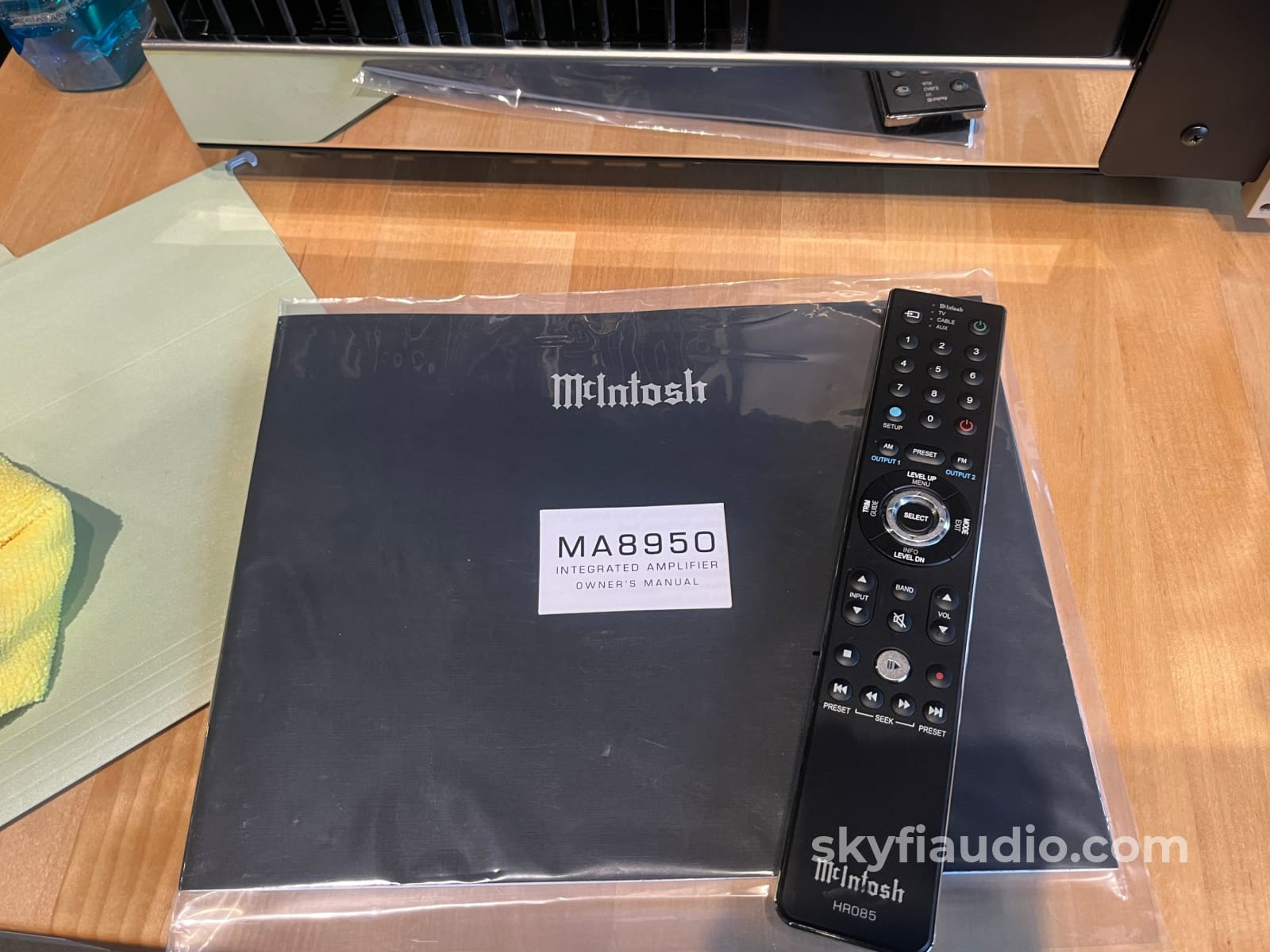
This MA8950 will come with its manual, remote, and McIntosh carton just as new. Tested and functioning perfectly.
A SkyFi 1-year warranty will be included with this product (no McIntosh warranty).
Support your local McIntosh Dealer!
More from McIntosh:
Standout Features:
• 200 Watts x 2 channel
• 5-band tone control
• Comes with DA2 Digital Audio Module installed
• 55% increase in Dynamic Headroom for better music peak reproduction
General:
The MA8950 Integrated Amplifier offers 200 Watts per channel and combines McIntosh's amplification expertise and preamplifier technologies into one comprehensive stereo sound system component. It replaces the award-winning MA8900 (Secrets of Home Theater and High Fidelity 2017 Best Stereo Integrated Amplifier) and adds additional performance enhancements to an already outstanding stereo integrated amplifier.
Dynamic headroom has increased from 2.0dB to 3.1dB in the MA8950 as a result of its filter capacity being doubled. This gives the MA8950 even greater ability to reproduce musical peaks with less distortion. The increased filter capacity will also help deliver more amazing bass playback, low end performance, and overall bass control.
"An amplifier that can handle almost any spread of sources, power almost any pair of speakers and work comfortably in almost any room." Received Editor's Choice Award for Best High-End Stereo Amplifier 2022. - AVForums
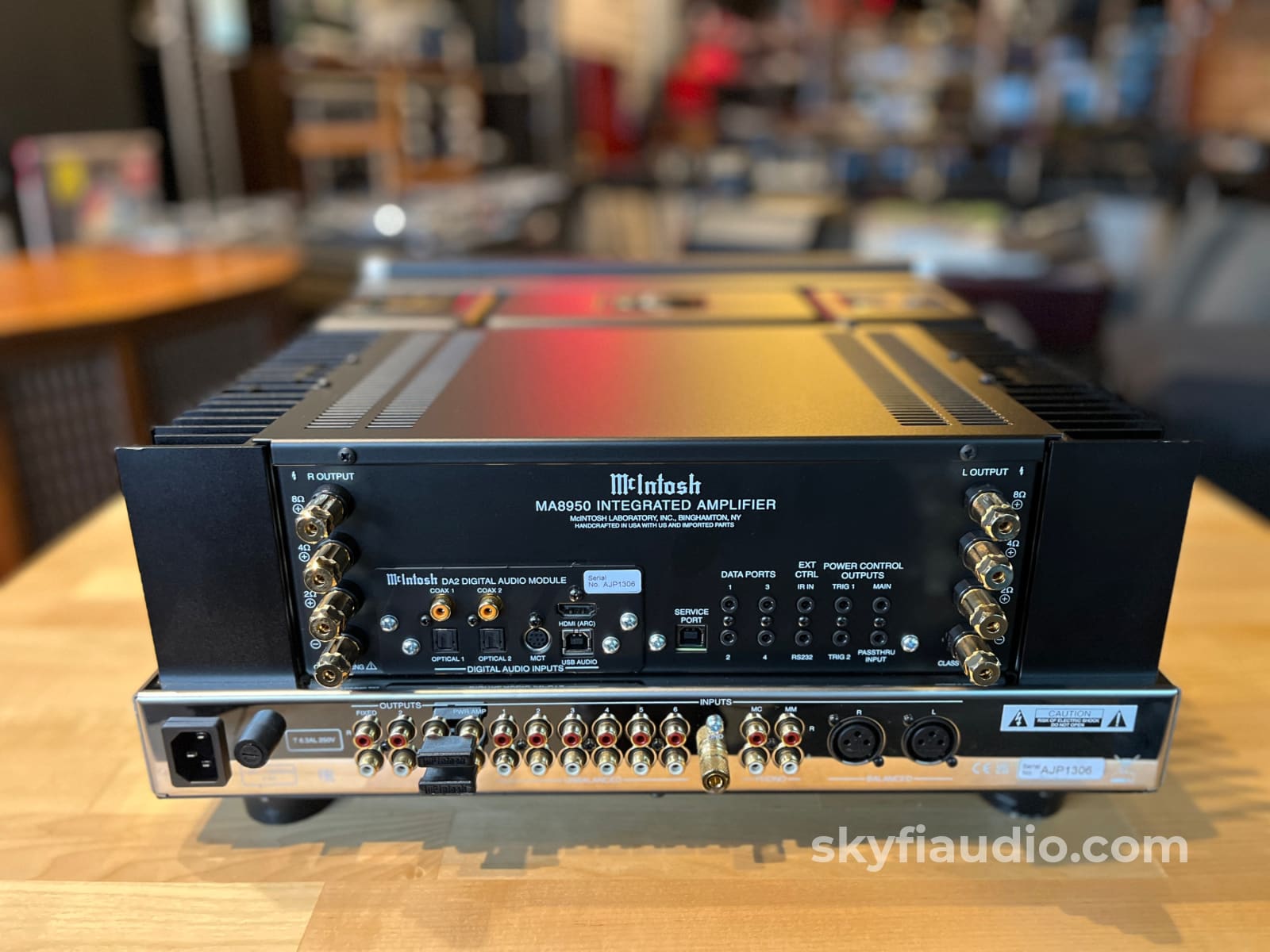
The MA8950 comes standard with the DA2 Digital Audio Module instead of the DA1 Digital Audio Module that came in the MA8900. The DA2 offers 7 digital inputs: 2 coaxial, 2 optical, 1 USB, 1 MCT, and 1 audio-only HDMI Audio Return Channel (ARC)1 connection. TVs with a compatible HDMI (ARC) output can be connected to the MA8950 to enjoy your TV’s sound like never before through your home music system. Popular multi-channel audio formats from Dolby® and DTS® are supported and will be expertly converted to 2-channel audio for proper playback. The MA8950 remote can control the TV’s power and volume when CEC communication is enabled in both the amplifier and the TV. The DA2 also features increased DSD playback support of up to DSD512 via the USB input.
The DA2 is powered by an audiophile-grade, Quad Balanced, 8-channel, 32-bit Digital-to-Analog Converter (DAC) that has improvements in both dynamic range and total harmonic distortion compared to the DAC in the DA1. The coax and optical inputs in the DA2 can decode digital music up to 24-bit/192kHz for playback of high-resolution audio. The DA2 has a McIntosh exclusive MCT input that offers a secure DSD connection to any of our MCT series of SACD/CD Transports to deliver the best possible sound quality of the high-definition audio found on your SACDs. And with its modular design, it's possible to someday replace the DA2 with a newer Digital Audio Module.
With its vast selection of digital audio inputs, analog connectivity has not been overlooked on the MA8950. It comes with 1 balanced and 6 unbalanced stereo inputs plus 1 Moving Coil and 1 Moving Magnet phono inputs for your turntable(s). All inputs can be given custom names for user-friendly system control and configuration. The Moving Coil phono input comes with adjustable loading so you can fine tune the sound of your vinyl records. All unbalanced analog connectors are made from premium gold-plated solid brass for superior signal handling and grounding. All analog and digital inputs can be given custom names for user-friendly system control and configuration. For further flexibility in setting up your stereo system, the MA8950 includes an unbalanced fixed output and an unbalanced variable output that can be used to send the audio signal to a second power amplifier.
"An amplifier that can handle almost any partnering equipment and speaker and deliver outstanding performance and flexibility with all of it. This is how McIntosh makes hifi and the results are sensational... It delivers sparkling performance while offering enormous connectivity and user friendliness." - Sound Online
Other updates include upgraded power supply components for even lower noise emission and added reliability under the most demanding conditions. The MA8950 continues to use powerful control microprocessors for robust and smooth system operation, as well as some of the latest state-of-the-art audio-grade circuit components to produce the best sound possible.
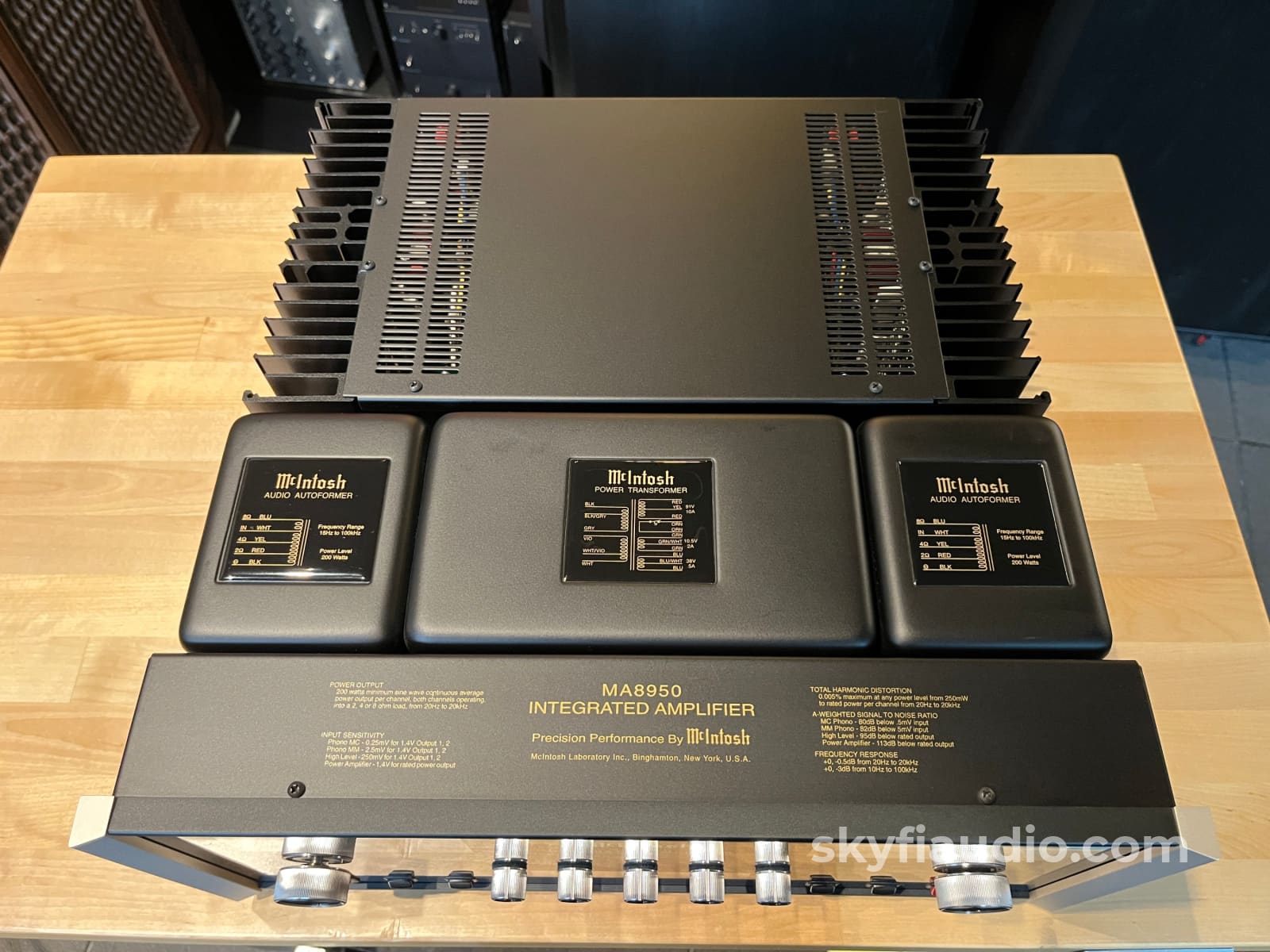
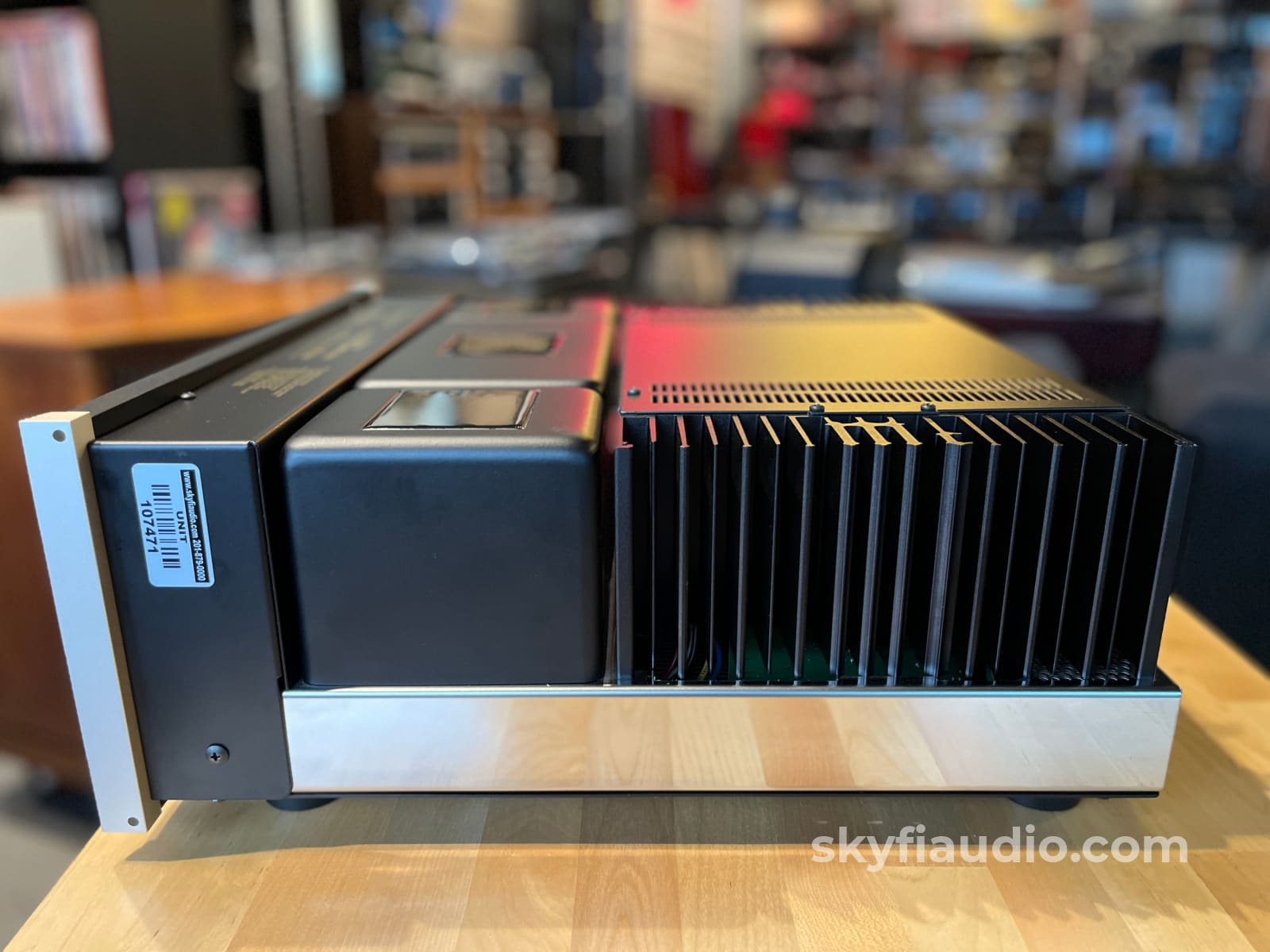
The MA8950's 200 Watts per channel are delivered by a pair of the famous McIntosh Autoformer™ and is enough power to properly drive virtually all loudspeakers. The unique design of the Autoformer guarantees your speakers will always receive the full 200 Watts regardless if they have 2, 4 or 8 Ohm impedance.
Other McIntosh features included in the MA8950 are:
• Power Guard® that continuously monitors input and output signals and can dynamically adjust input levels to ensure maximum output while avoiding harsh sounding distortion and clipping that could damage your speakers
• Our fuse-less short-circuit protection technology Sentry Monitor™ that disengages the output stage before the current can exceed safe operating levels and then resets automatically when operating conditions return to normal
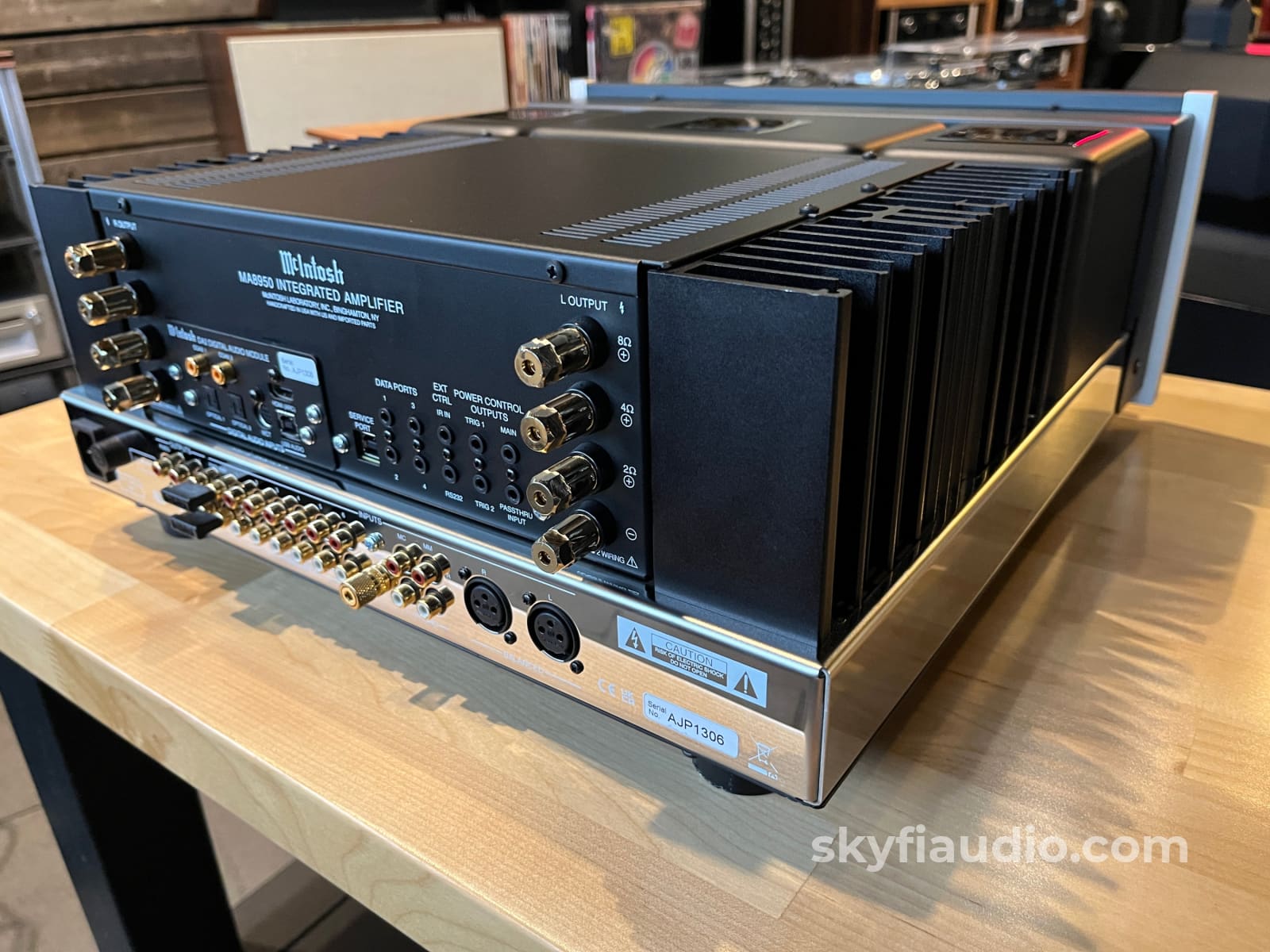
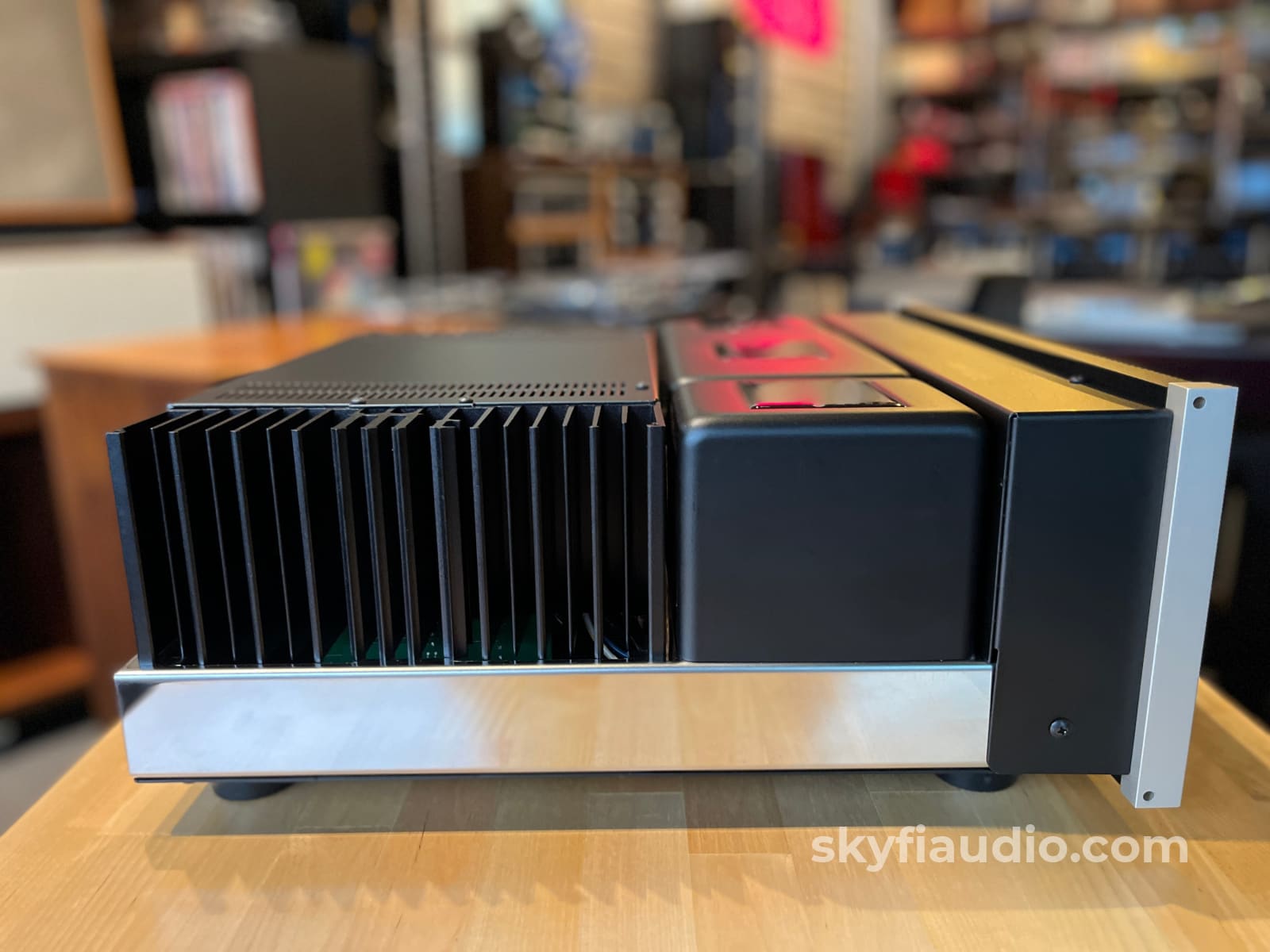
• McIntosh Monogrammed Heatsinks™ that are made from high quality materials with excellent thermal conductivity and heat dissipation properties
• Home Theater PassThru that allows for seamless integration into a home theater system
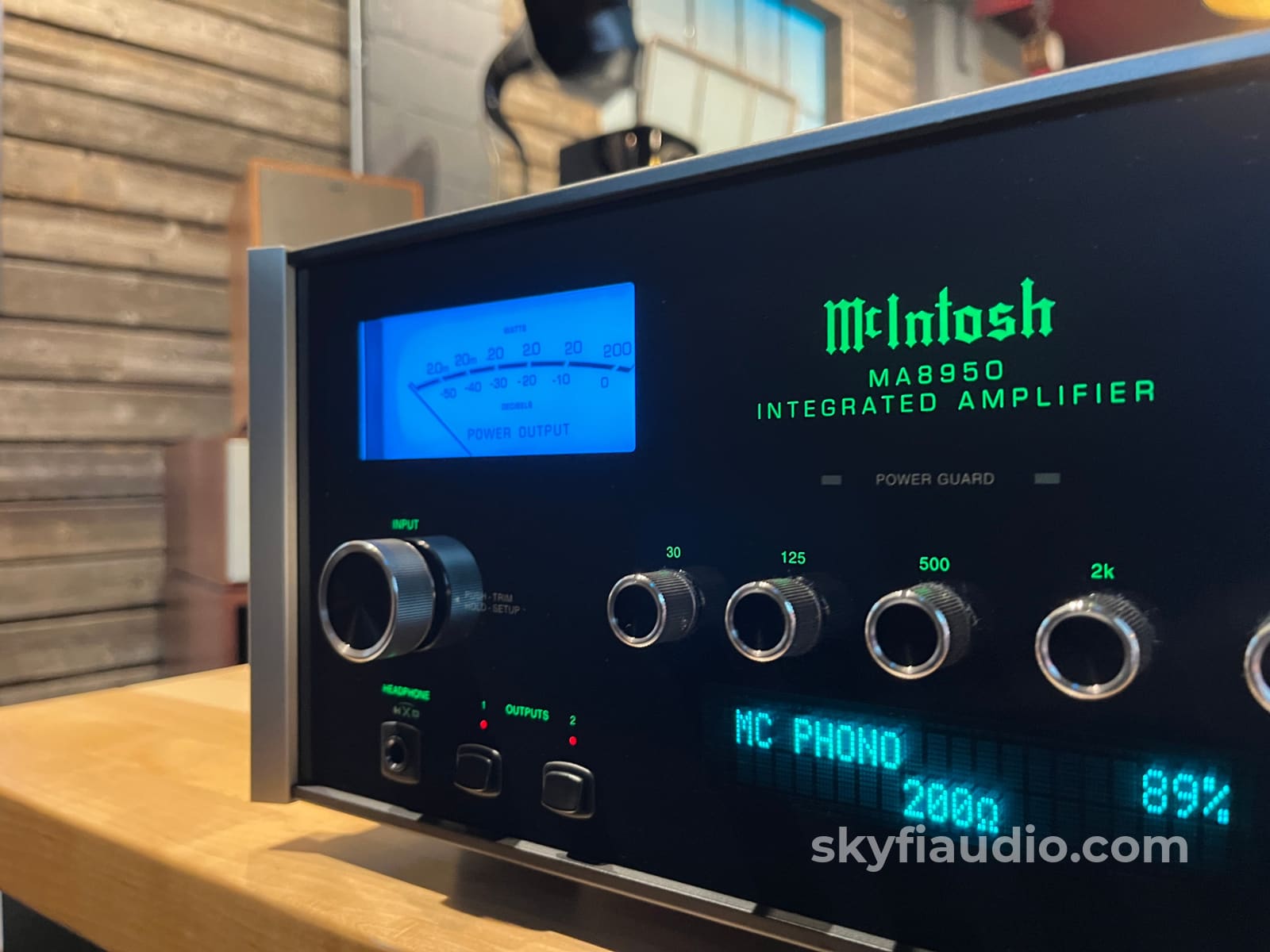
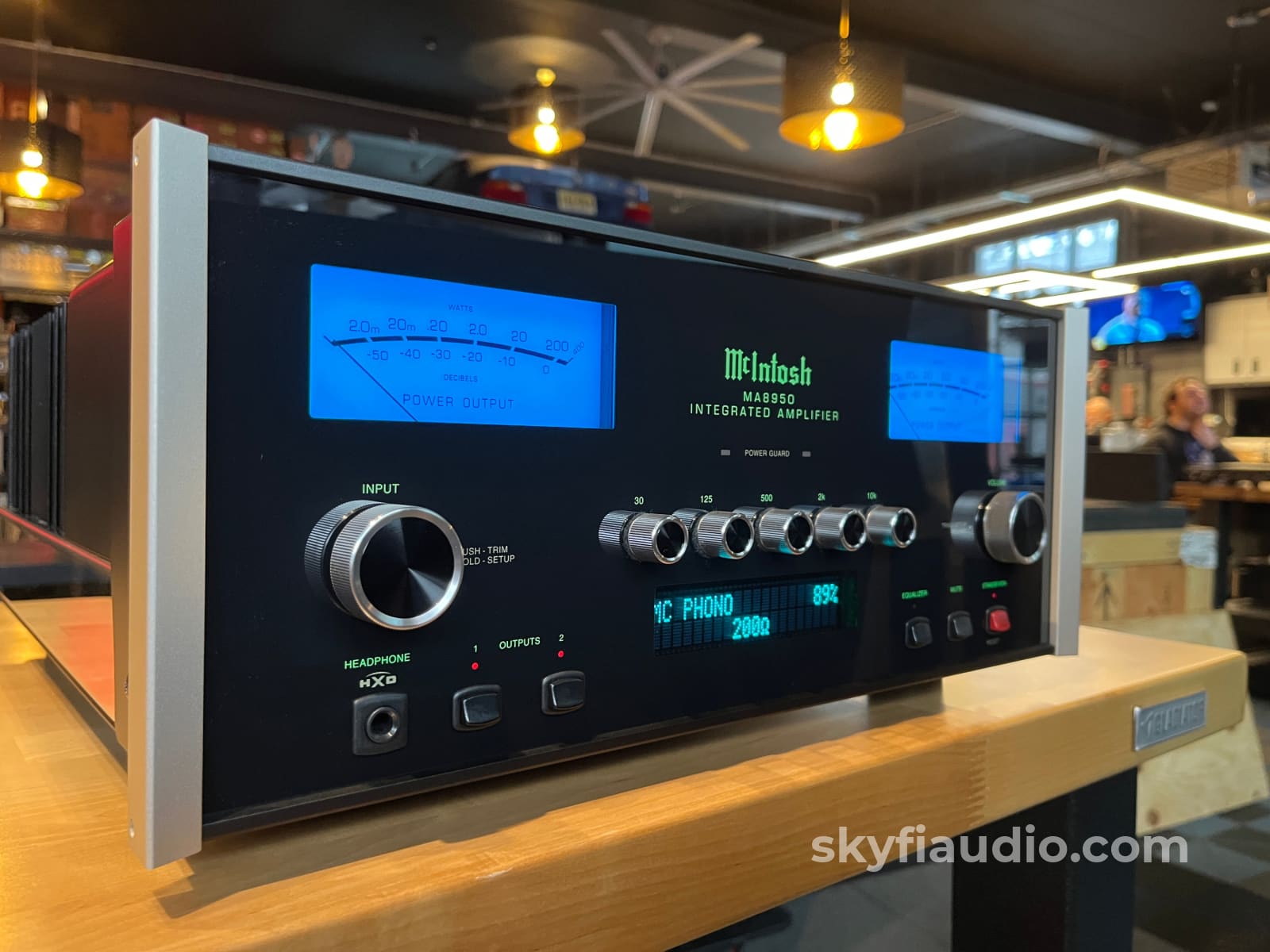
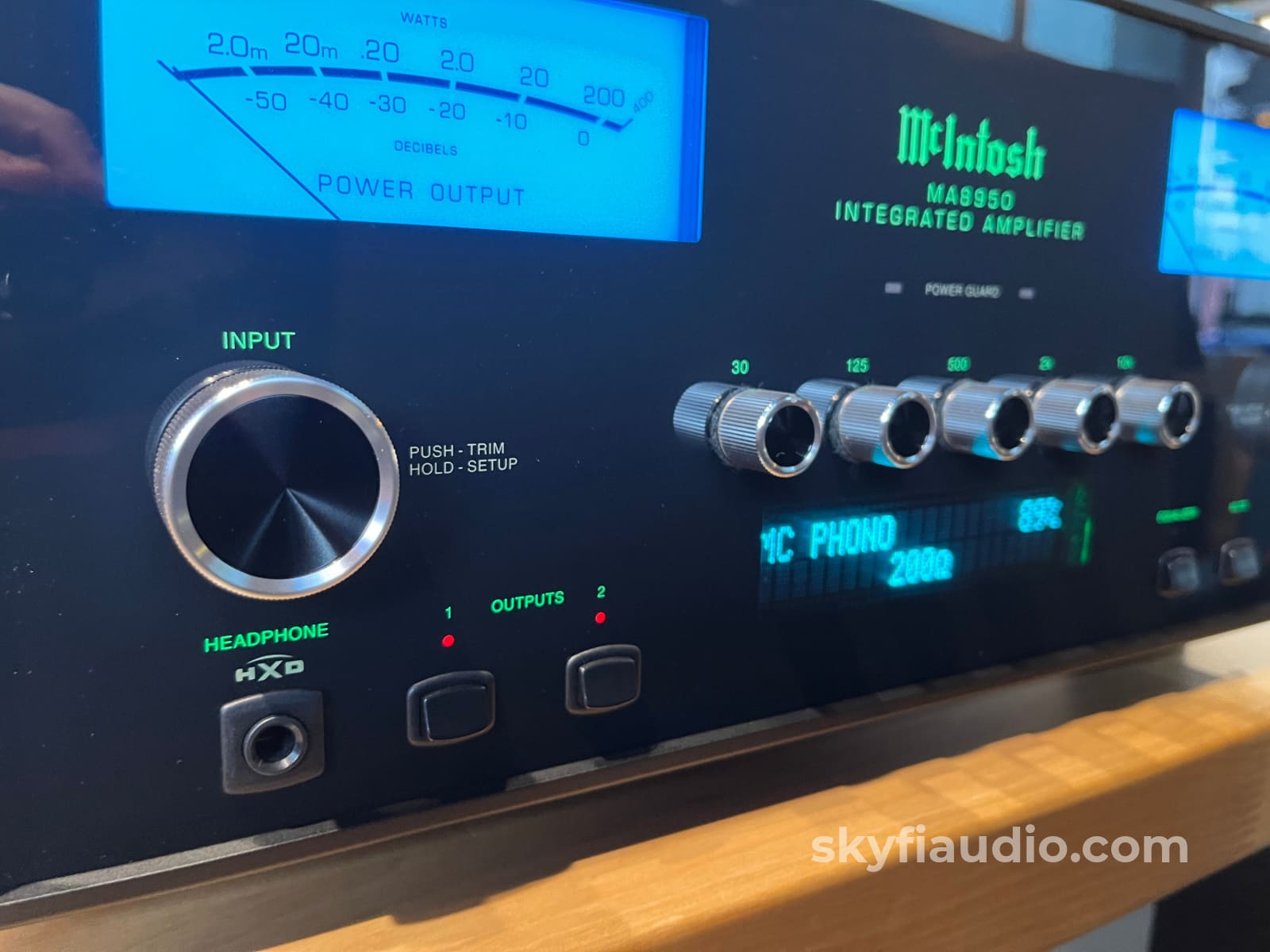
• High Drive headphone amplifier with Headphone Crossfeed Director (HXD®) which can bring an added dimension to headphone listening
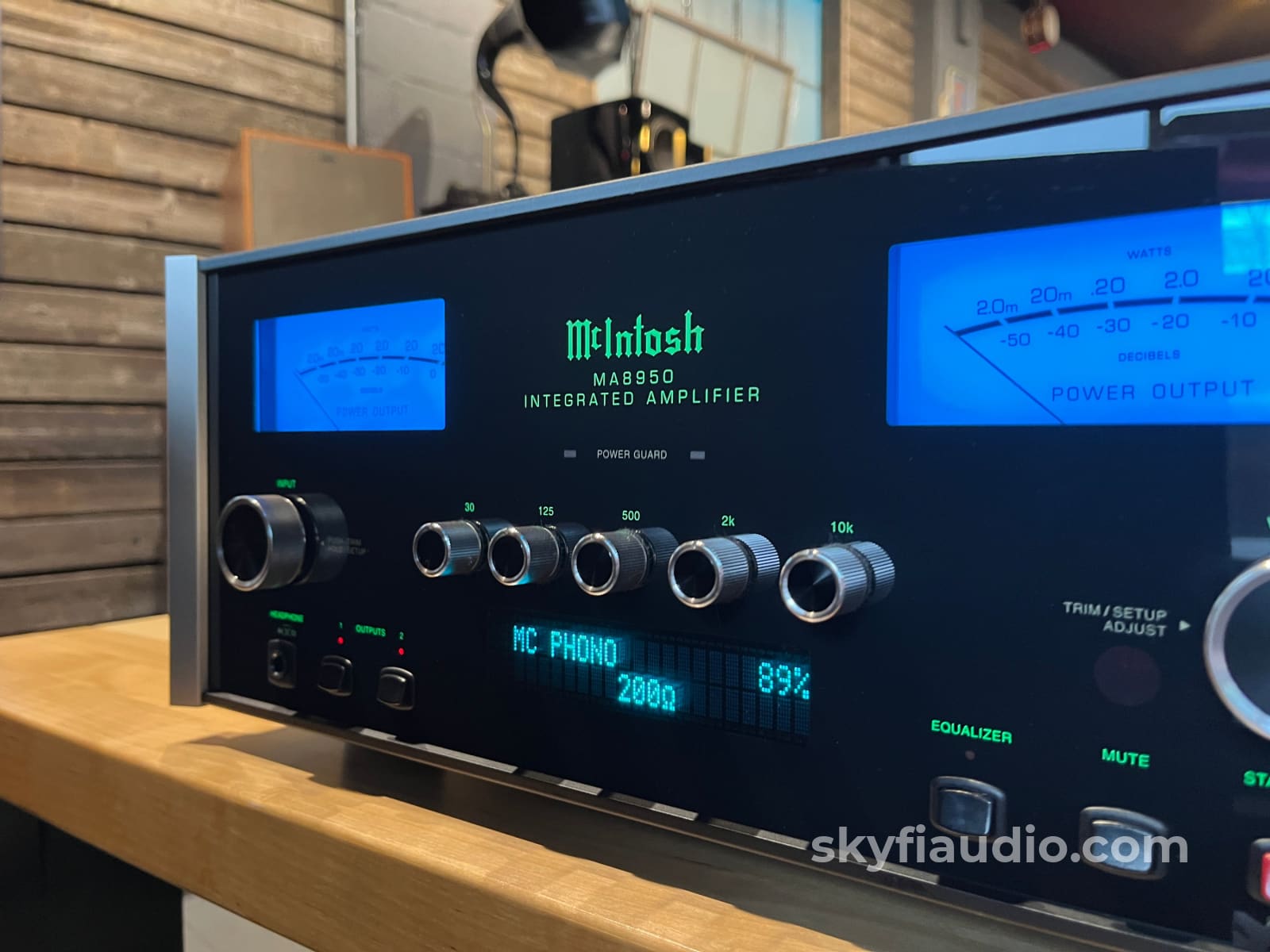
• A discrete, five-band tone control that allows for advanced manual analog adjustment of ±12dB in 2dB increments of your favorite recordings at frequencies of 30Hz, 250Hz, 500Hz, 2kHz, and 10kHz
• Power Control to send power on/off signals to connected McIntosh components for easy system power up and shutdown
• Gold-plated speaker binding posts that prevent corrosion to ensure a quality signal is sent over your speaker cables to your speakers
The MA8950 is one of many McIntosh products to receive Roon Tested designation from Roon Labs. As a Roon Tested partner, McIntosh has provided equipment to Roon for testing with a variety of different operating systems and computers, and shared information about its design and capabilities.
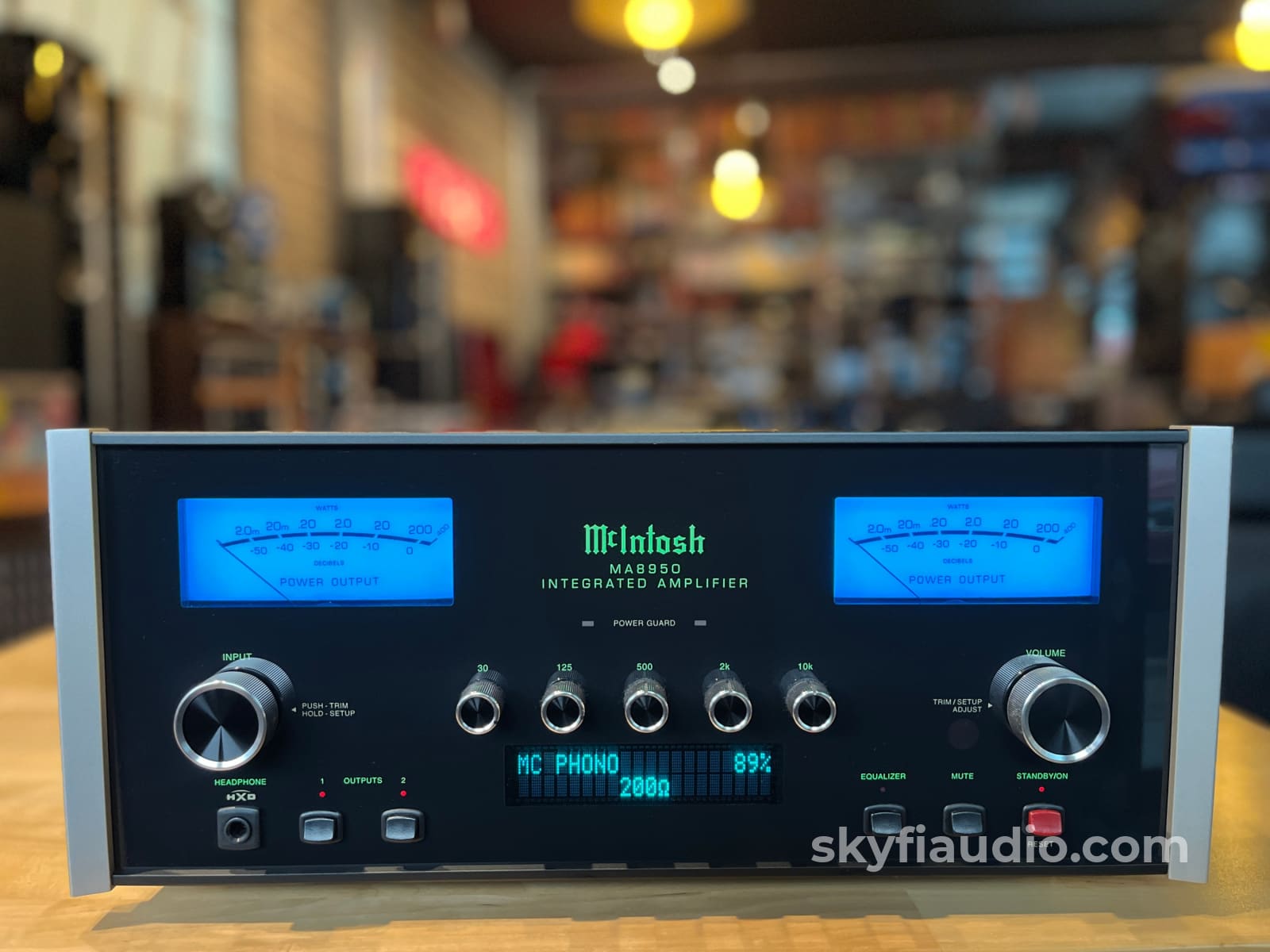
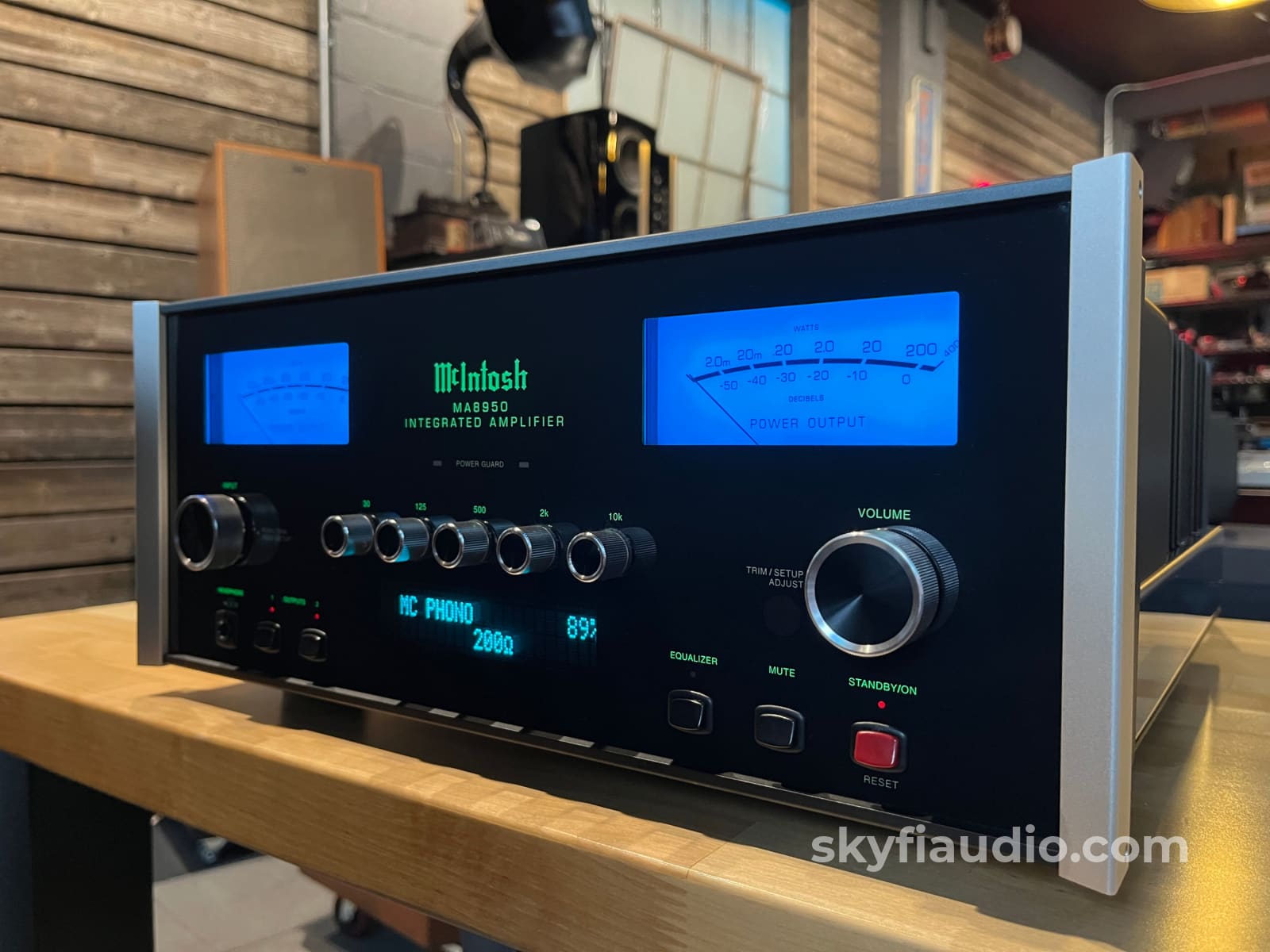
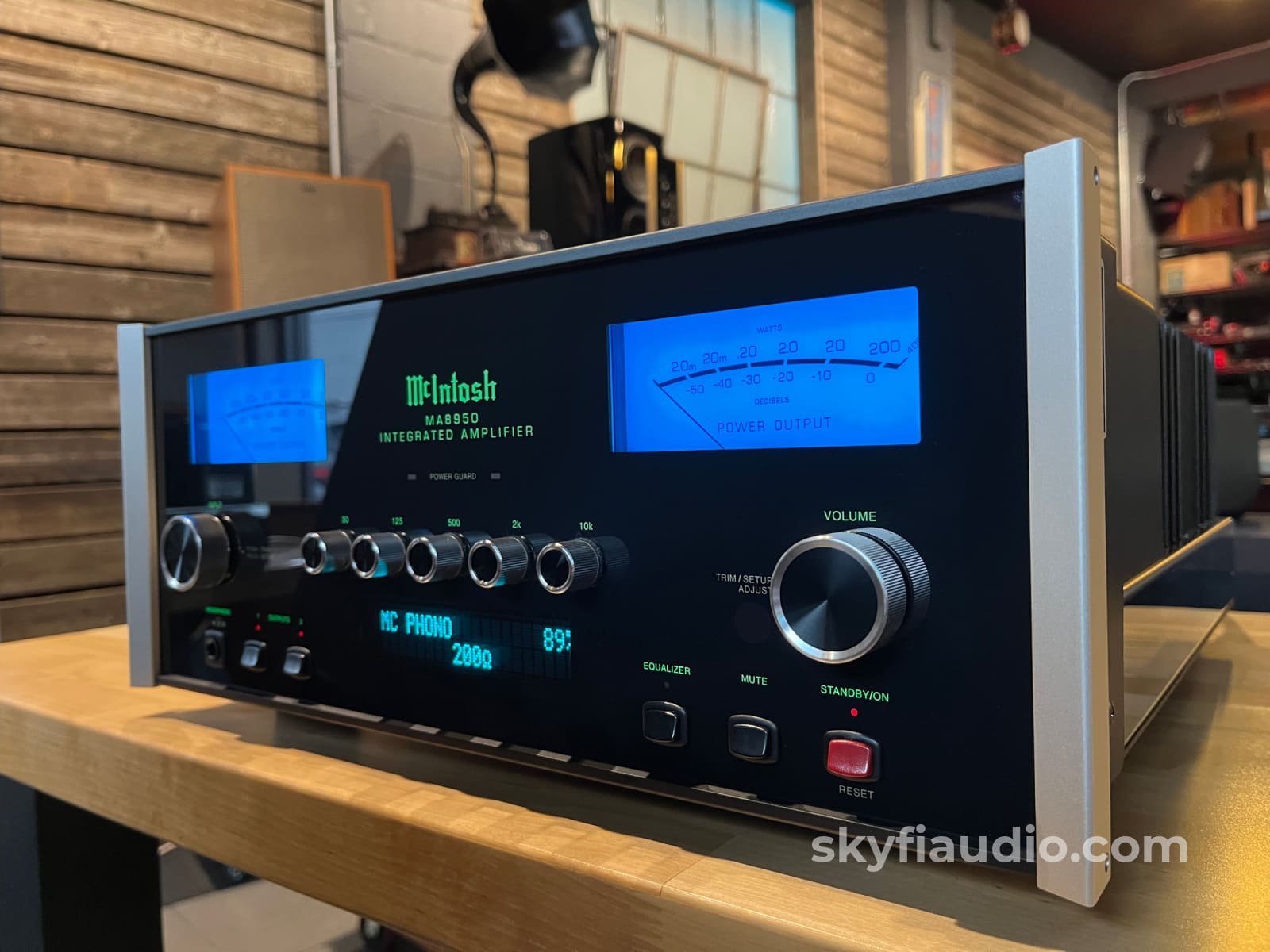
The entire unit is wrapped in the timeless McIntosh aesthetic with a black glass front panel with LED lighting, blue watt meters, control knobs, illuminated logo, aluminum end caps and a beautiful polished stainless steel chassis.
SkyFi Cosmetic Notes:
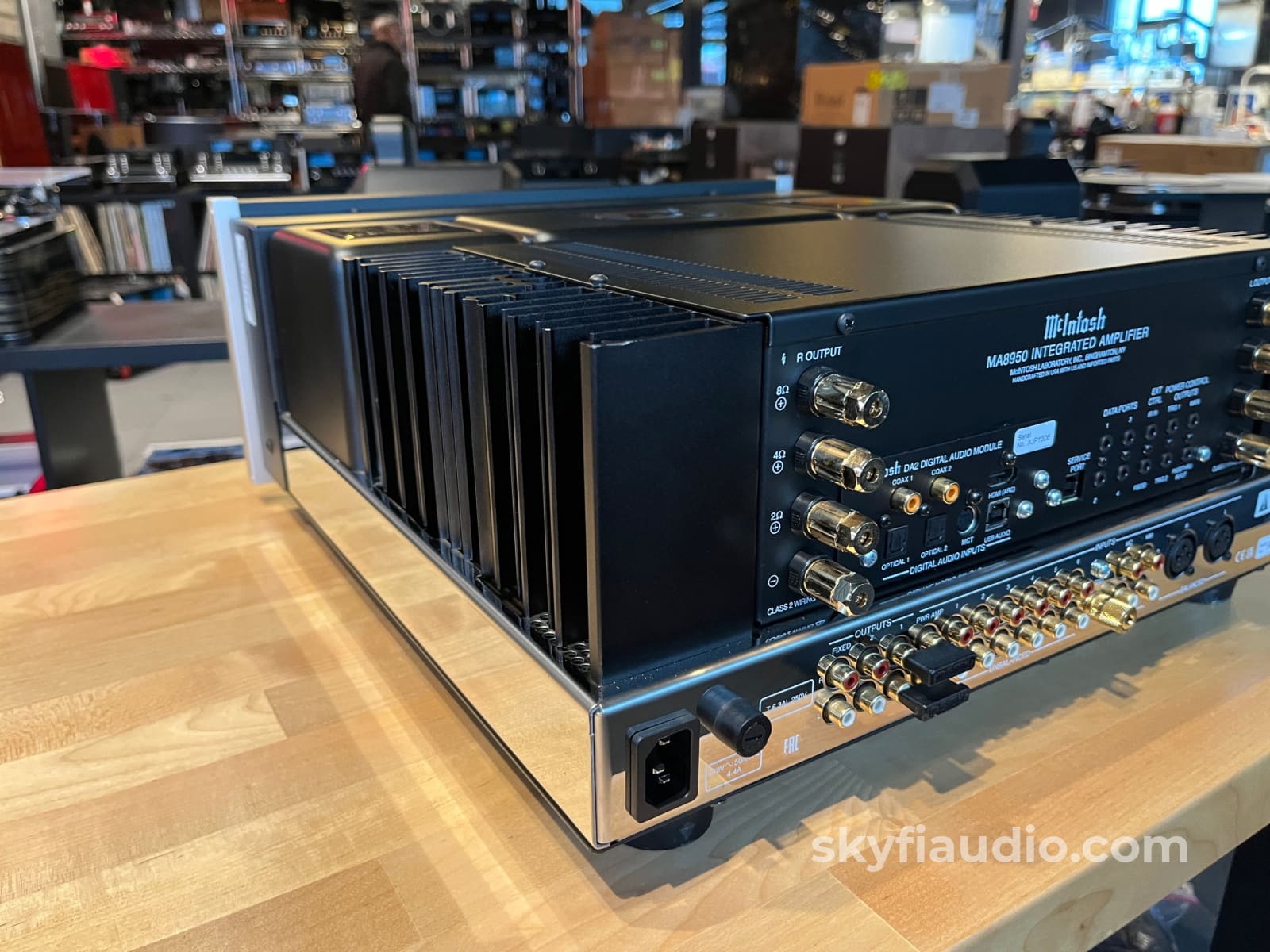
Light marks are present on the transformers and rear surfaces of the heat sinks. Overall condition is excellent.
Brand Background:
McIntosh Laboratory is an American manufacturer of handcrafted high-end audio equipment based in Binghamton, New York. The company was founded in 1949 by Frank McIntosh. The company designs and produces audio amplifiers, stereo tuners and other consumer electronics products.
Ownership:
Single Owner
Connections:
XLR, RCA, IEC Power, Power control, Speaker Binding Posts, USB, Digital,
Cosmetic Condition:
8/10 = Very Good. Excellent front faceplate, one minor flaw on chassis side or top. See our detailed rating description here.
Working Condition:
Working perfectly and tested in our lab and listening room.
Included:
Everything like when it arrived new
Packing:
Original Manufacturers Packing
Reviews:
Click Here
Specs:
ELECTRONIC SPECIFICATIONS
Power Output per Channel
200 Watts
Number of Channels
2
Speaker Impedance
2, 4, or 8 Ohms
Rated Power Band
20Hz to 20kHz
Total Harmonic Distortion
0.005%
Dynamic Headroom
3.1dB
Frequency Response +0,-0.5dB
20Hz to 20kHz
Frequency Response, +0, -3dB
10Hz to 100kHz
Sensitivity Phono (Moving Coil)
0.25mV
Sensitivity Phono (Moving Magnet)
2.5mV
Sensitivity High Level (Balanced / Unbalanced)
0.5V/0.25V
Sensitivity (Power Amp input)
1.4V
Signal To Noise Ratio (Moving Coil)
80dB
Signal To Noise Ratio (Moving Magnet)
82dB
Signal To Noise Ratio (High Level)
95dB
Signal To Noise Ratio (Power Amp input)
113dB
Input Impedance (Balanced / Unbalanced)
20K/20K
Damping Factor
\>40
Maximum Output (Balanced / Unbalanced)
8V Unbalanced
DIGITAL AUDIO SPECIFICATIONS
Digital-to-Analog Converter (DAC) Type
8-channel, 32-bit/384kHz PCM/DSD, Quad Balanced
Digital Coaxial Input Sample Rate
24-bit/44.1kHz to192kHz
Digital Optical Input Sample Rate
24-bit/44.1kHz to192kHz
Digital MCT Input Sample Rate
16-bit/44.1kHz (CD)
DSD64 (SACD)
Digital USB Input Sample Rate
32-bit/44.1kHz to 384kHz (PCM)
DSD64, DSD128, DSD256, DSD512, DXD352.8kHz, DXD384kHz
GENERAL SPECIFICATIONS
Vacuum Tube or Solid State
Solid State
Output Type
Autoformer™
Output Meters
Yes
Dual Layer Chassis
Yes
Chassis Finish
Polished stainless steel & black painted steel
McIntosh Monogrammed Heatsinks™
Yes
Power Requirement
120V 50/60Hz, 4.4 amps
Standby Power Requirement
<0.25 Watts
Dimensions:
17-1/2" (44.5cm) x 7-5/8" (19.4cm) x 18-3/4" (47.6cm)
Weight:
75 lbs.
Link to Manual:
Click Here
Recommended Cables:
Kimber Kable - RCA Interconnects - Better
Kimber Kable - RCA Interconnects - Best
Kimber Kable - Phono Interconnects
Kimber Kable - BALANCED XLR Connectors - Better
Kimber Kable - BALANCED XLR Connectors - Best
Kimber Kable - Speaker Cables - Better
Kimber Summit Series Monocle XL Speaker Cables (PAIR) - Best
Kimber Summit Series BiFocal XL Bi-Wire Speaker Cables (PAIR) - Best If Applicable
Kimber Kable - Power Cords - Better
Kimber Kable - Power Cords - Best
Kimber Kable - Coaxial Digital Interconnect
Kimber Kable - Optical Digital Interconnect
Kimber Kable - Select Series Reference USB Cable
Testing Process:
We start with a visual inspection of all internal components to make sure that there are no signs of heat stress or damage. Capacitors are checked for telltale signs of predictive failure including bulging, shrunken wrappers, or physical leakage. We also inspect the PCBs for discoloration from resistors or transistors that may have been running hot. On vintage units we often spot check select capacitors for value and ESR.
If the device has the ability to decouple the preamplifier from the power amplifier, we remove the jumpers and independently test each section. If the device cannot be decoupled, we assess the electronic condition of the piece by analyzing the speaker level output only.
We start by connecting the "Pre-Out" jacks of the integrated to a Sencore PA81 Power Analyzer which simulates real world loading conditions and gives us an oscilloscope interface. The first order of business is checking that the volume control works smoothly throughout its entire range with acceptable channel balance. This is accomplished by feeding a 1 KHz sine wave into one of the preamp’s line level inputs while monitoring the preamp’s output on an oscilloscope.
We then switch to a 1 KHz square wave to test the tone controls, loudness function, and filters where applicable. During this step we are watching for equal alteration of the test signal by both channels. This also helps us identify dirty controls that will need treatment.
Once the basic line stage functions are verified, we test each input individually. This is especially important for devices that use relays to select their sources.
If the preamp section is equipped with a phono stage we test that as well. We use an inverse RIAA filter which allows us to feed a reference test signal into the phono input with the proper RIAA equalization and level. A square wave or sine sweep is used to verify that the device’s phono stage is faithfully reproducing the RIAA curve.
Next we test the power amplifier section by connecting the integrated amplifier speaker outputs to a Sencore PA81 Power Analyzer which acts as a dummy load, DC offset monitor, and oscilloscope interface. We start with a low level 1 KHz test signal at the "Main In” jacks and slowly increase its amplitude while monitoring the output on an oscilloscope for signs of noise, clipping, distortion, or improper channel balance. We continue increasing the signal level until the amplifier reaches clipping.
At this point we take an output power measurement and compare it to the spec sheet of the amplifier to verify proper performance. We finish off the bench evaluation with a 1 KHz square wave check and a 20 Hz to 20 KHz sine sweep to assess the amplifier’s frequency response characteristics.
This battery of tests will usually reveal if the amplifier has any issues that need further attention.
If the preamp and power amp both pass these tests, we reconnect the sections and verify that the preamp section can drive the power amp to rated power with a 1KHz tone on one of the line level inputs.
Before the device leaves the bench, we perform a listening test with actual music using a variety of preferred test tracks. Our benches are outfitted with familiar monitor speakers which help us identify inconsistencies that will not always show up on our test gear. The main things that we are listening for are hum or noise with no signal present, proper center image, clicks, pops, or any other obvious undesirable audio characteristics.
If the unit passes all of these tests it moves to our long term testing rig where we simulate real word operating conditions for 6-8 hours minimum. This allows us to monitor the unit for signs of thermal runaway or intermittent issues that only crop up when the unit has fully come up to temperature.
We start with a visual inspection of all internal components to make sure that there are no signs of heat stress or damage. Capacitors are checked for telltale signs of predictive failure including bulging, shrunken wrappers, or physical leakage. We also inspect the PCBs for discoloration from resistors or transistors that may have been running hot. On vintage units we often spot check select capacitors for value and ESR.
If the device has the ability to decouple the preamplifier from the power amplifier, we remove the jumpers and independently test each section. If the device cannot be decoupled, we assess the electronic condition of the piece by analyzing the speaker level output only.
Choose options