
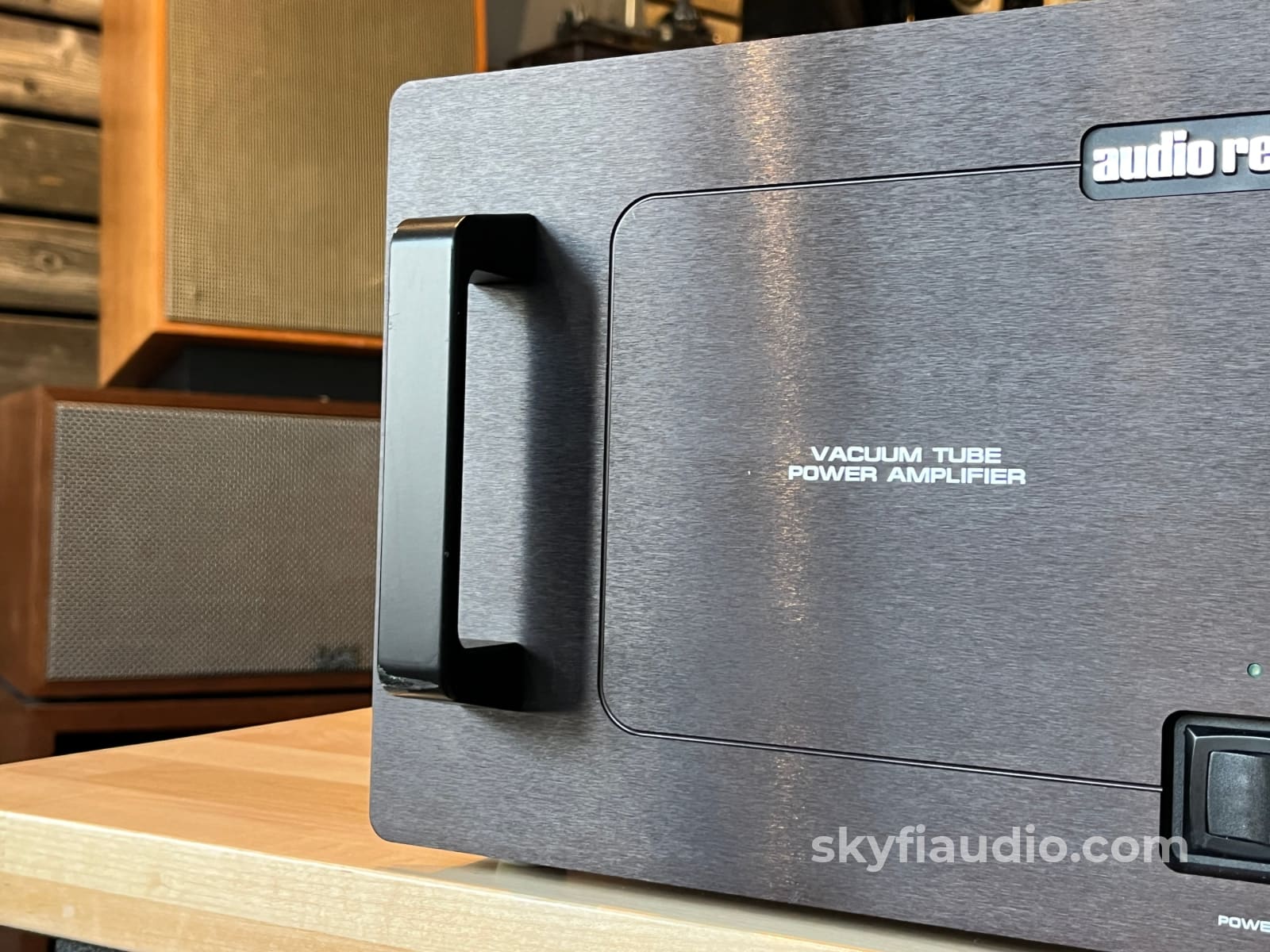
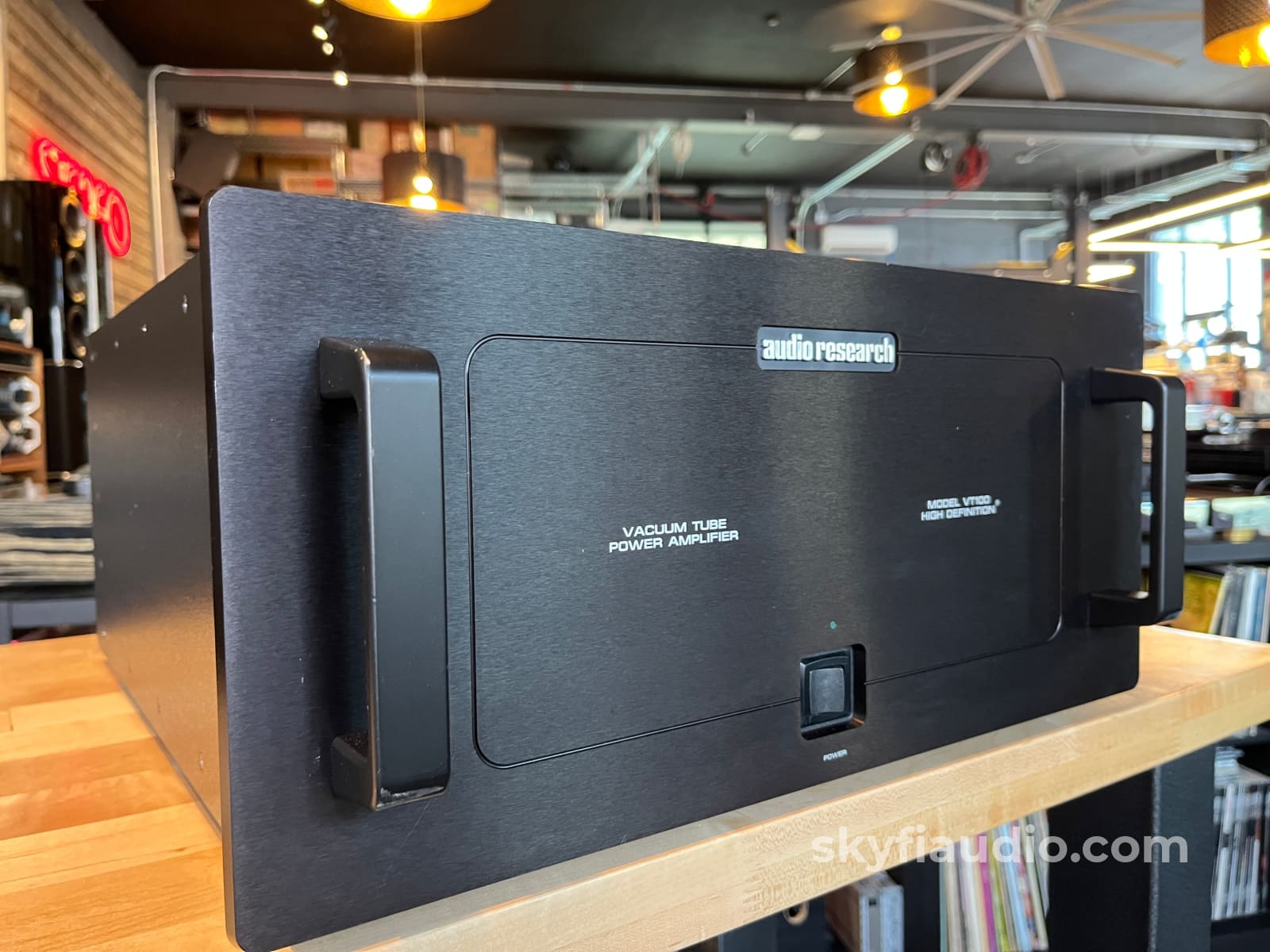
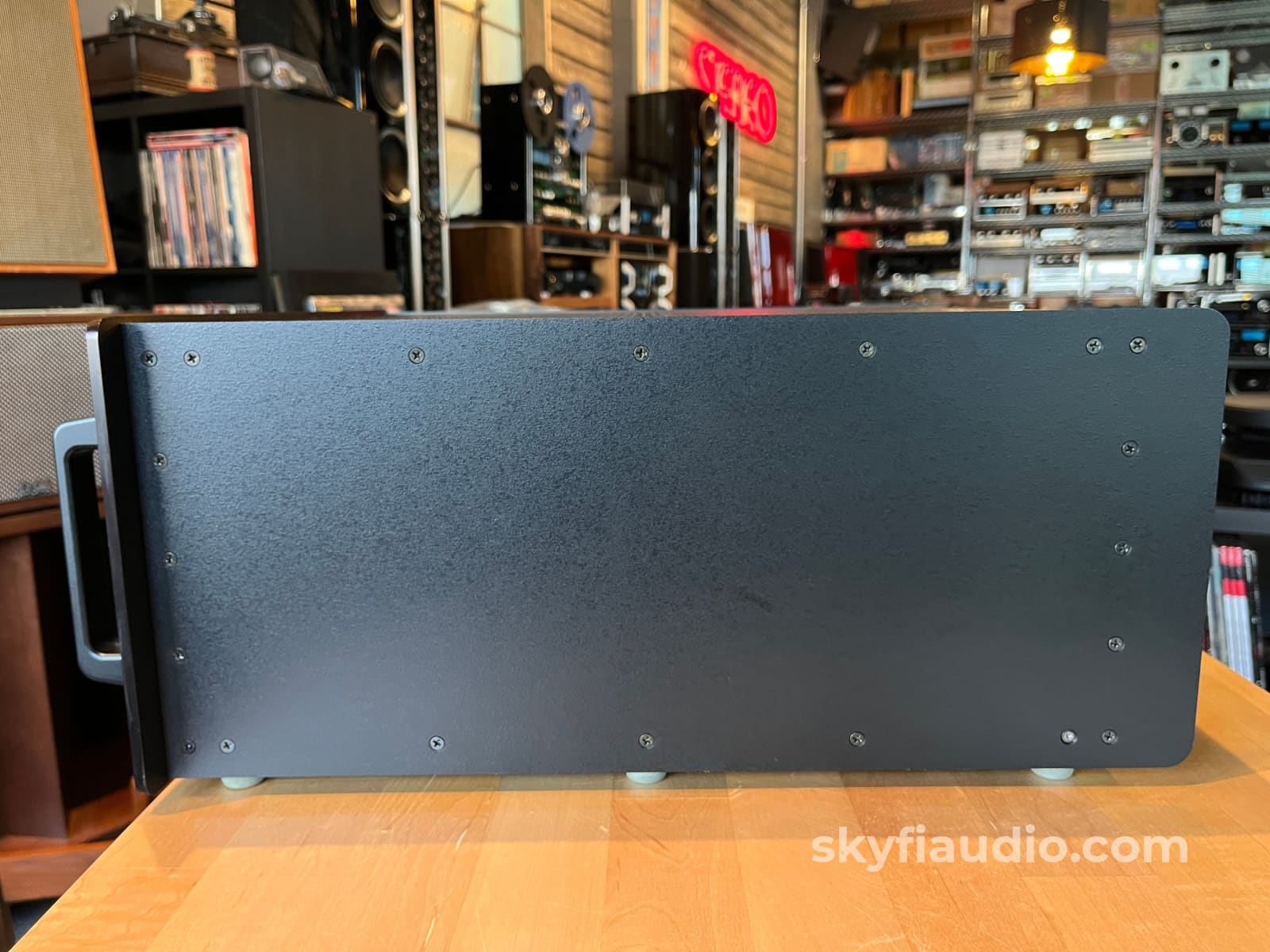
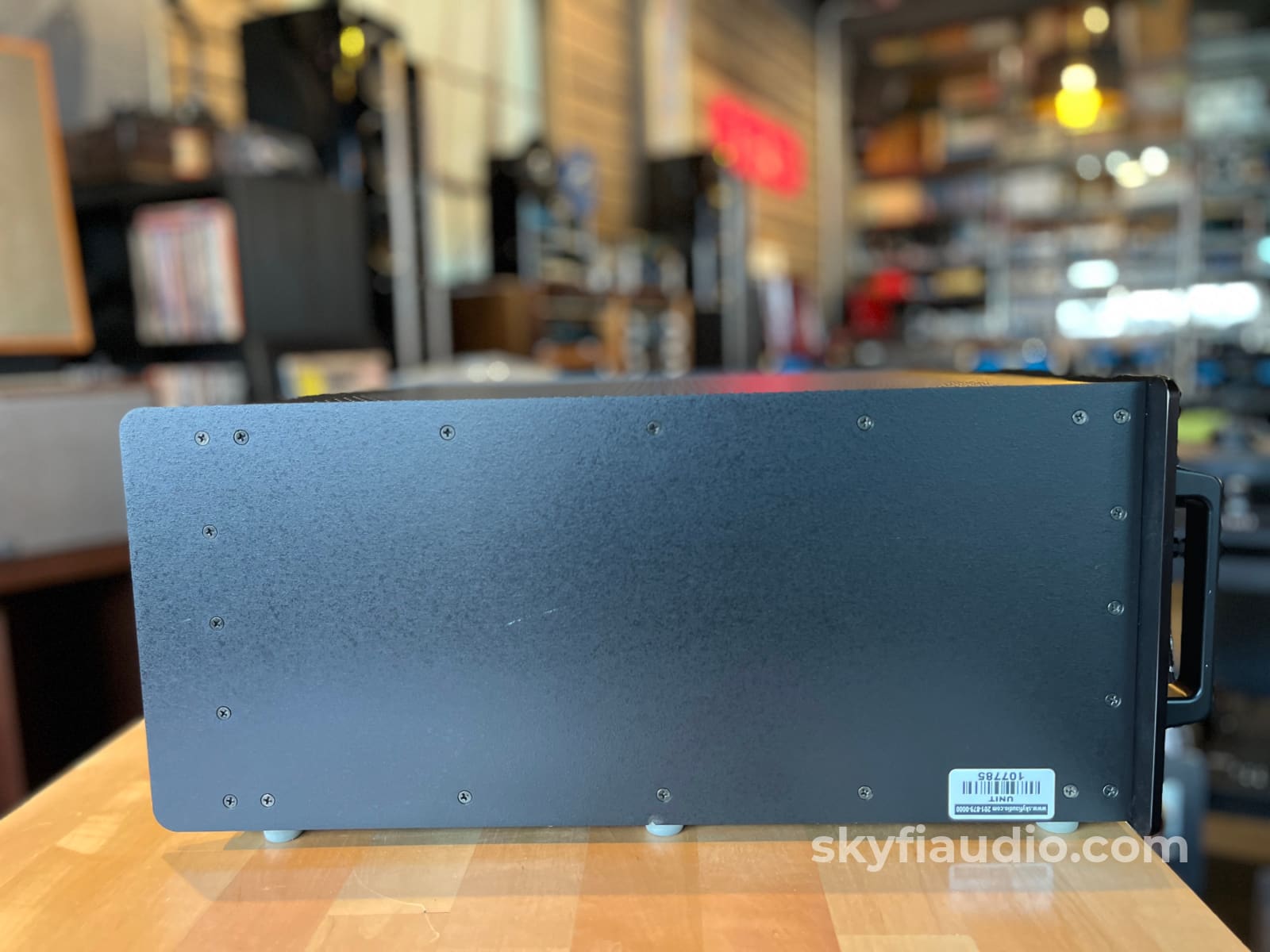
Audio Research VT100 MKII Tube Amplifier - Serviced + New Tubes
Free Shipping (Contiguous U.S. Only)
Pickup currently unavailable at SkyFi 479
Audio Research VT100 MKII Tube Amplifier - Serviced + New Tubes
SkyFi 479
479 South Broad Street
Glen Rock NJ 07452
United States
General:
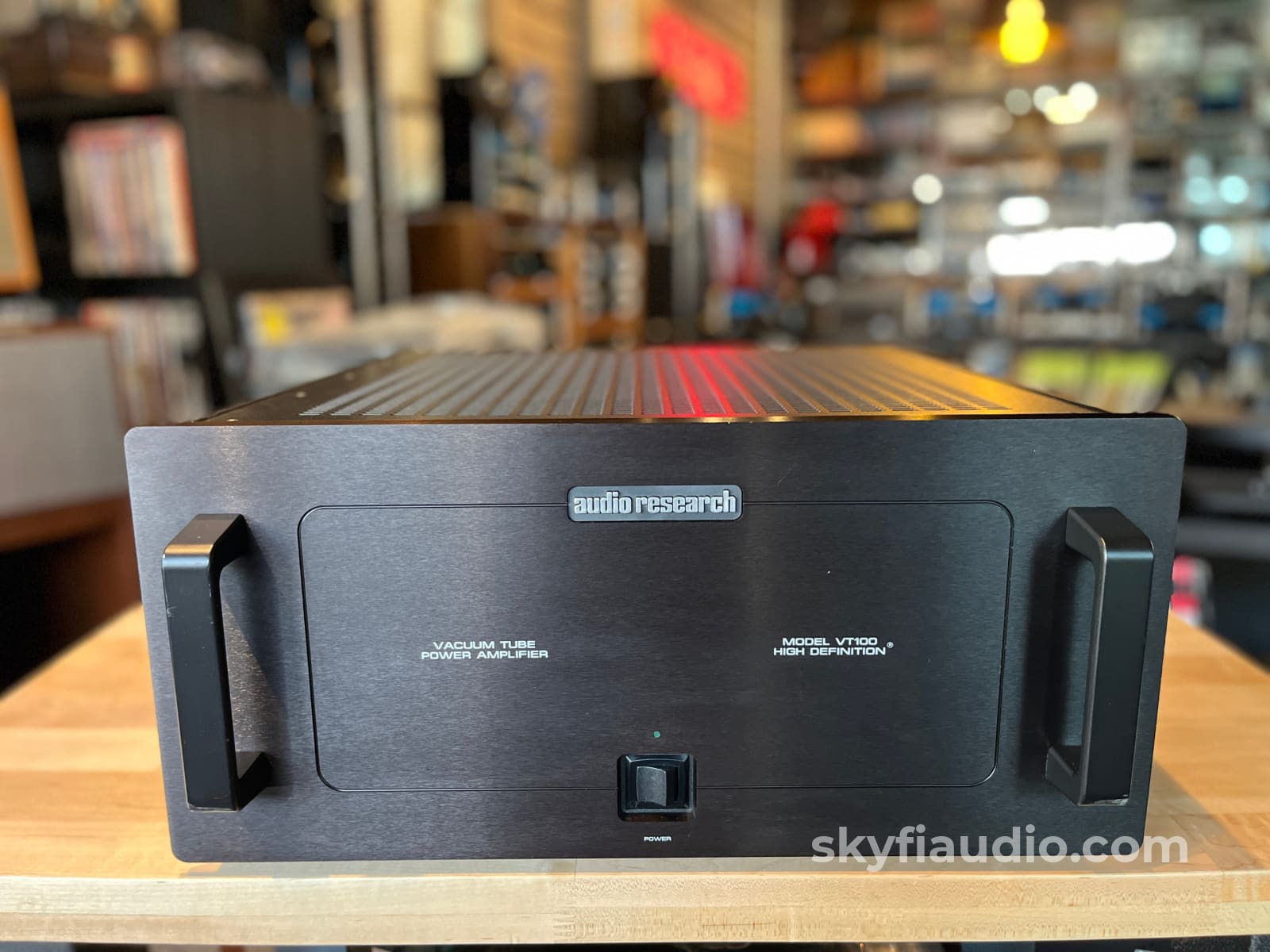
The Audio Research VT100 is a classic all-tube power amplifier. Whenever we get one of these in the shop, we're always impressed by its sound. It is also incredibly powerful for an all-tube design, rated at 100 watts into an 8-ohm load.
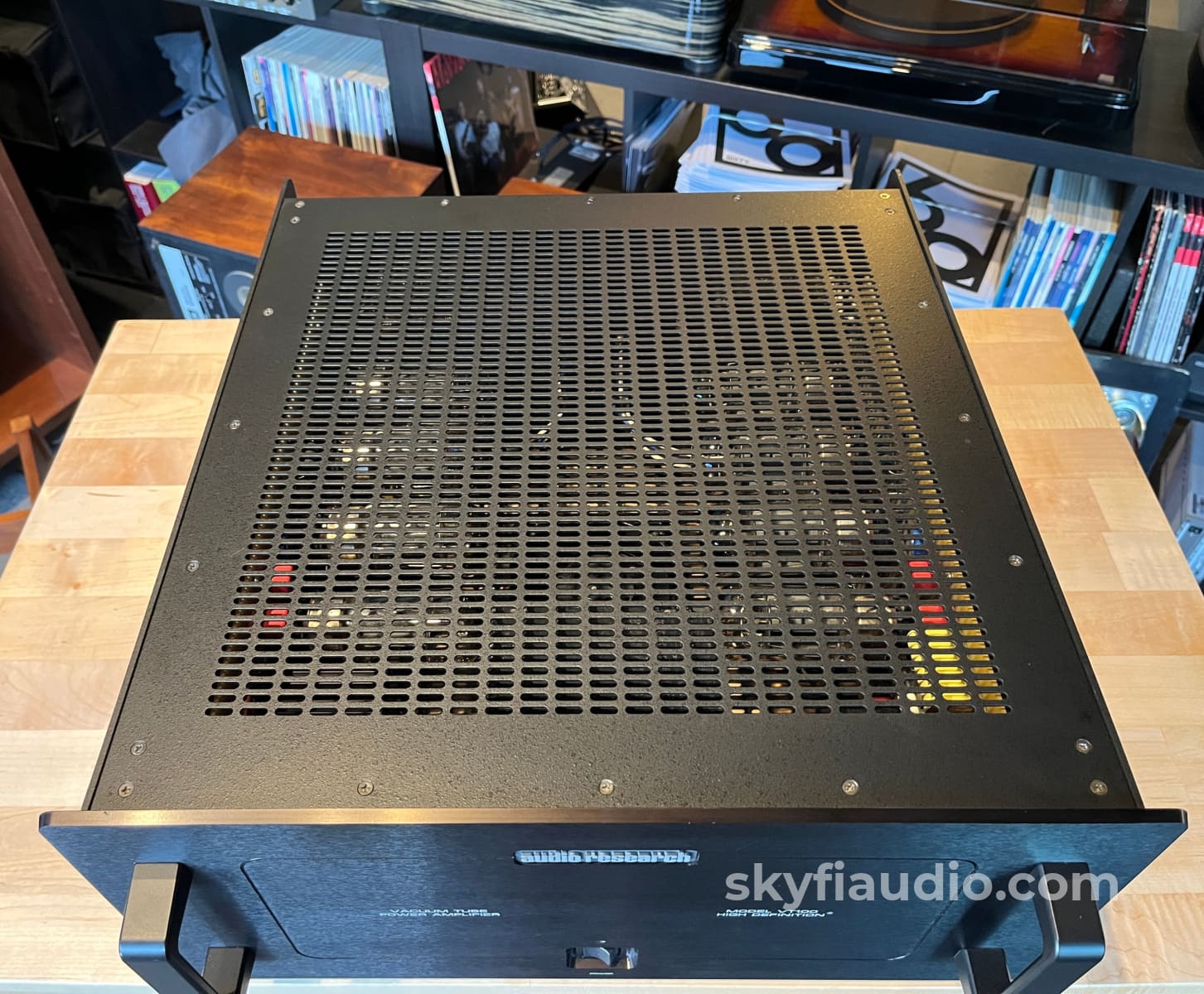
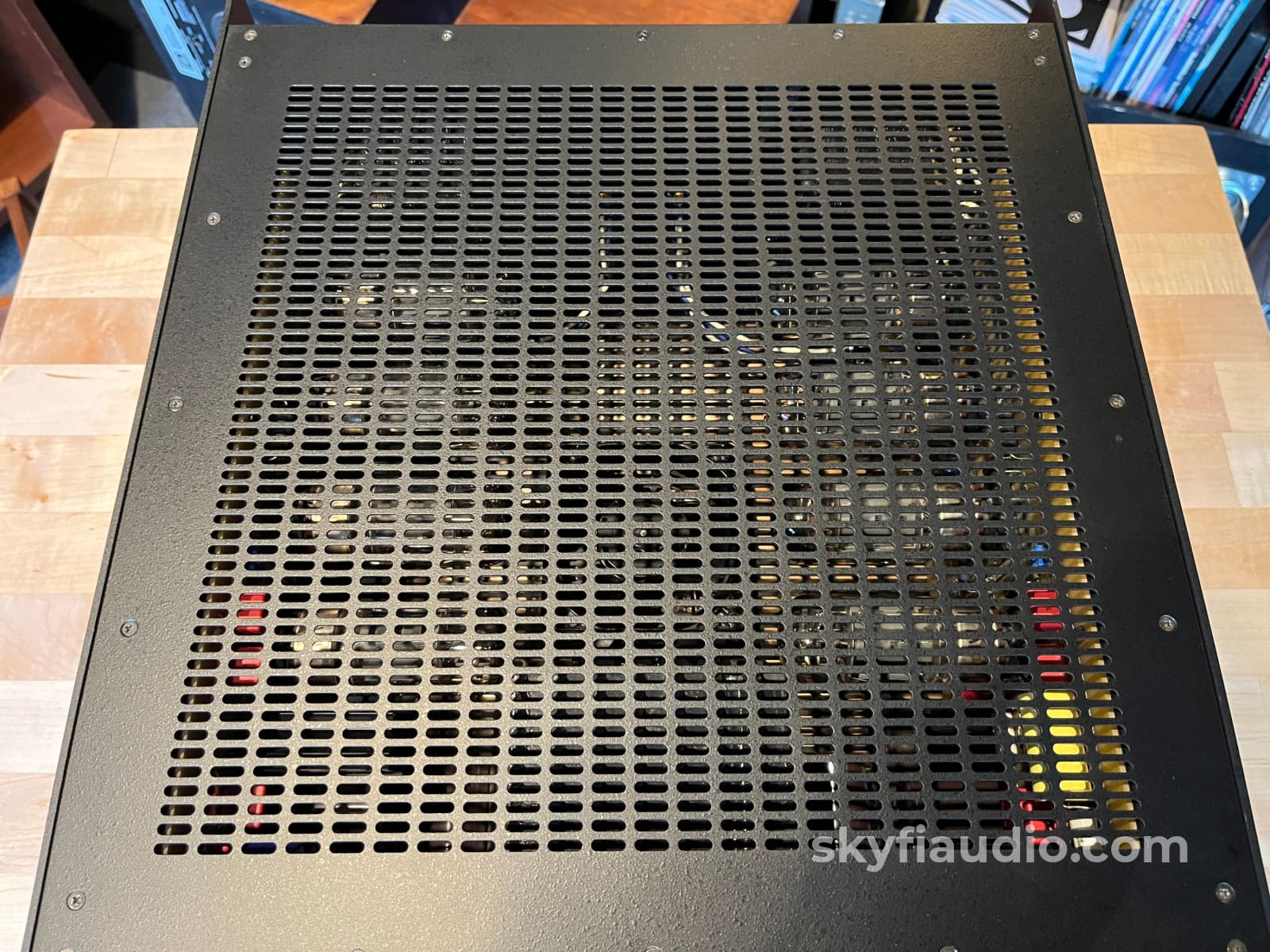
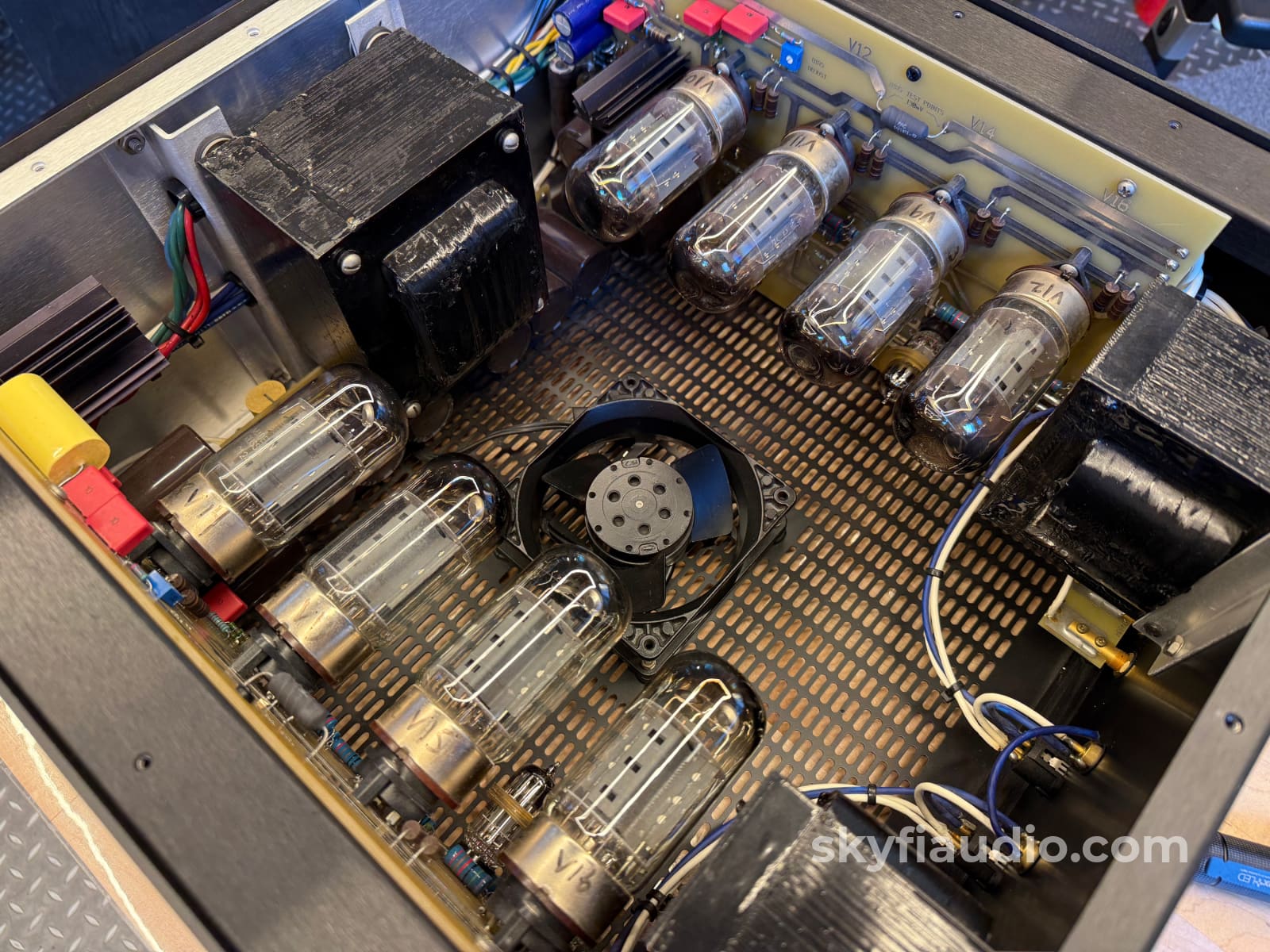
The VT100 is powered by 12 vacuum tubes: eight 6922 tubes in the driver section and four 6550 output tubes. This amplifier has been biased and aligned with a new set of Electro-Harmonix 6922 tubes and a strong matched set of Svetlana Winged C 6550 output tubes. It is sounding beautiful.
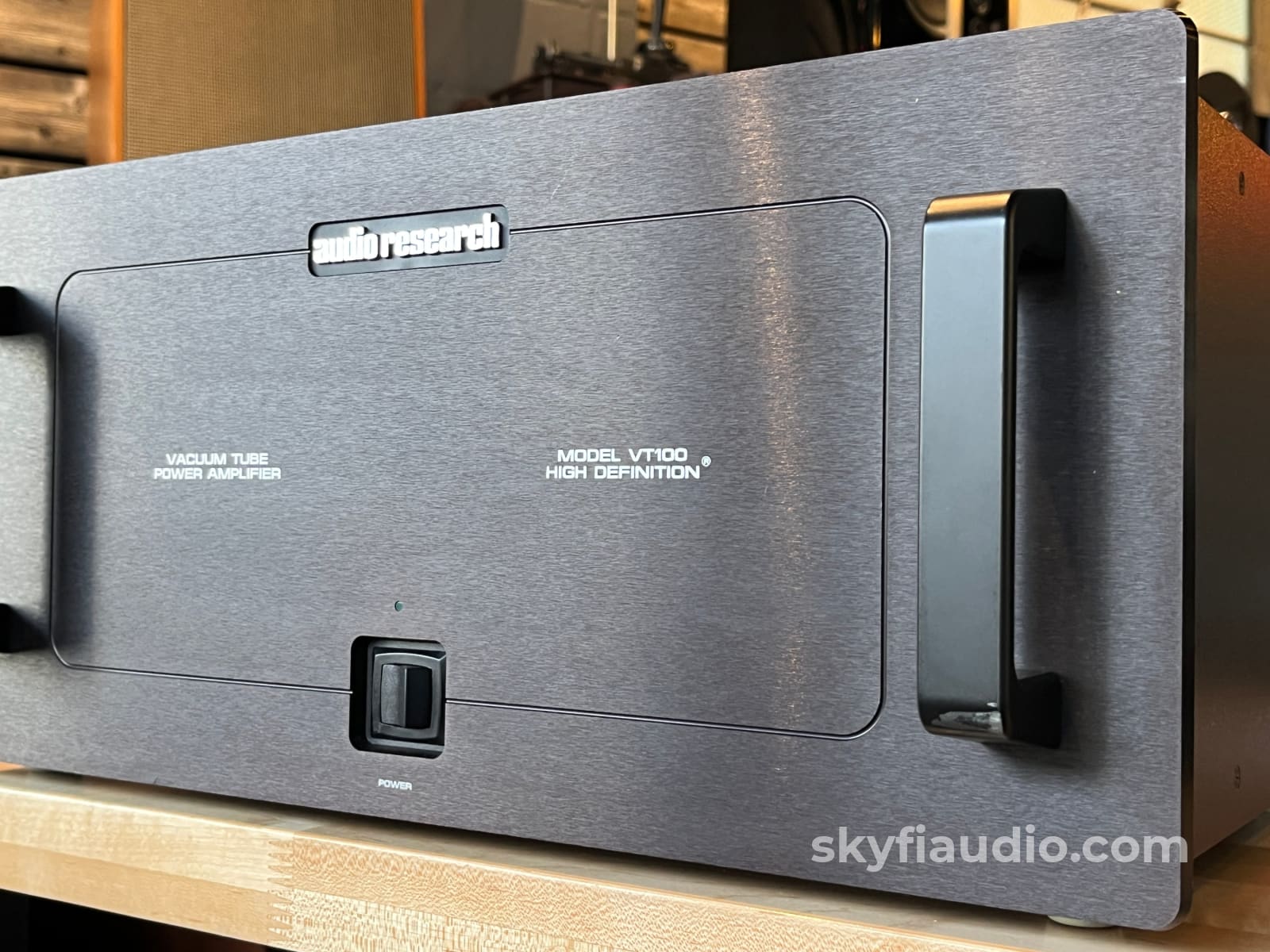
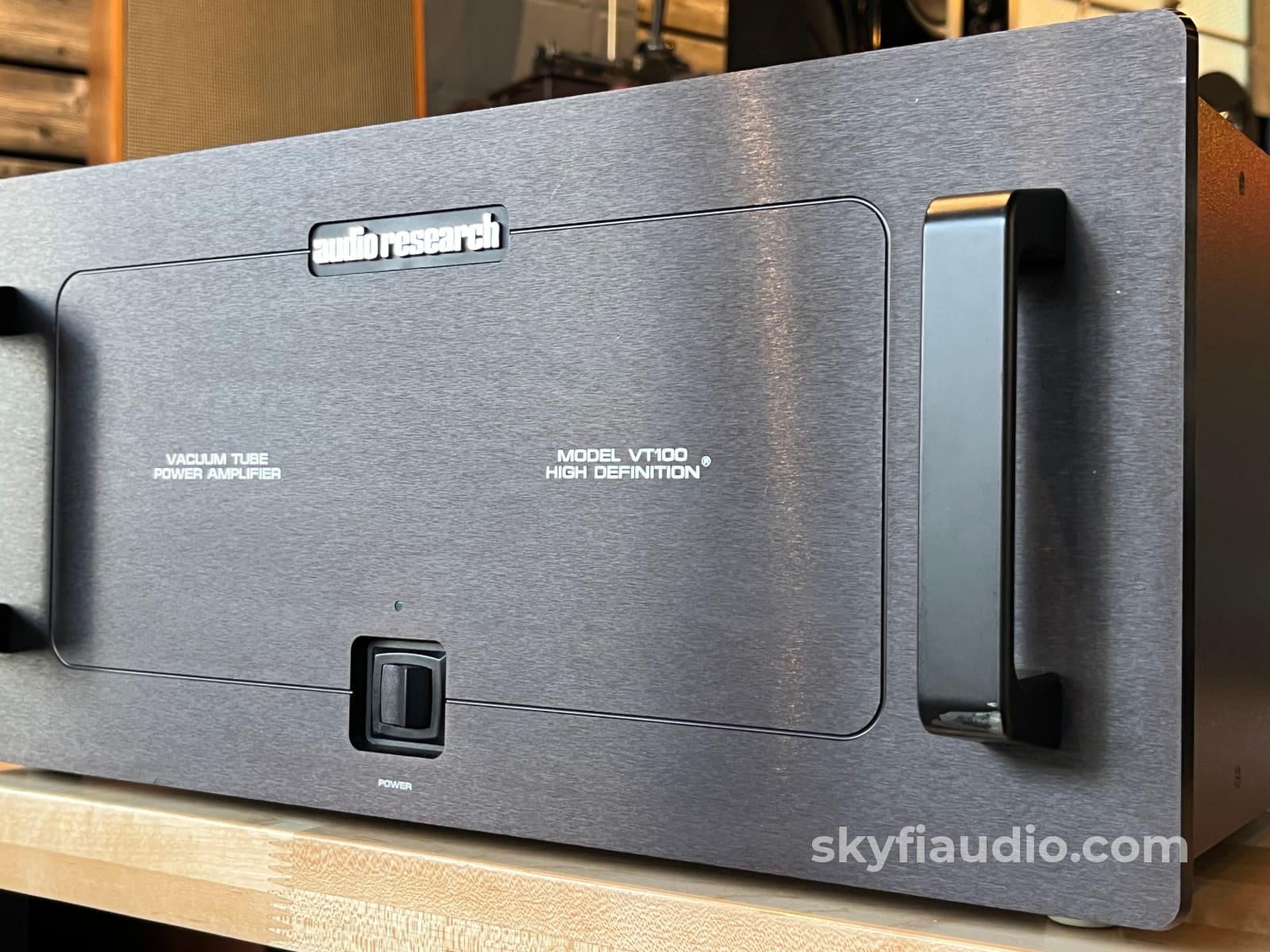
This particular VT100 is the Mk II version, which features multiple upgrades, including a larger power supply and active cooling. It is also finished in the much harder-to-find black finish.
All VT100 amplifiers can be converted to native 220V operation if you have the necessary knowledge. Please let us know when ordering if you'd like it reconfigured.
The amplifier is in good condition, with some scratches and signs of normal use. It has been serviced, biased, and is ready to go.
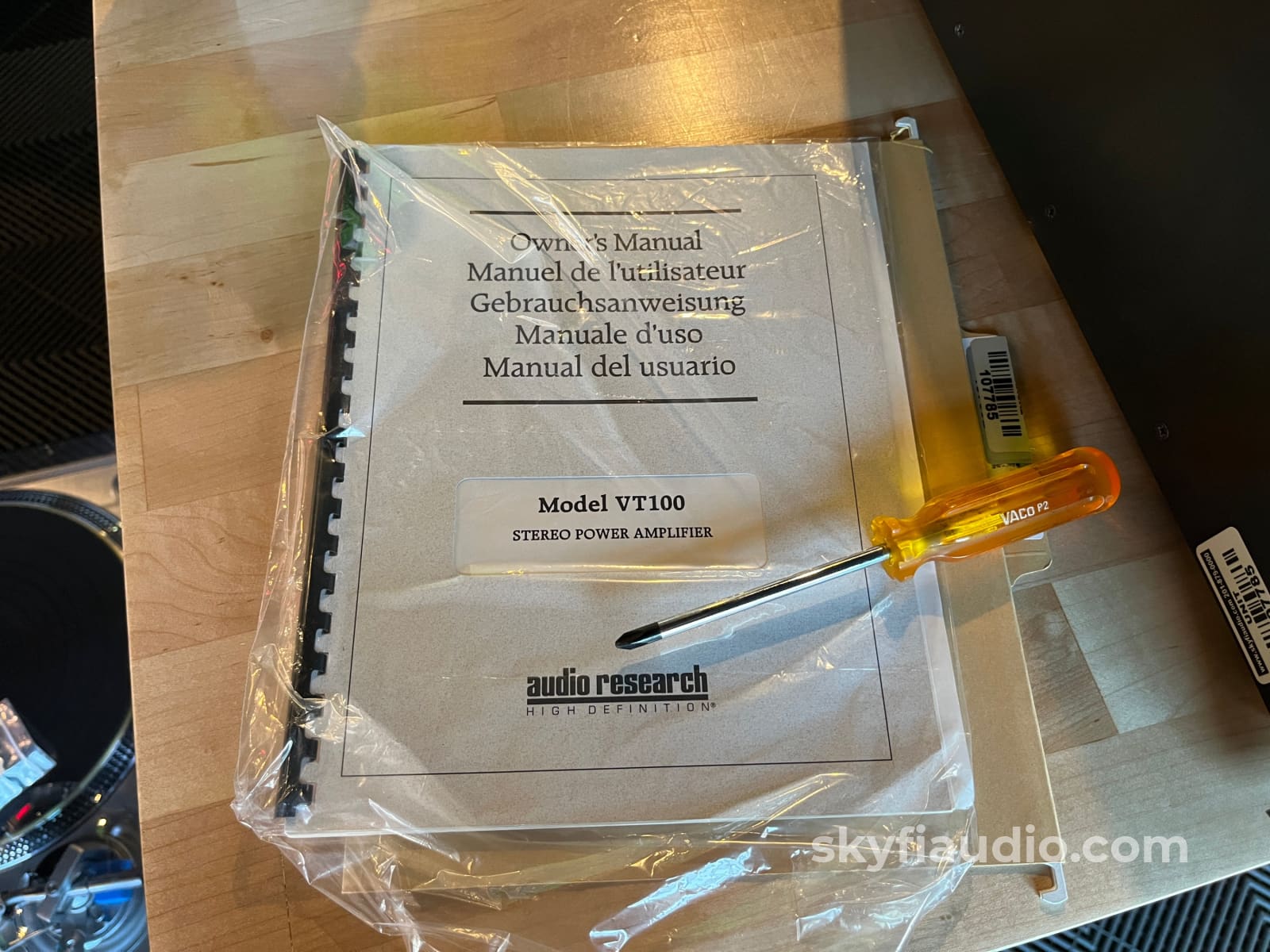
Included with the amplifier are the original box, screwdriver, and owner's manual.
SkyFi Cosmetic Notes:
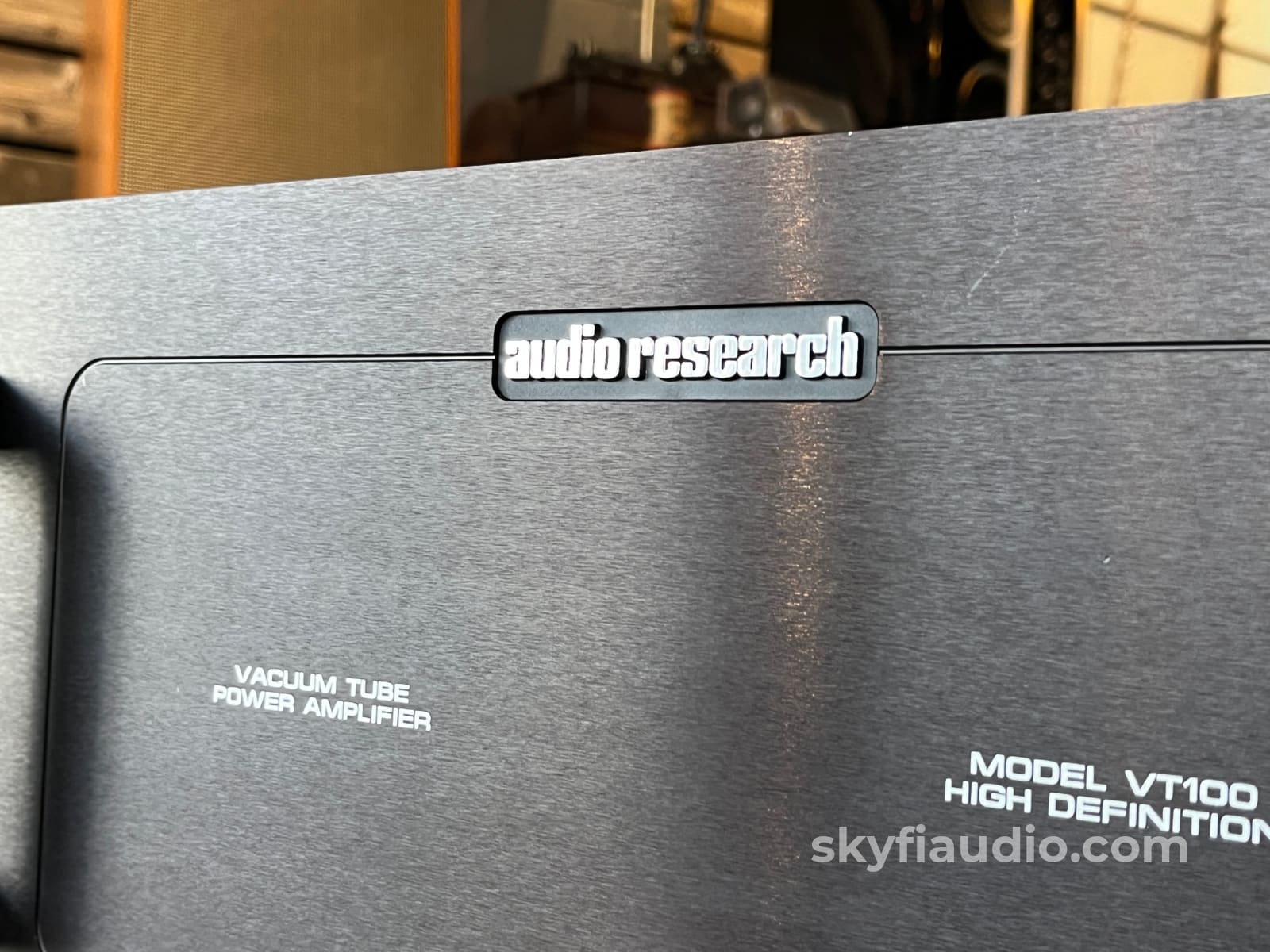
This amplifier is in great condition with just some light blemishes on the faceplate. NOTE: The including packaging has a bit of a musty odor but otherwise intact.
SkyFi Technical Notes:
This is the MKII version of this amp, featuring fan cooling. We also confirmed that a resistor change service bulletin for reducing current in the driver stage had already been implemented. This unit was serviced in house here at SkyFi. We fitted a brand new set of selected Electro Harmonix 6922 tubes in the driver section and aligned the driver circuitry according to Audio Research specification. The output tubes are two strong used matched quads of the legendary Svetlana Winged C 6550. Both channels test to 100W into 8 ohms, both channels driven.
Brand Background:
Audio Research continues its dedication to unparalleled musical expression and crafting components of the highest quality and lasting value for its customers. Our long-term dedication to service is peerless in this industry (Audio Research, with few exceptions, can repair anything ever produced during its entire history). We continue to seek out new and exciting ways to make music more real and more enjoyable. More than just a name or a marketing tool, Audio Research has come to represent exceptional performance and long-term value. Experience Audio Research – experience High Definition®.
Ownership:
Single Owner
Connections:
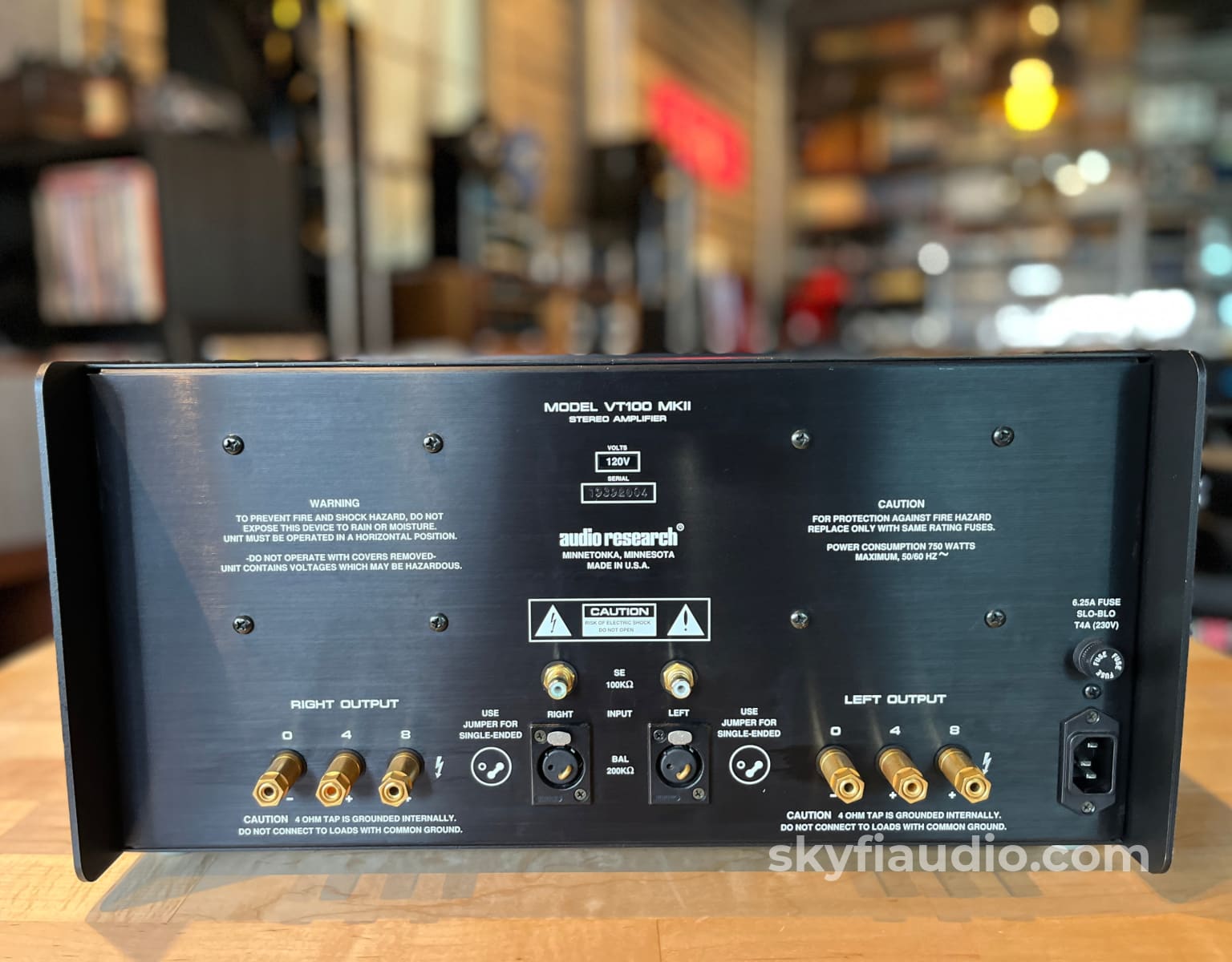
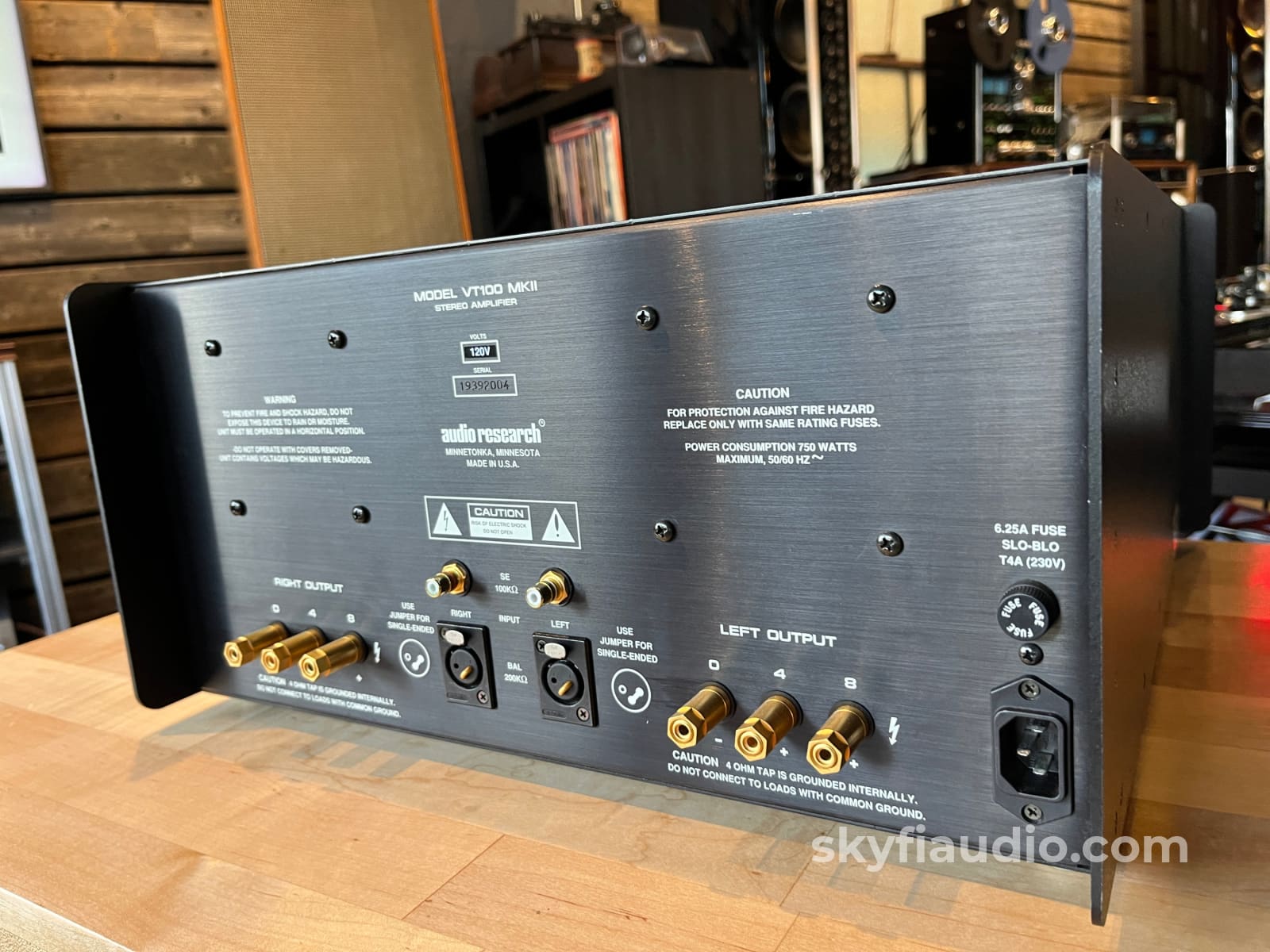
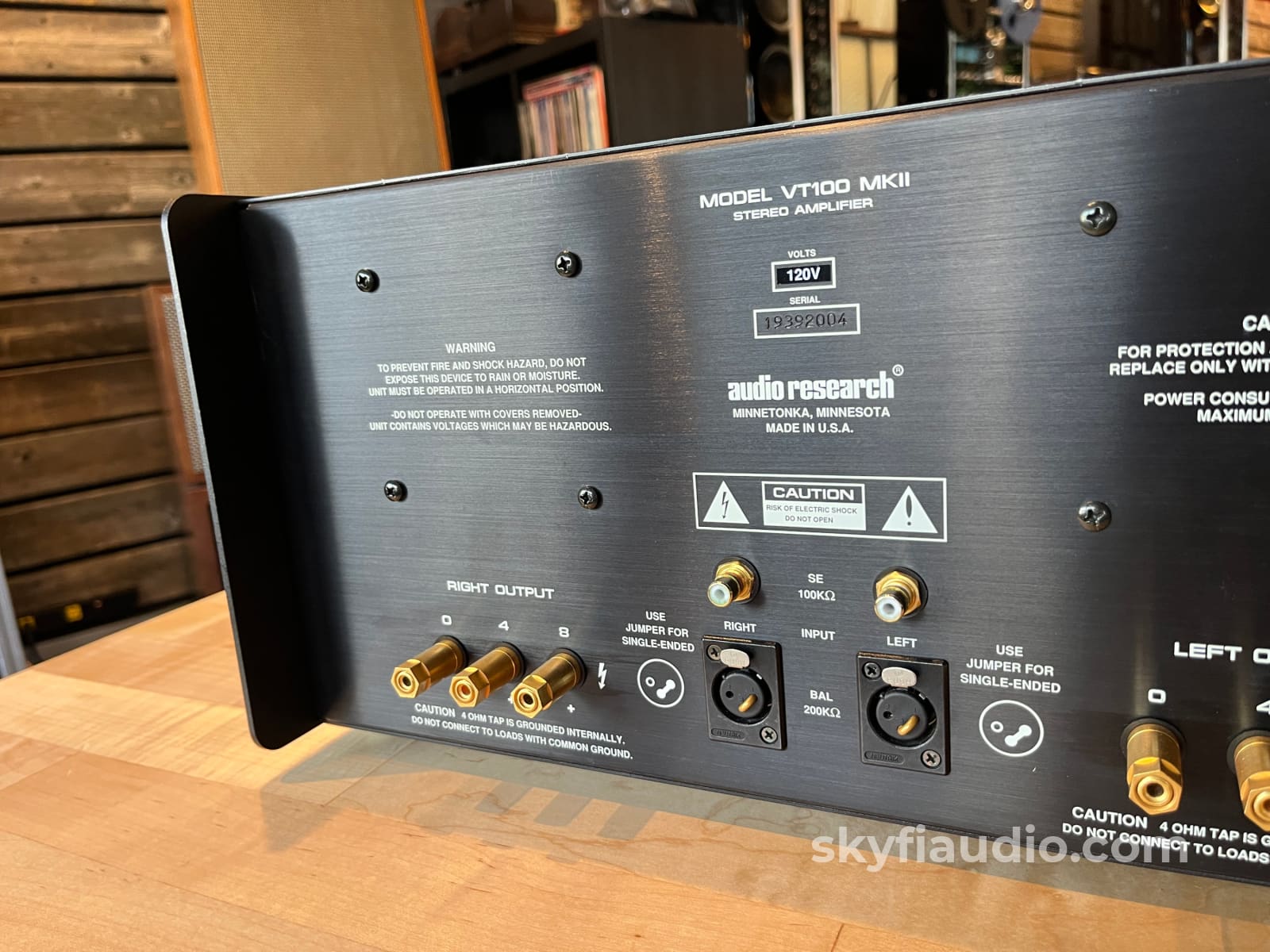
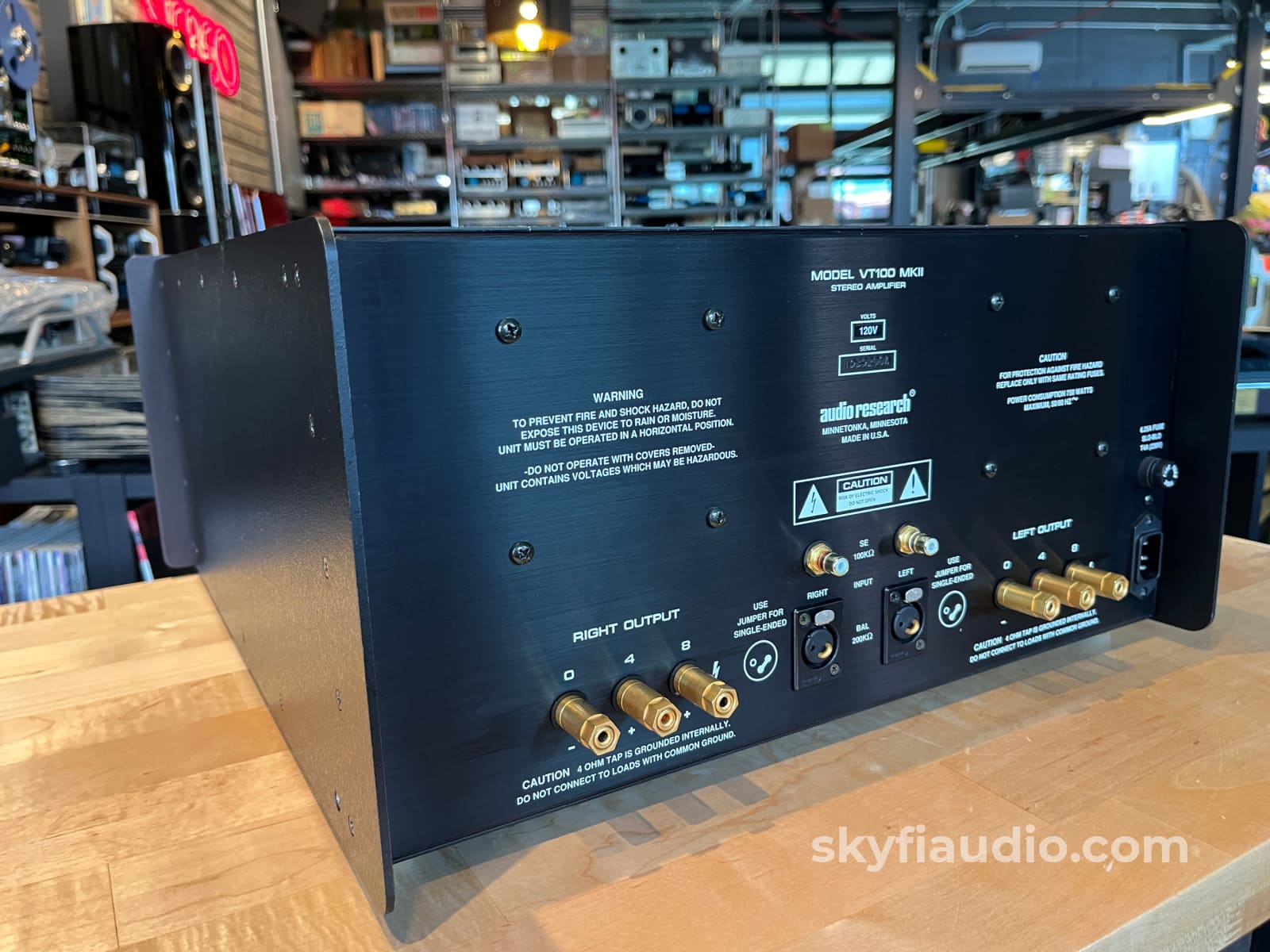
RCA + XLR Inputs, Speaker Binding Posts, IEC Power Input
General Sound:
Big beautiful musical sound with little fatigue.
Cosmetic Condition:
7/10 = Good. One or two minor scratches. Well Maintained. See our detailed rating description here.
Working Condition:
Working perfectly and tested in our lab and listening room.
Included:
Unit, Box, Manual
Packing:
Original Manufacturers Packing
Specs:
POWER OUTPUT
100 watts minimum continuous from 20Hz to 20kHz. 1kHz total harmonic distortion typically 1% (VT100 MKIII: 0.3%) at 100 watts, below .05% (VT100 MKIII: 0.03%) at 1 watt. Approximate actual power available at "clipping": 110 watts (VT100 MKIII: 120 watts) (1kHz) (Note that the actual RMS power output is dependent upon both line voltage and "condition" ie: if power line has high distortion, maximum power will be affected adversely, although from a listening standpoint this is not very critical.)
POWER BANDWIDTH
(-3dB points) 15Hz to 80kHz. VT100 MKIII: (-3dB points) 12Hz to 60kHz
FREQUENCY RESPONSE
(-3dB points at 1 watt) 1Hz to 100 kHz. VT100 MKIII: (-3dB points at 1 watt) 1Hz to 80 kHz
INPUT SENSITIVITY
1.9V RMS (Bal or SE) for rated output. (23.5 dB gain into 8 ohms.). VT100 MKIII: 1.7V RMS (Bal, 0.87V RMS SE) for rated output. (24.3 dB Bal gain, 32.2dB SE gain into 8 ohms.)
INPUT IMPEDANCE
200K ohms Balanced, 100K ohms Single-ended.
OUTPUT TAPS
8 ohms, 4 ohms
OUTPUT REGULATION
Approximately 0.8dB 8 ohm load to open circuit
OVERALL NEGATIVE FEEDBACK
10dB. VT100 MKIII: 15dB
DAMPING FACTOR
Approximately 11
DISTORTION
1kHz total harmonic distortion typically 1% at 100 watts, below .05% at 1 watt
SLEW RATE
15 Volts/µs. VT100 MKIII: 8 Volts/µs
RISE TIME
3 µs. VT100 MKIII: 4 µs
HUM & NOISE
Less than 0.5mV RMS - 95dB below rated output (IHF weighted, input shorted). VT100 MKIII: Less than 0.2mV RMS - 103dB below rated output (IHF weighted, Bal input shorted)
POWER SUPPLY ENERGY STORAGE
VT100: 270 joules. VT100 MKII/III: 540 joules
POWER REQUIREMENTS
105-125VAC 60Hz (210-250VAC 50Hz) 585 watts at rated output, 750 watts maximum, 380 watts at "idle". VT100 MKII/III: 105-125VAC 60Hz (210-250VAC 50Hz) 650 watts at rated output, 800 watts maximum, 440 watts at "idle"
TUBE COMPLEMENT
VT100: (4 matched pairs) 6550 power output, (8) 6922. VT100 MKII: (4 matched pairs) 6550C power output, (4) 6922 driver, (4) 6922 input. VT100 MKIII: (4 matched pairs) 6550C power output, (4) 6H30 driver
Dimensions:
19" (48.3 cm) W x 8 ¾" (22.2 cm) H x 19½" (49.5 cm) D. Handles extend 1½" (3.8 cm) forward
Weight:
66.7 lbs.
Approximate Age:
1998
Link to Manual:
Click Here
Recommended Cables:
Kimber Kable - RCA Interconnects - Better
Kimber Kable - RCA Interconnects - Best
Kimber Kable - BALANCED XLR Connectors - Better
Kimber Kable - BALANCED XLR Connectors - Best
Kimber Kable - Speaker Cables - Better
Kimber Kable - Power Cords - Better
Kimber Kable - Power Cords - Best
Testing Process:
We start with a visual inspection of all internal components to make sure that there are no signs of heat stress or damage. Capacitors are checked for telltale signs of predictive failure including bulging, shrunken wrappers, or physical leakage. We also inspect resistors and other passive components for signs of overheating. If tube arcing has occurred in the past we can usually spot discoloration on the output tube sockets. On vintage units we often spot check select capacitors for value and ESR.
If the amplifier passes visual inspection, we move on to a full test of all of the tubes. We use a modern Amplitrex AT-1000 Professional Tube Tester which is capable of testing both emission and Gm with a high degree of accuracy.
We document the results of each tube and replace any weak or suspect tubes before proceeding.
When we power on tube amplifiers for the first time we usually use a variac and current limited AC supply and slowly raise the voltage up to nominal mains level while monitoring plate, screen, filament, and negative bias supply voltages where applicable.
If everything is in order we feed a low level test signal into the amplifier’s input and monitor its output on an oscilloscope across an 8 ohm dummy load. At this point we are just looking to verify basic function and confirm that the output transformers are not damaged.
Once we have verified that the amplifier is safe to operate, we connected it to full mains power. For fixed bias amps we set the bias to manufacturer spec. For cathode biased amps we monitor the plate to cathode voltage to determine if the output tubes are operating in a safe range. Once the output section is verified we move onto bench evaluation.
We start by feeding the input of the amplifier with a low level 1 KHz test signal, slowly increasing its amplitude while monitoring the amplifier’s output on an oscilloscope for signs of noise, clipping, distortion, or improper channel balance. We continue increasing the signal level until the amplifier reaches clipping. At this point we take an output power measurement and compare it to the spec sheet of the amplifier to verify proper performance.
We finish off the bench evaluation with a 1 KHz square wave check and a 20 Hz to 20 KHz sine sweep to assess the amplifier’s frequency response characteristics. This battery of tests will usually reveal if the amplifier has any issues that need further attention.
Before the device leaves the bench we perform a listening test with actual music using a variety of preferred test tracks. Our benches are outfitted with familiar monitor speakers which help us identify inconsistencies that will not always show up on our test gear. The main things that we are listening for are hum or noise with no signal present, proper center image, clicks, pops, or any other obvious undesirable audio characteristics.
If the unit passes all of these tests it is moved to our long term testing rig where we simulate real word operating conditions for 6-8 hours minimum.
For tube amps we like to run this test at least twice.
This allows us to monitor the unit for signs of thermal runaway or intermittent issues that only crop up when it has fully come up to temperature. We find this step to be essential, especially for vintage units.

Choose options