
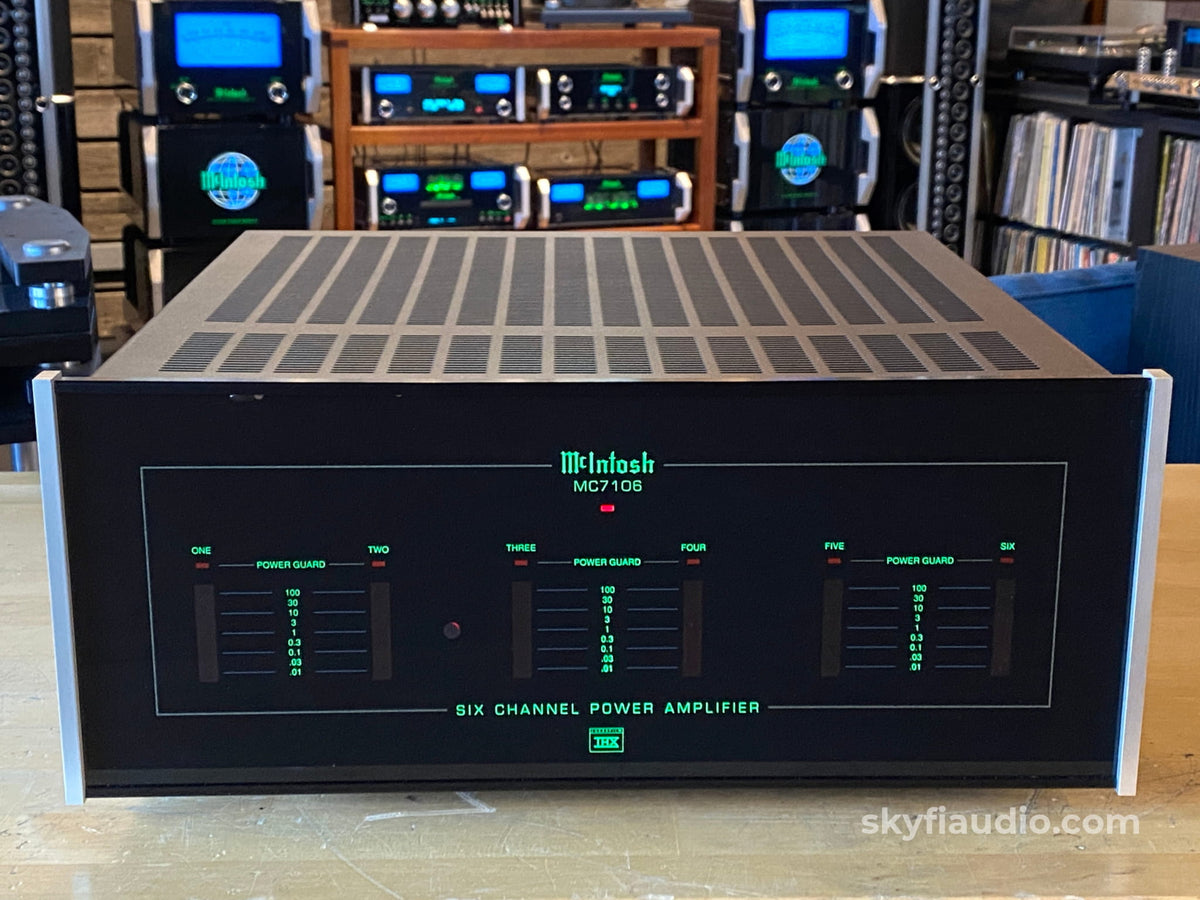
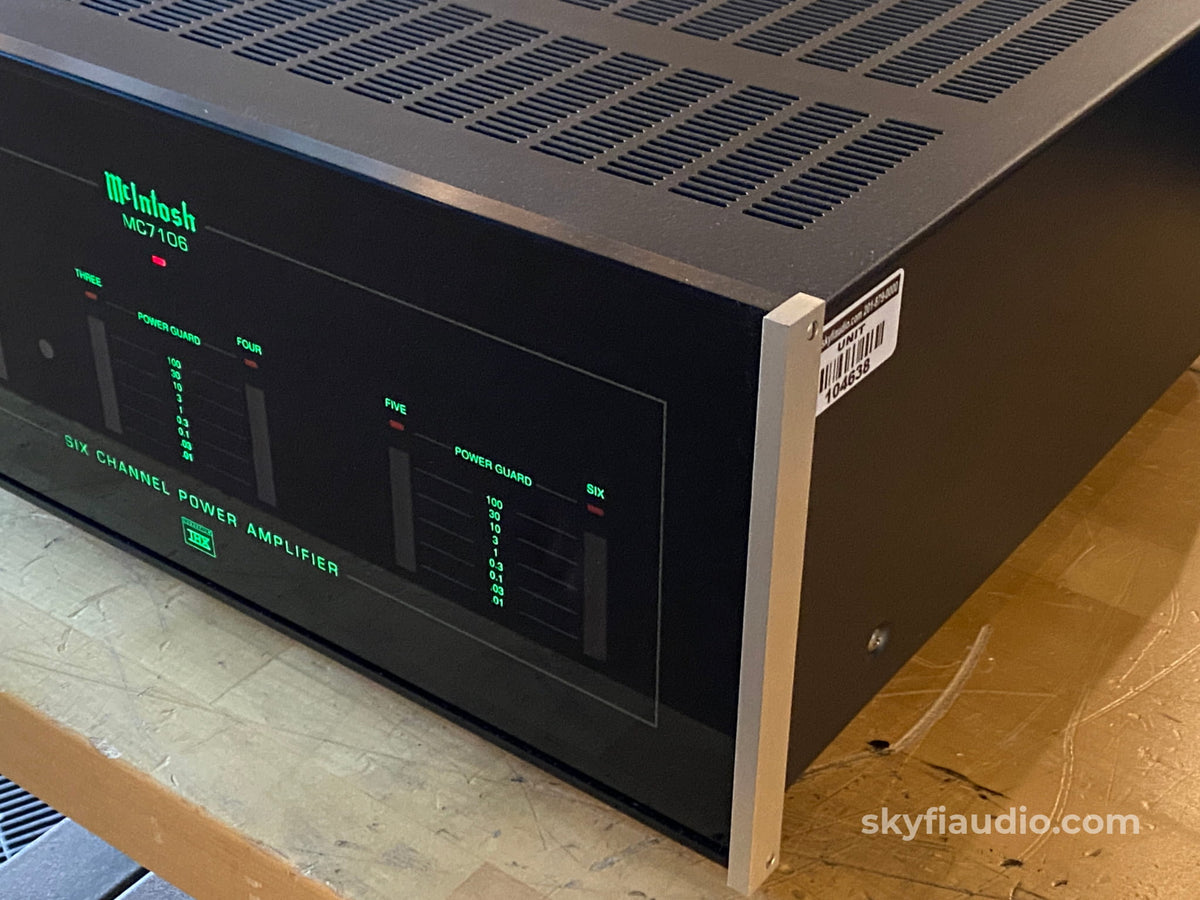
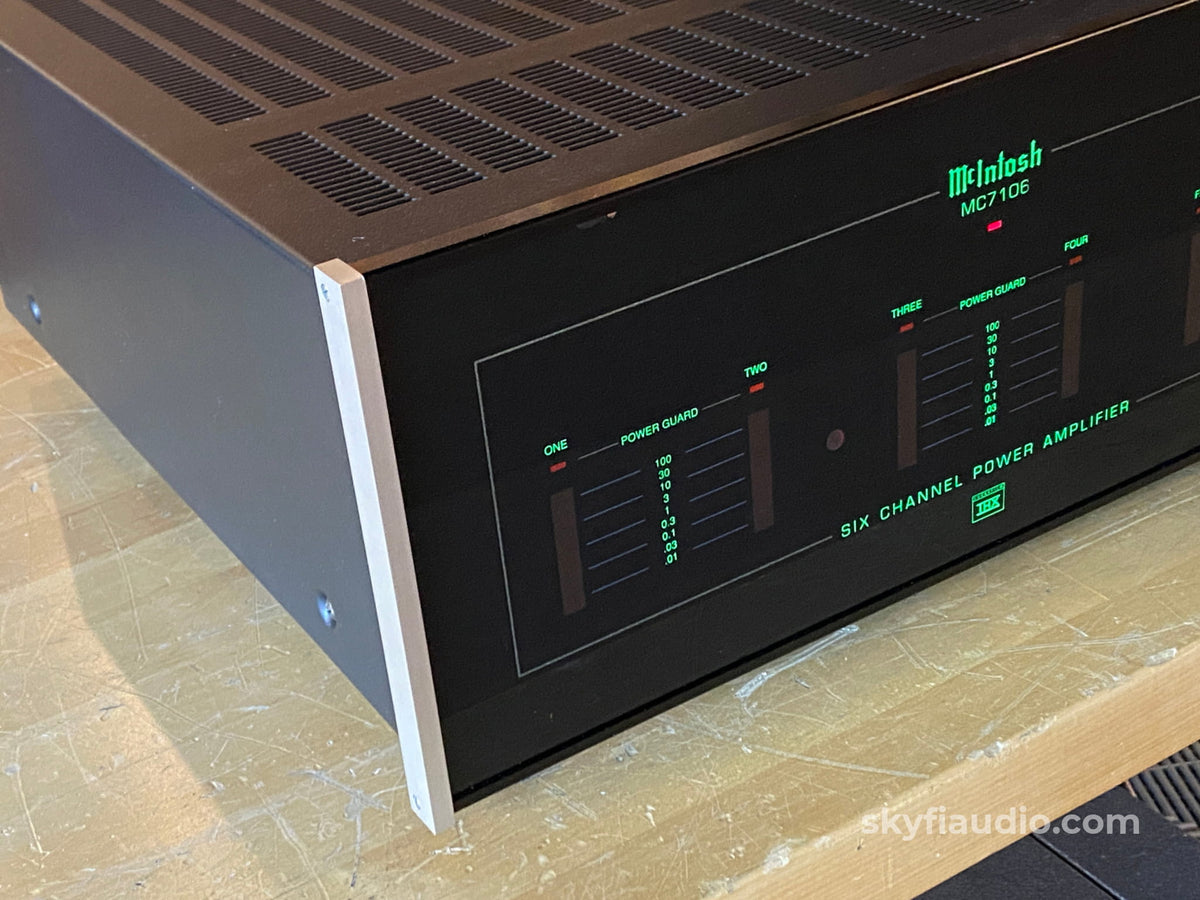
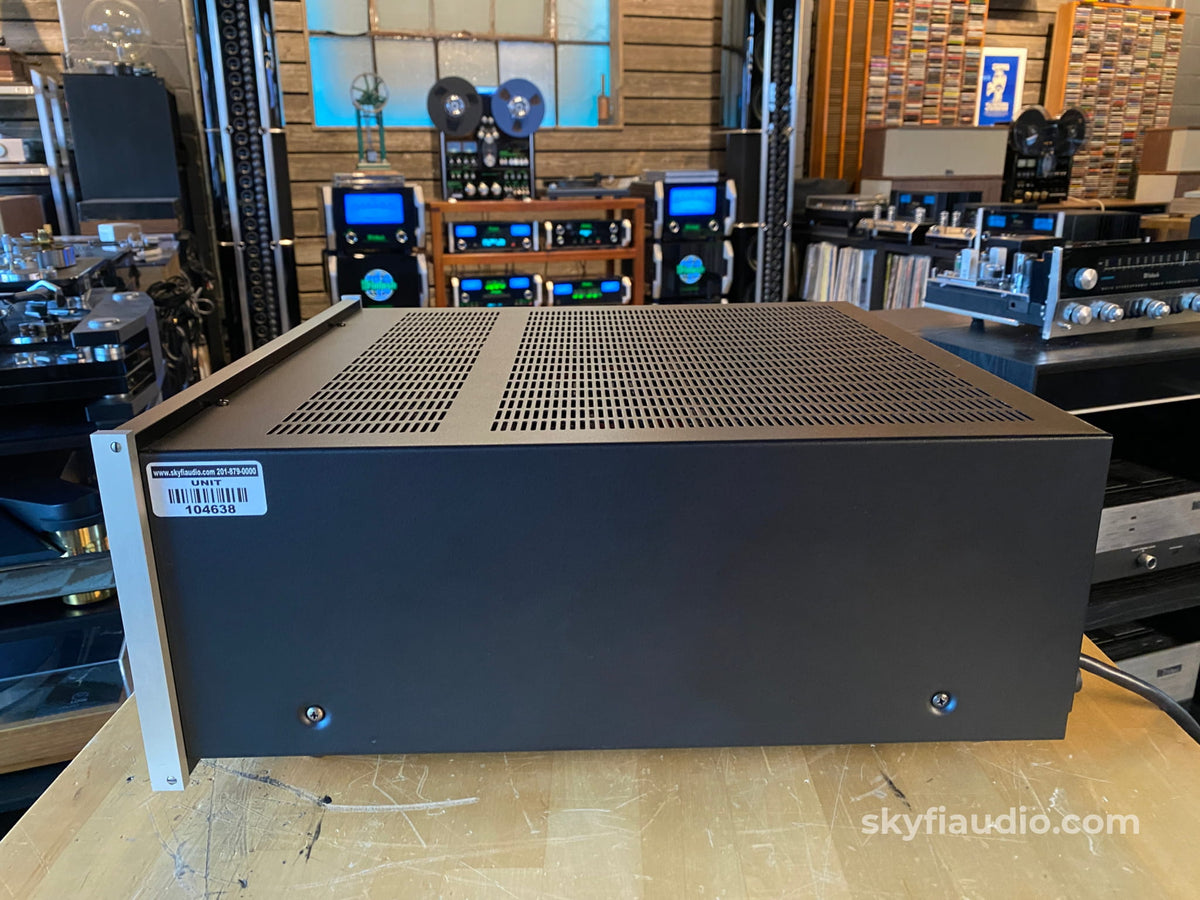
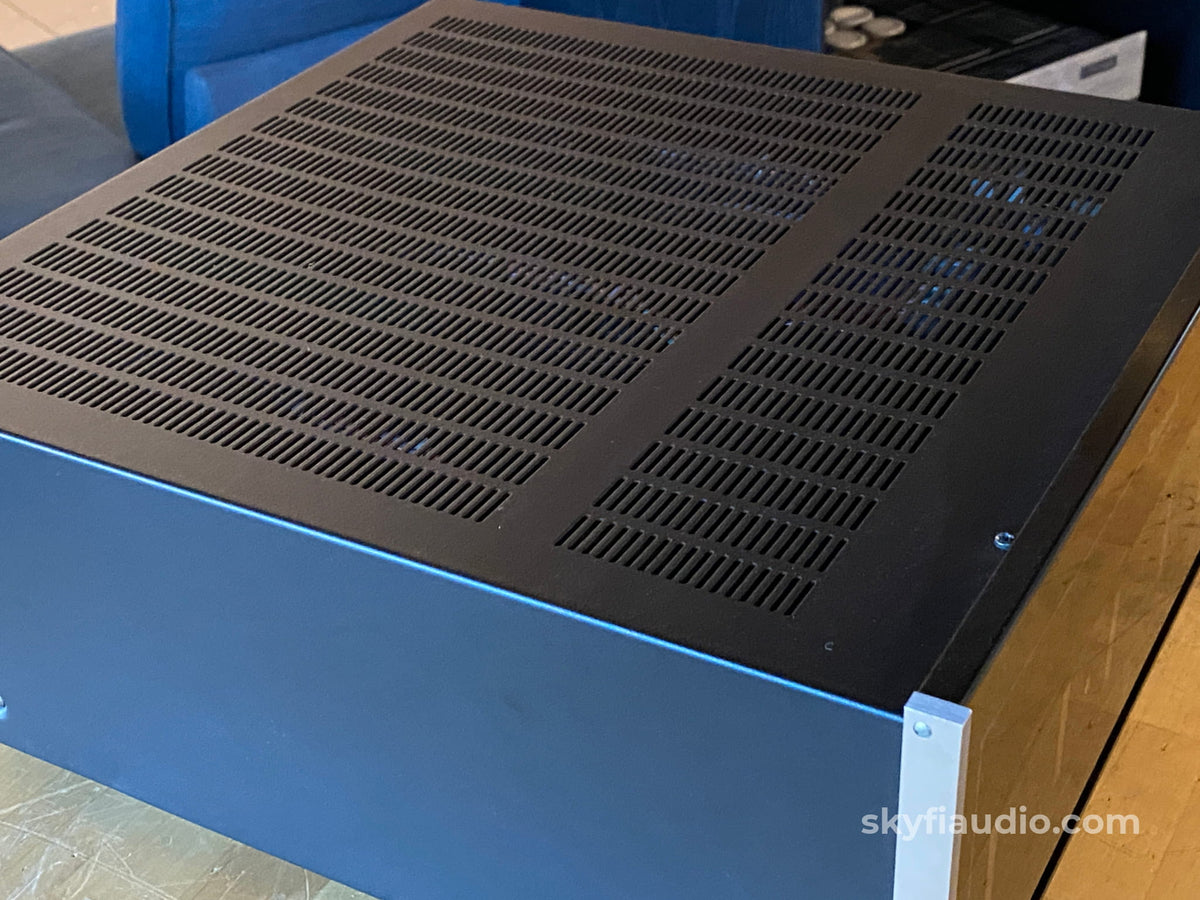
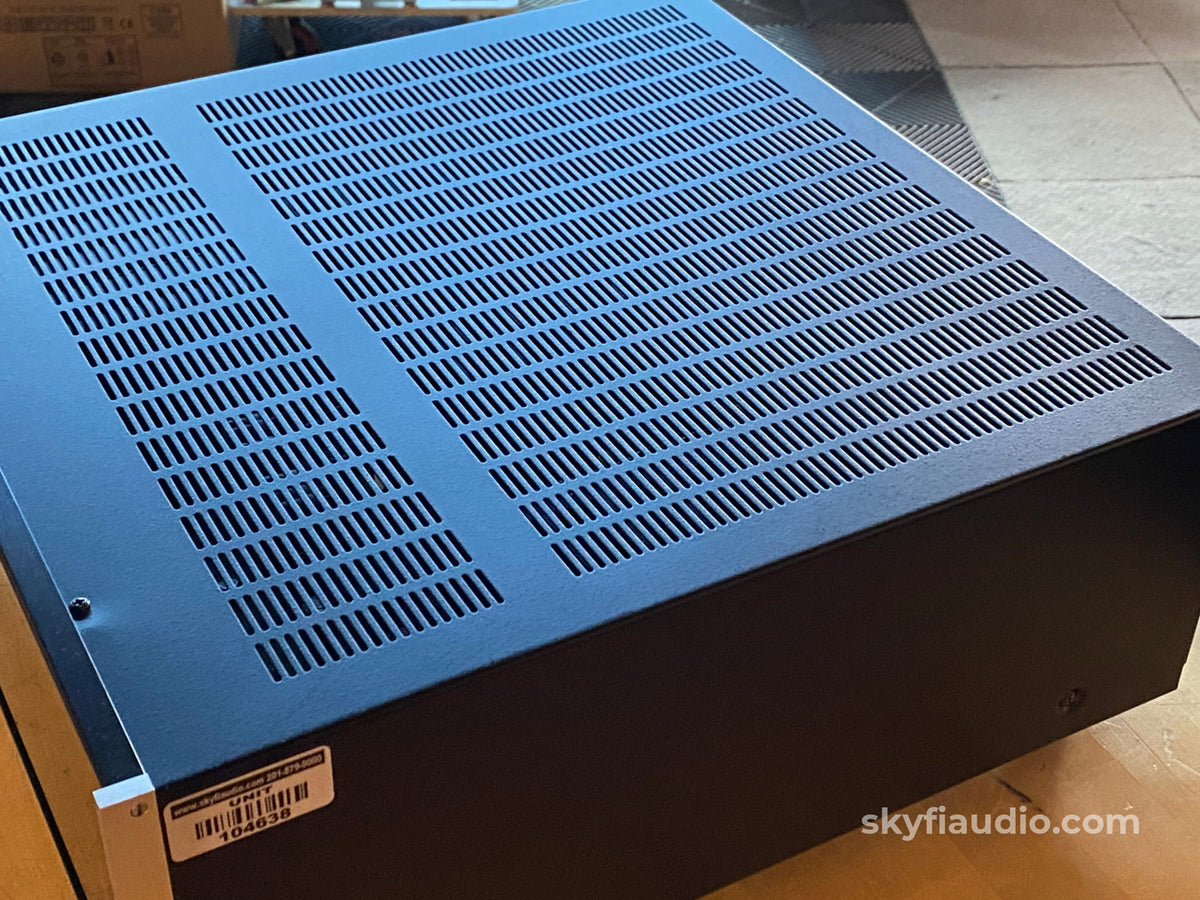
McIntosh MC7106 6-Channel Configurable Power Amplifier
Free Shipping (Contiguous U.S. Only)
Pickup available at SkyFi 479
Usually ready in 24 hours
McIntosh MC7106 6-Channel Configurable Power Amplifier
SkyFi 479
479 South Broad Street
Glen Rock NJ 07452
United States
General:
The McIntosh MC7106 is an exceptionally flexible six-channel power amplifier designed for high-performance home theater, multi-channel, and multi-zone systems.
In its standard configuration it delivers 100 watts per channel into 8 ohms, or 160 watts per channel into 4 ohms, across all six channels.
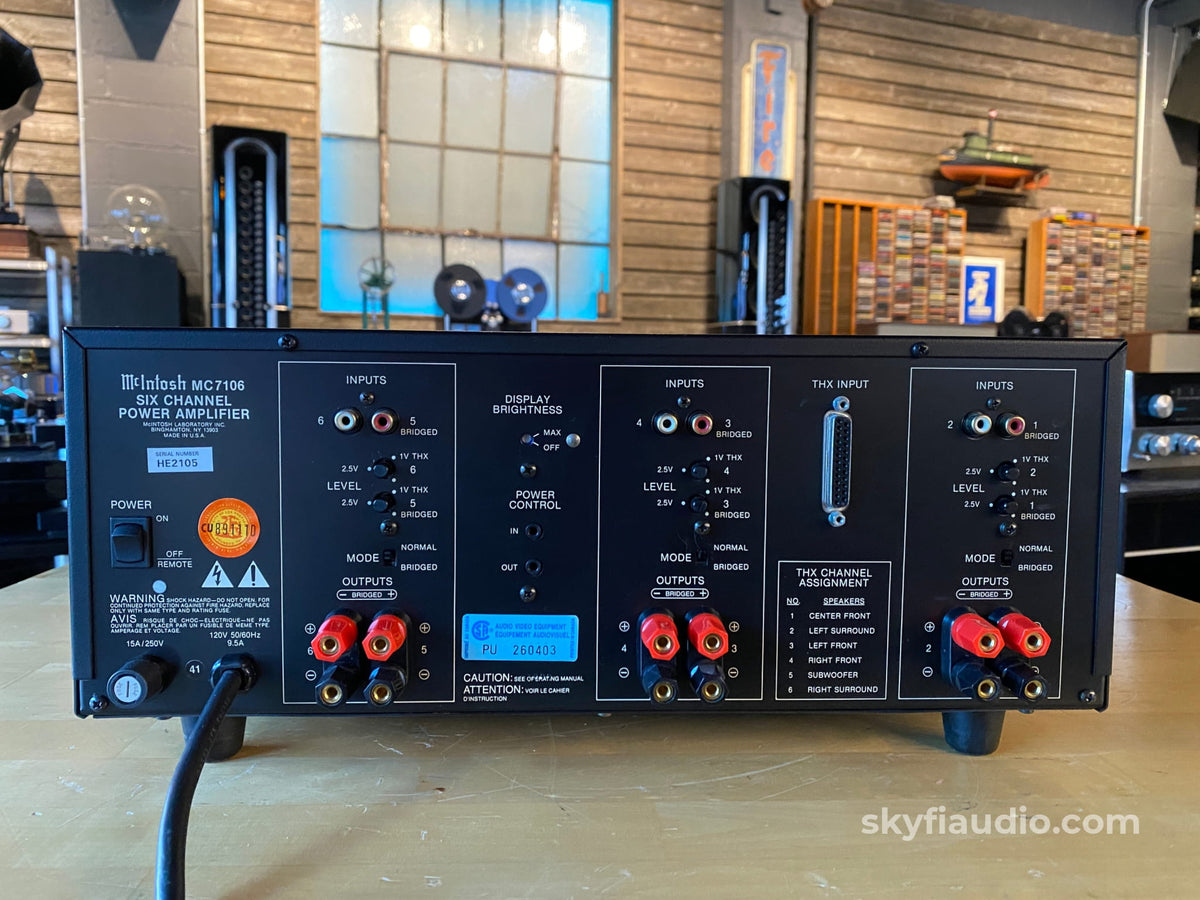
Where things get especially interesting is its ability to bridge any of its three channel pairs.
Each bridged pair delivers 320 watts into 8 ohms, allowing the MC7106 to be configured for anywhere from three to six output channels depending on your system.
It also features McIntosh Power Guard protection, six front-panel LED power-level displays, and Lucasfilm THX Audio certification.
MC7106 Output Configurations:
6-Channel Mode:
6 x 100W into 8 ohms
6 x 160W into 4 ohms
5-Channel Mode:
4 x 100W/160W channels
1 x 320W bridged channel
4-Channel Mode:
2 x 100W/160W channels
2 x 320W bridged channels
3-Channel Mode:
3 x 320W bridged channels
Each 320W output is created by bridging a pair of amplifier channels.
Bridged operation is rated for 8-ohm loudspeaker loads only.
Cosmetic Notes:
• Very clean overall condition with only light signs of use.
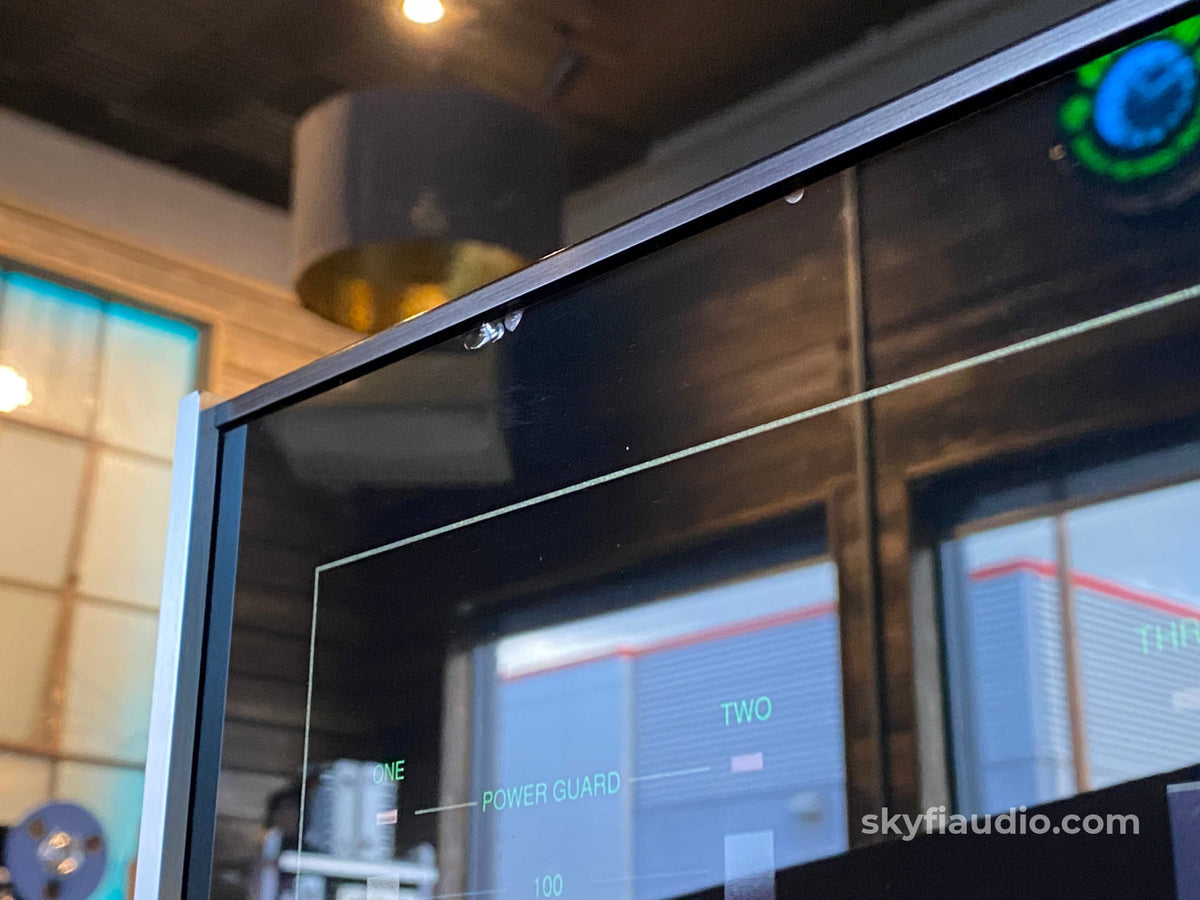
• Minor bubbling along the very top edge of the front glass.
• Like most McIntosh components the front panel uses printed glass, so the lettering remains crisp and resistant to wear.
Service Notes:
• All lamps replaced
• The amplifier was serviced prior to arriving at SkyFi; however, no documentation of that previous work was included
Brand Background:
McIntosh Laboratory is an American manufacturer of handcrafted high-end audio equipment based in Binghamton, New York. The company was founded in 1949 by Frank McIntosh. The company designs and produces audio amplifiers, stereo tuners and other consumer electronics products.
Ownership:
Single Owner
Connections:
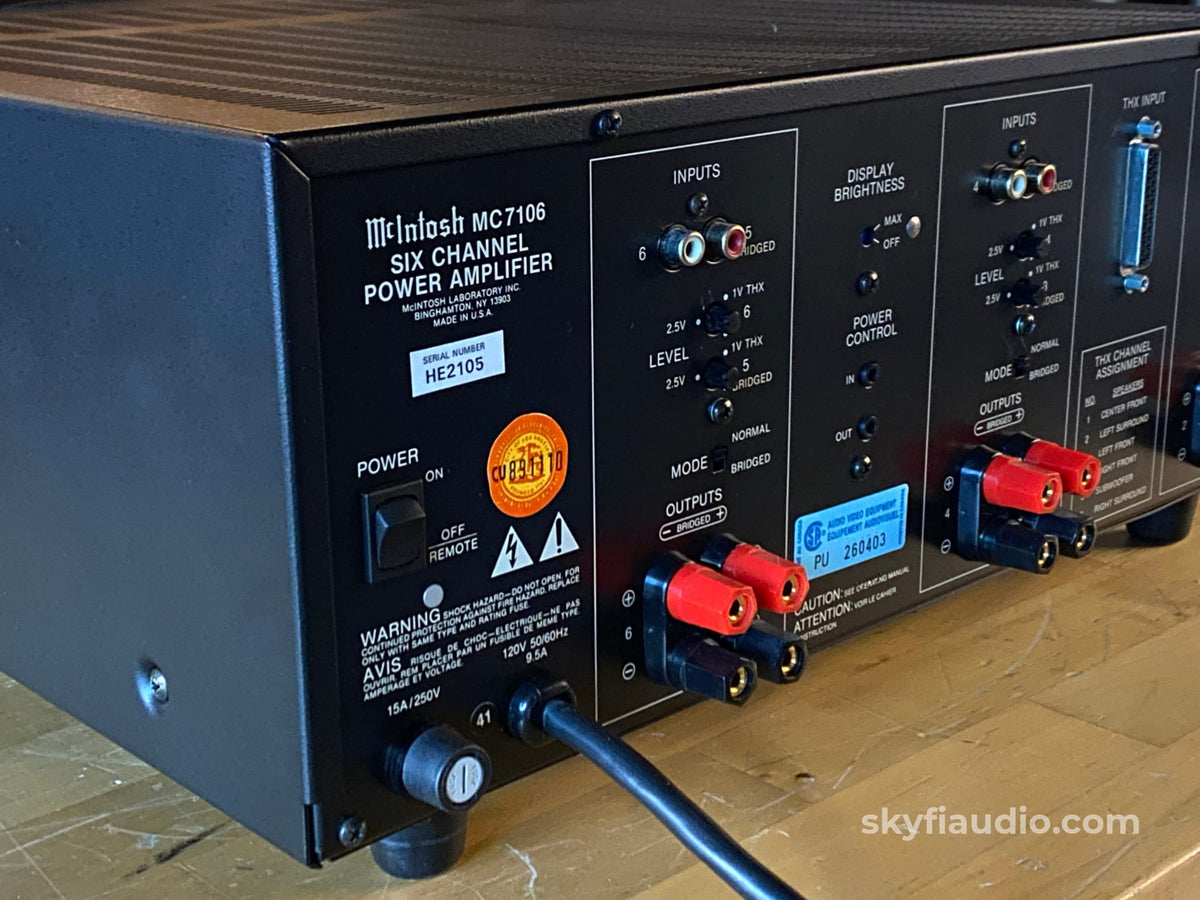
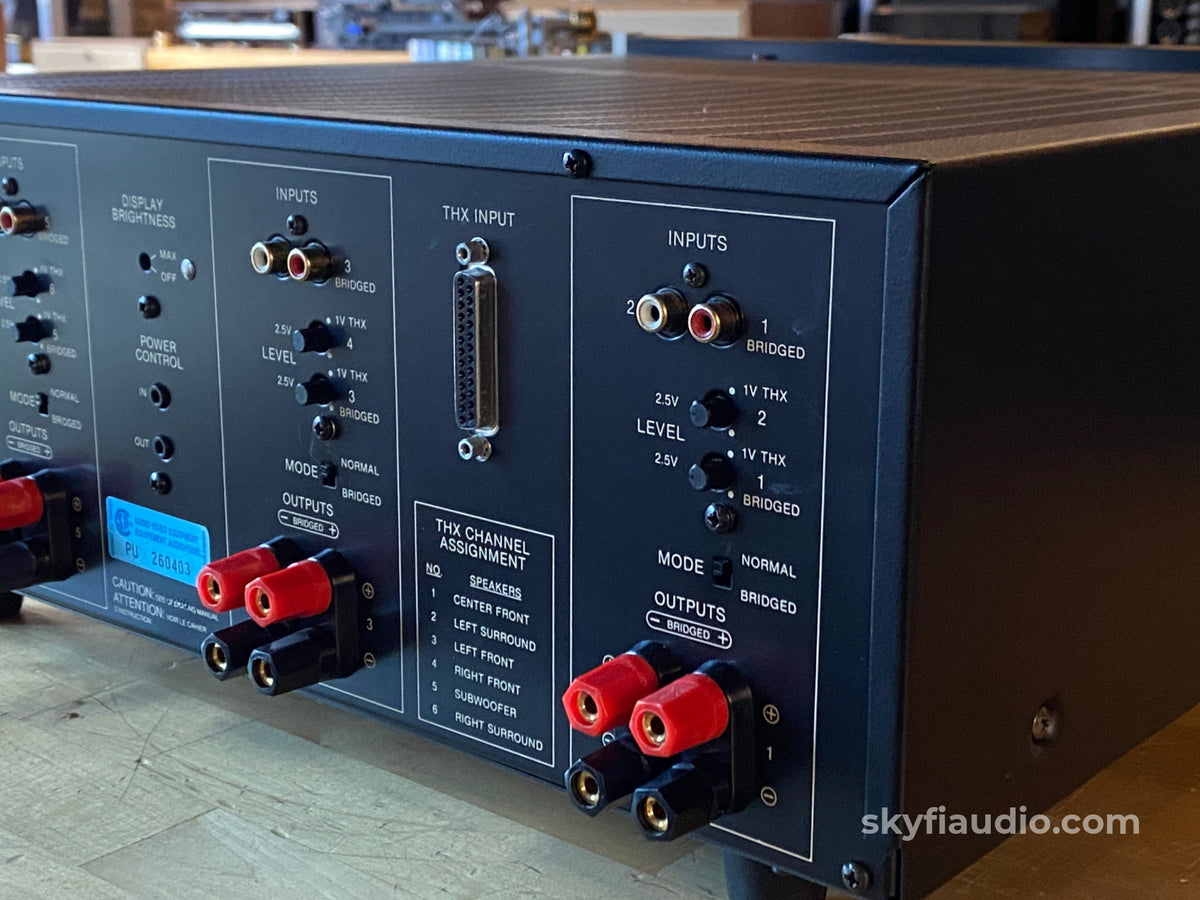
RCA inputs and outputs, captive power cord, 5 way binding posts for speakers, 12V in and out triggers
General Sound:
Accurate to the recording
Cosmetic Condition:
7/10 = Good. One or two minor scratches. Well Maintained. See our detailed rating description here.
Working Condition:
Working perfectly and tested in our lab and listening room.
Included:
Just the unit and power cord.
Packing:
Original Manufacturers Packing
Specs:
PERFORMANCE LIMITS
Performance limits are the maximum deviation from perfection permitted for a Mclntosh instrument. We promise you that when you purchase an MC7106 from a Mclntosh franchised dealer, it will be capable of performance at or better than these limits.
POWER OUTPUT, SIX CHANNELS
100 watts per channel into 8 ohm loads, or 160 watts per channel into 4 ohm loads minimum sine wave continuous average power output per channel, all channels operating.
The output RMS voltage is:
28.3V across 8 ohms
25.2V across 4 ohms
POWER OUTPUT, TWO CHANNELS BRIDGED
320 watts into an 8 ohm load, minimum sine wave continuous average power output.
The output RMS voltage is:
50.6V across 8 ohms
OUTPUT LOAD IMPEDANCE
8 or 4 ohms, for all six separate channels
8 ohms, Bridged operation
RATED POWER BAND
20Hz to 20,000Hz
TOTAL HARMONIC DISTORTION
0.005% maximum harmonic distortion at any power level from 250 mW to rated power output.
IHF DYNAMIC HEADROOM
8 ohms, 1.8dB
4 ohms, 2.1dB
FREQUENCY RESPONSE
+ 0, -0.25dB from 20Hz to 20,000Hz
+ 0, -3.0dB from 10Hz to 100,000Hz
INPUT SENSITIVITY
1V, (2.5V with Level control at center detent)
A-WEIGHTED SIGNAL-TO-NOISE RATIO
93dB (113dB below rated output)
INTERMODULATION DISTORTION, SMPTE
0.005% maximum if instantaneous peak power does not exceed twice the output power rating.
RATINGS
WIDE BAND DAMPING FACTOR
200 at 8 ohms
100 at 4 ohms
INPUT IMPEDANCE
20,000 ohms
POWER GUARD
Clipping is prevented and THD does not exceed 2% with up to 14dB overdrive at 1000Hz.
POWER REQUIREMENTS
120V, 50/60Hz, 12A UL/CSA
Dimensions:
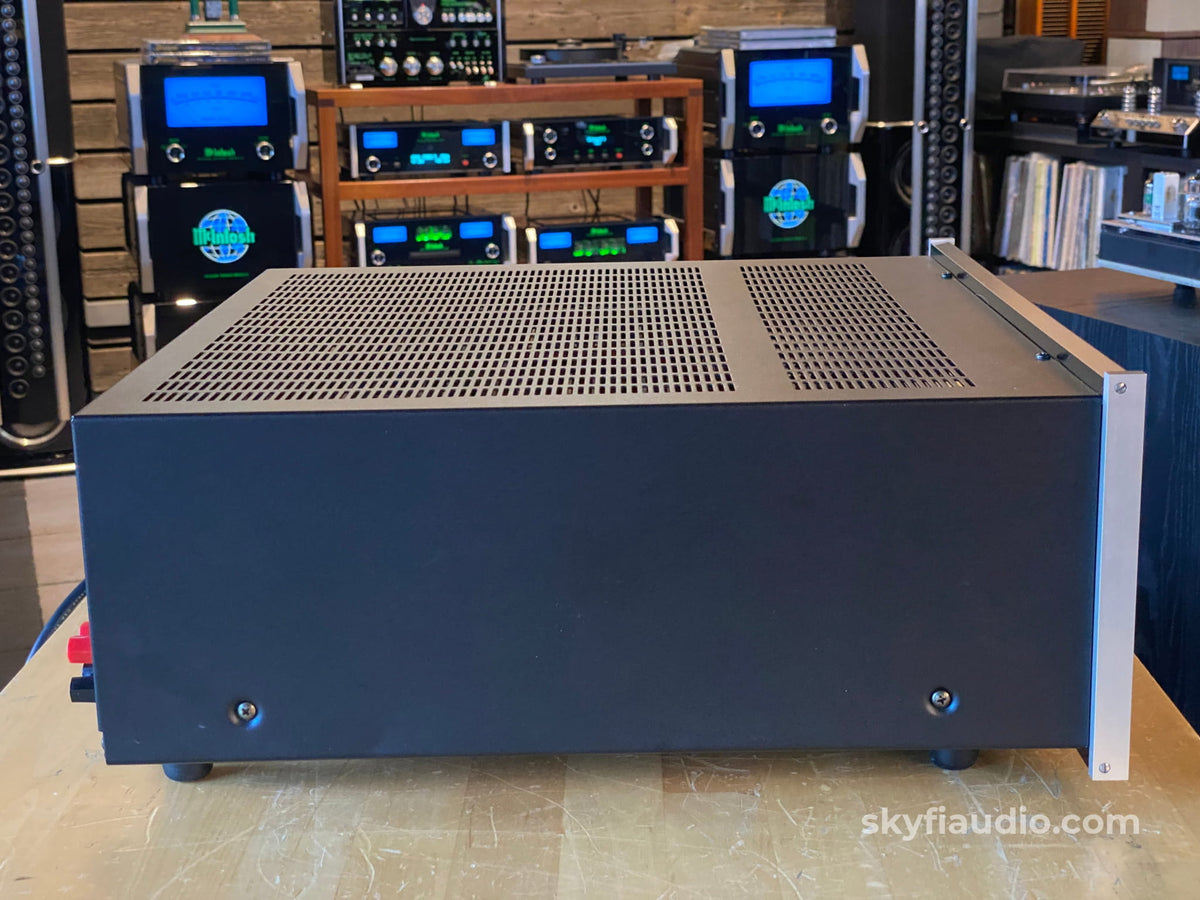
Size 7-1/16"H, 17-1/2"W and 20"D
Weight:
48 lbs.
Approximate Age:
1995
Link to Manual:
Click Here
Recommended Cables:
Kimber Kable - RCA Interconnects - Better
Kimber Kable - Speaker Cables - Better
Kimber Summit Series Monocle XL Speaker Cables (PAIR) - Best
Kimber Summit Series BiFocal XL Bi-Wire Speaker Cables (PAIR) - Best If Applicable
Kimber Kable - Power Cords - Better
Kimber Kable - Power Cords - Best
The SkyFi Testing Process for Solid State Amplifiers:
We start with a visual inspection of all internal components to make sure that there are no signs of heat stress or damage. Capacitors are checked for telltale signs of predictive failure including bulging, shrunken wrappers, or physical leakage. We also inspect the PCBs for discoloration from resistors or transistors that may have been running hot. On vintage units we often spot check select capacitors for value and ESR.
If the amplifier passes visual inspection, we move on to a controlled power on sequence using a Sencore safety analyzer to monitor current draw in real time. Once the amplifier is determined to be safe to operate, we connect it to full AC mains for function and power testing. We connect the speaker outputs of the amplifier to a Sencore PA81 Power Analyzer which acts as a dummy load, DC offset monitor, and oscilloscope interface. We start with a low level 1KHz test signal at the amplifier’s input and slowly increase its amplitude while monitoring the output on an oscilloscope for signs of noise, clipping, distortion, or improper channel balance. We continue increasing the signal level until the amplifier reaches clipping. At this point we take an output power measurement and compare it to the spec sheet of the amplifier to verify proper performance. If the device under test has both balanced and single ended inputs they are both tested at this time. We finish off the bench evaluation with a 1KHz square wave check and a 20Hz to 20KHz sine sweep to assess the amplifier’s frequency response characteristics. This battery of tests will usually reveal if the amplifier has any issues that need further attention.
Before the device leaves the bench, we perform a listening test with actual music using a variety of preferred test tracks. Our benches are outfitted with familiar monitor speakers which help us identify inconsistencies that will not always show up on our test gear. The main things that we are listening for are hum or noise with no signal present, proper center image, clicks, pops, or any other obvious undesirable audio characteristics.
If the unit passes all of these tests it is moved to our long term testing rig where we simulate real word operating conditions for 6-8 hours. This allows us to monitor the unit for signs of thermal runaway or intermittent issues that only crop up when the unit has fully come up to temperature.

Choose options