


Cello Duet 350 Amplifier - 350W Class A/B - Serviced
Free Shipping (Contiguous U.S. Only)
Pickup available at SkyFi 479
Usually ready in 24 hours
Cello Duet 350 Amplifier - 350W Class A/B - Serviced
With Adapter ($700)
SkyFi 479
479 South Broad Street
Glen Rock NJ 07452
United States
General:
This is an absolutely legendary amplifier from the golden days of HiFi.
Rated at 350W this is true powerhouse capable of driving just about anything with great finesse and detail which is often missing from big amplifiers.
You won't find any digital trickery in this amp, it features true class A/B amplification and no expense was spared.
Designed by renowned engineer Mark Levinson, the Cello line of products exemplify the absolute top of the class. Coveted by audiophiles and collectors, Cello products don't trade very often.
This Duet 350 was thoroughly tested and serviced in house and is now working perfectly. This is a must for Amplfiiers this age with high-power output capability.
We have seviced several a few of these in the past and know exactly how to bring them back to top condition.
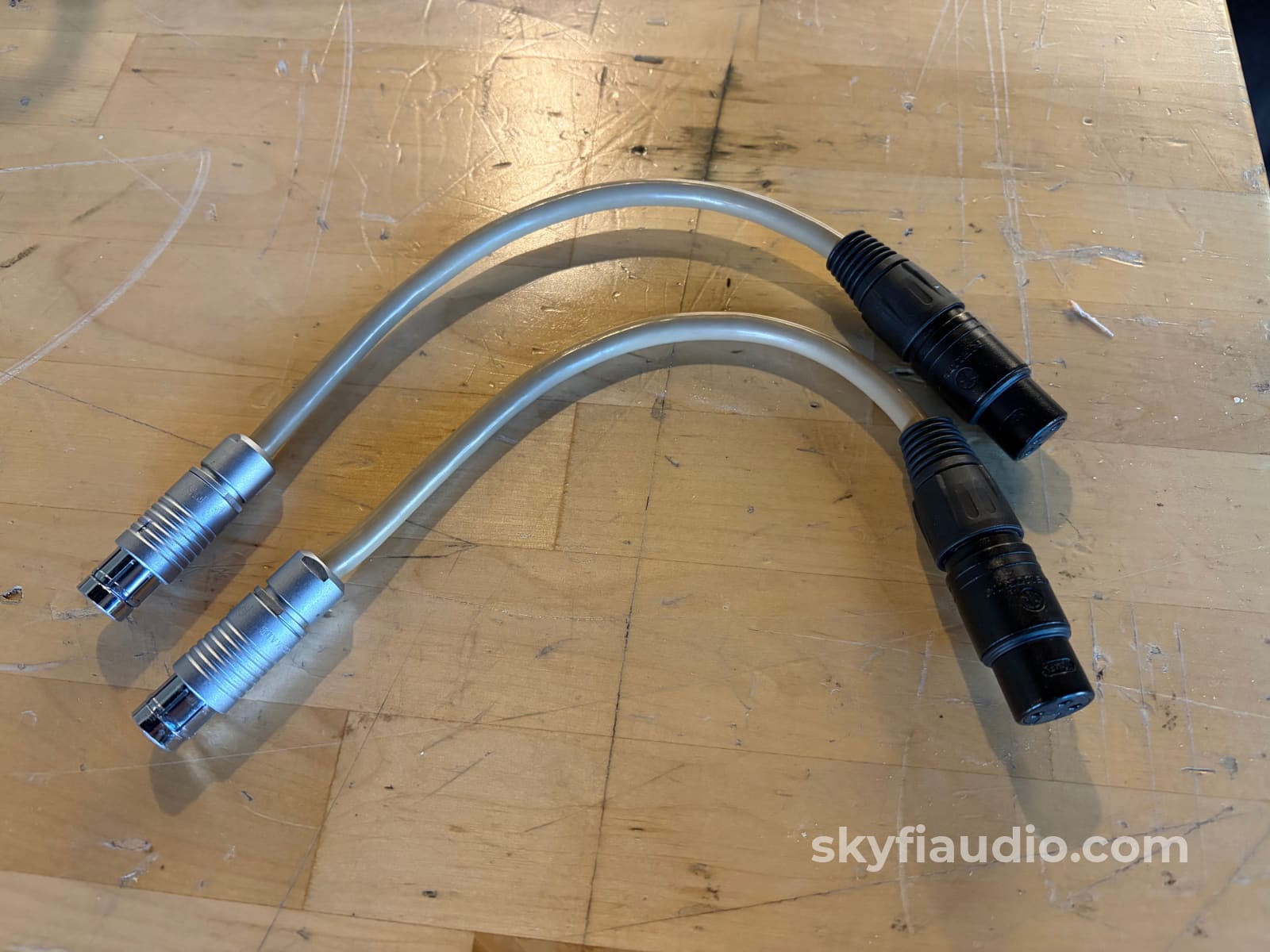
If you'd like to add Cello Fischer to XLR adapters to the listing shown in the last photo, please select the option in this listing add them to your cart. Otherwise they will not be included with your purchase.
Shipping:
This amplifier is exempt from any Free Shipping promotions.
The Cello Duet 350 will be carefully wrapped and packed on a pallet to ship via truck freight with full insurance within the lower 48 US States for a flat $400. This amount will automatically be added during your checkout.
We can safely pack this amplifier to ship worldwide, just contact us for a quote. Local pickup welcome and we can also arrange a local courier depending on distance. Please contact us for details.
The Duet 350 Amplifier
Real music fills a room.
Even the softest instruments are more present in life than most music systems can reproduce from recordings. Part of the problem has been the limitations in power amplifiers.
The Duet 350 Power Amplifier is a stereo power amplifier that has achieved affordable excellence in sonic quality, power capability and reliability.
In its normal stereo mode it has more than enough power to drive most speakers to their limits with the kind of open, clear, effortless sound which are the hallmark of Cello. When used in a bridged configuration, the Duet 350 becomes a mono block power station capable of high speed and powerful dynamics under any condition.
The Duet 350 Amplifier has been specifically designed by Cello engineers to be compatible with a wide variety of available equipment.
SkyFi Cosmetic Notes:
This amplifier has marks and scratches on all surfaces including the faceplate and handles. The edges of the faceplate are chipped and marred in some places. Overall condition is presentable.
SkyFi Technical Notes:
This amplifier was serviced in house here at SkyFi.
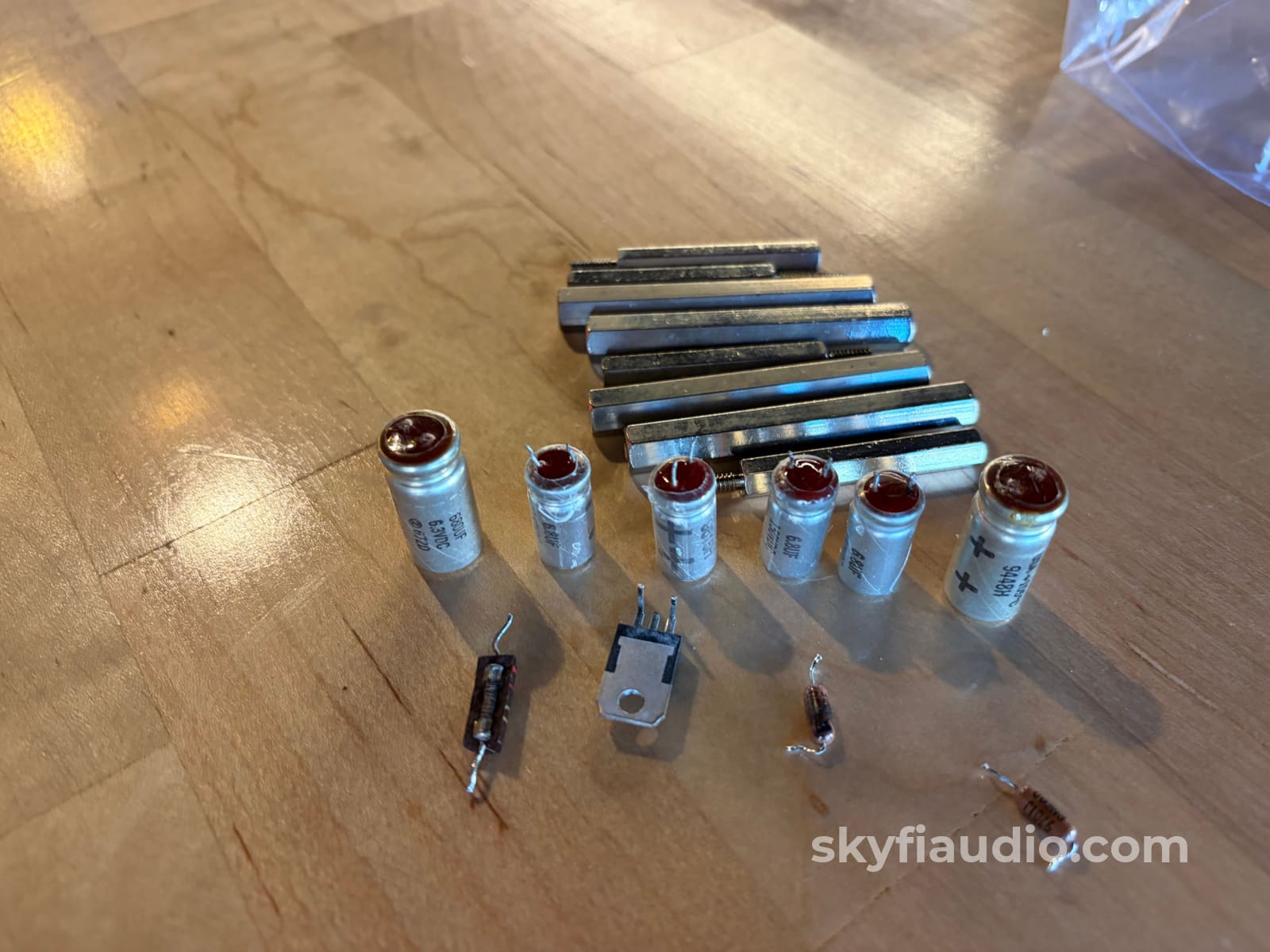
We replaced select components in the right channel to restore proper functionality. Known to fail Sprague capacitors in both channels were also replaced. After the service was completed we tested both channels. They clip at approximately 400W into 8 ohms both channels driven.
Please contact us for Fischer interconnect options (Additional Charge).
Ownership:
Second Owner
Connections:
Fisher inputs, IEC Power
General Sound:
Smooth, uncolored, undistorted natural and clean
Cosmetic Condition:
6/10 = Fair. Three to four minor scratches, or one major scratch. See our detailed rating description here.
Working Condition:
Working perfectly and tested in our lab and listening room.
Included:
Just the unit and power cord.
Packing:
Will be packed using our highly developed in-house process and custom packing materials.Specs:
Class of operation:
Class AB2
Power Output (single amp):
@8 Ohms Rated: 350 Watts
@4 Ohms Rated: 600 Watts
Power Output (bridged amps):
@8 Ohms Rated: 1,200 Watts
IMD (SMPTE):
0.3% (60 Hz / 8 Ohms / 52.92 V Output)
IMD (CCIF):
<0.2%
THD (20 - 20000Hz):
<0.3% (8 Ohms / 52.92 Volt Output)
<0.6% (4 Ohms / 49 Volt Output)
Frequency Response:
+0/-0.8 dB @ 10 - 20000 Hz
Dynamic Headroom:
1.8 dB
Channel Separation:
90 dB
Signal to Noise:
< -100 dB (10 - 22000 Hz / Rated Output)
Input Sensitivity:
1.491 V (8 Ohms / 350 Watts / 52.92 Volt Output)
Input Impedance:
1 mOhm (Non-Inverting)
5000 Ohm (Inverting)
1 mOhm (Unbalanced)
Gain:
31 dB (Unbalanced)
37 dB (Balanced)
Dimensions:
19" x 12.62" x 23.25"
Weight:
90 lbs.
Link to Manual:
Click Here
Recommended Cables:
Kimber Kable - Speaker Cables - Better
Kimber Summit Series Monocle XL Speaker Cables (PAIR) - Best
Kimber Kable - Power Cords - Better
Kimber Kable - Power Cords - Best
Testing Process:
We start with a visual inspection of all internal components to make sure that there are no signs of heat stress or damage. Capacitors are checked for telltale signs of predictive failure including bulging, shrunken wrappers, or physical leakage. We also inspect the PCBs for discoloration from resistors or transistors that may have been running hot. On vintage units we often spot check select capacitors for value and ESR.
If the amplifier passes visual inspection, we move on to a controlled power on sequence using a Sencore safety analyzer to monitor current draw in real time. Once the amplifier is determined to be safe to operate, we connect it to full AC mains for function and power testing. We connect the speaker outputs of the amplifier to a Sencore PA81 Power Analyzer which acts as a dummy load, DC offset monitor, and oscilloscope interface. We start with a low level 1 KHz test signal at the amplifier's input and slowly increase its amplitude while monitoring the output on an oscilloscope for signs of noise, clipping, distortion, or improper channel balance. We continue increasing the signal level until the amplifier reaches clipping.
At this point we take an output power measurement and compare it to the spec sheet of the amplifier to verify proper performance. If the device under test has both balanced and single ended inputs they are both tested at this time.
We finish off the bench evaluation with a 1 KHz square wave check and a 20 Hz to 20 KHz sine sweep to assess the amplifier's frequency response characteristics.
This battery of tests will usually reveal if the amplifier has any issues that need further attention.
Before the device leaves the bench, we perform a listening test with actual music using a variety of preferred test tracks. Our benches are outfitted with familiar monitor speakers which help us identify inconsistencies that will not always show up on our test gear. The main things that we are listening for are hum or noise with no signal present, proper center image, clicks, pops, or any other obvious undesirable audio characteristics.
If the unit passes all of these tests it is moved to our long term testing rig where we simulate real word operating conditions for 6-8 hours minimum. This allows us to monitor the unit for signs of thermal runaway or intermittent issues that only crop up when the unit has fully come up to temperature.

Choose options